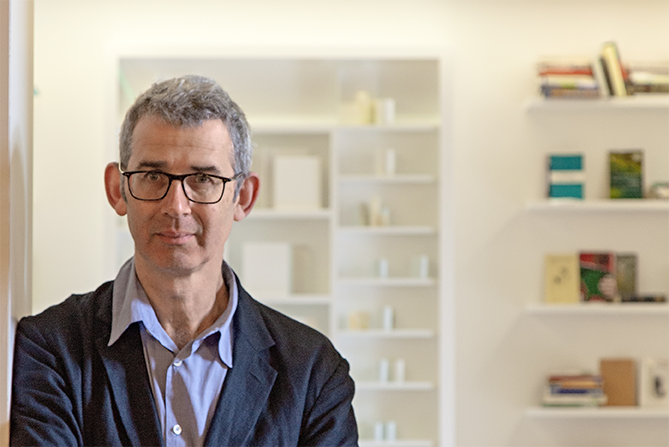
To open our series with the British Museum and Edmund de Waal, Edmund speaks to us about his library of exile
PEN Transmissions is English PEN’s magazine for international and translated voices. PEN’s members are the backbone of our work, helping us to support international literature, campaign for writers at risk, and advocate for the freedom to write and read. If you are able, please consider becoming an English PEN member and joining our community of over 1,000 readers and writers. Join now.
Over the next five weeks, PEN Transmissions, in collaboration with the British Museum and Edmund de Waal, is publishing a series of essays on the theme of exile. This series speaks to Edmund de Waal’s library of exile, currently housed at the Museum. English PEN’s event series for the exhibition has been postponed due to COVID-19, and these essays – from writers in the events programme, or with books in the library – touch on issues that will be discussed at the rescheduled events. Here, to introduce the series, Edmund de Waal speaks to Hannah Trevarthen (English PEN’s Events and Partnerships Manager) about his library of exile.
~
HANNAH TREVARTHEN: Edmund, your library of exile has moved between three locations. It was in Venice (with its connection to the ghetto, and Jewish experience), then in Dresden (which has its own resonances with porcelain, and also with atrocity and reconciliation), and then in London (in a space connected to the King’s Library). What effects has that movement had?
EDMUND DE WAAL: Something that matters to me, as an artist, is seeing how a work has different resonances in different places. That’s at the heart of what I do: putting something down in different places, and then looking at what happens as it moves. As you say, this library has had three homes, and it has accreted significance in each.
In Venice, it came out of thinking about the Ghetto as a place of aggregation – a place where languages and cultures were put under huge pressure, and where there was a huge amount of creativity as a consequence. It has a particular resonance with exile, and a particular connection for the Jewish community. And it’s also absolutely about translation.
Dresden, as you say, not only has a connection to porcelain, but is a place whose destruction continues to resonate. It’s also a place where the book burnings began in the 1930s – where the fragility of libraries was laid bare.
And London – well, in London, the library is located in an extraordinary place. It’s in a museum of polyphonic nature, where the objects of the world are talking profoundly about the state of exile. It’s in a museum that was created with a library – a museum and a library which are co-inherent. The original British Library is the centre of exilic literature – not least for Marx, and now as a place which is tidal for people from different communities. The people of London speak more languages than the people of any other city. So to have a library which has 90 countries and 60 languages represented gives it a certain strength, I think.
It’s very special indeed. I want to pick up on the point about translation, something very much at the core of English PEN’s work. A number of the titles PEN has supported are in the library, and that’s been very profound for us. When you were building the library, did you expect to represent so many languages? How did you go about selecting the titles that were included?
It’s a sort of non-programmatic library. It began with passion, and very much continues with passion. It began when I scanned my shelves and realised that a vast majority of my books were exilic. It began with the books I had. That turned into conversations with writers, in which I asked them who the voices were and what the books were that mattered to them. Then it involved academics and translators and publishers – growing incrementally and naturally. We weren’t crossing countries off a list.
Then a very powerful thing that happened. On the first night in Venice, we put up a sign asking people to tell us if they thought a book should be in the library. We said we’d find it and buy it and put it in. The moment of transition – from it being my library to being a library – was when someone came up to me in tears and said, ‘You don’t have this book, this community, this language – how can you not have this literature in your library’, to which the answer was, ‘Well, we will now’. It was that synapse of energy, in which it goes from being a curated space to being something owned by other people, that was most significant.
How have you found that process – giving over an artwork for people to contribute to it? It strikes me that you do your making in isolation, but that your practice then becomes very collaborative. How do you find balancing those ways of working?
Well, for me, they are absolutely yin and yang. If I didn’t spend time entirely by myself, with clay, there would be no installation. If I didn’t spend time entirely by myself, with a pen and a blank piece of paper, there would be a no book. But putting something into the world – working with people to animate it – is the completely fabulous part. Collaboration is the expanding landscape of creativity. You get so much back. It isn’t a costive thing – a take it or leave it. It’s much more generative. The handing over of this library is the most positive and creative thing I’ve done in my life.
It’s been a career highlight for me, too, to work with you and the British Museum on this project. It is a project fundamentally about dialogue; about how to start conversations, and how take them beyond the walls of the library and the Museum. The library of exile is a piece that compels you to respond.
It’s what books do. They don’t stay still; they converse. Literature is a migrant art in itself. And the power of passing on a book into someone else’s hands is palpable. One of the great things about this project is that I’m endlessly being introduced to new writers. The people in the events series, and in this series on PEN Transmissions, are people I’m desperate to listen to. It’s a beautifully generative project.
And, of course, the library is going to Mosul.
Yes – there’s something very straightforward about that, actually. It’s about saying what matters: about standing next to people who have been through something so traumatic, and saying that you have heard them and are in solidarity with them. Recognising a community – and their literature and art and history – seems to me a powerful, political and beautiful action.
Solidarity is hugely important. It’s a funny state, solidarity: it’s about this moment, but also history and future. The history of destroyed libraries and burned books, which is inscribed on the outside of the library of exile, is very important to me. Memory is a powerful, contingent, fissile thing. You keep remembering: it’s not just about the past; these losses are contemporary, and potential, and we should mark them and have solidarity with those who suffer them. Solidarity is the right word: it goes back, it goes forward, but it’s at once completely of the moment.
I want to ask you about physicality and touch. A book, by appearance, is a single object, but it is an object that contains multitudes. There’s something very special, in your piece, about being encouraged to pick up a book that means something to us and write our names in it – something we’re not used to doing with library books. Was the conception of the library of exile always that people would be able be in dialogue through touch and inscription?
A very innate thing about being in a library is a strange relationship with time. Your focus goes. You can explore and be led in all kinds of different directions. It’s a very dynamic space in terms of time. It’s also dynamic physically, because all books have very different feelings in your hands.
To have the opportunity to touch a book, and then find all the names of people who have held this book before you, from different countries and in different languages, struck me as a way of actualising the way in which texts are inhabited by the people who wrote them, but also the people who read them. Of actualising this extraordinary inhabitation, re-inhabitation, invocation and iterative reading of all those readers who precede you. That felt like a profoundly humane way of marking how the presence of books talks to us as human beings.
This library is not an artwork. I’m fed up with contemporary artists who make libraries where you can’t touch the books – where it’s all about the ‘idea of the book’. This is about the ‘idea of the book’ but – my god! – the best idea of a book is to pick it up and read it.
I want to finish by asking about psalms. The vitrines in the library are named for psalms – things that are very much in praise. The library of exile feels like a very personal work – for you, in praising clay and writing, and for a wider public, in praising their relationships to books. How important is it, now, that we sing the praises of libraries?
Psalms are complicated. They have a lot of agony and despair in them, but they also have extraordinary happiness and exaltation in them. Underneath both is a huge amount of exile. That matters to me. As does the fact that they exist in all three Abrahamic traditions.
Libraries are threatened – they are so threatened. There is never a bad time to stand up publicly for the significance of libraries as an extraordinary private-social space. There’s something quite profoundly political about that. And making a new library – well, that’s cool.
Edmund de Waal is an internationally acclaimed artist and writer, best known for his large-scale installations of porcelain vessels, often created in response to collections and archives. His interventions have been made for diverse spaces worldwide, including The British Museum, London; The Frick Collection, New York; Ateneo Veneto, Venice; Schindler House, Los Angeles; Kunsthistorisches Museum, Vienna and V&A Museum, London. De Waal is also renowned for his bestselling family memoir, The Hare with Amber Eyes (2010), and The White Road (2015). He was made an OBE for his services to art in 2011 and awarded the Windham-Campbell Prize for non-fiction by Yale University in 2015.
Created as a ‘space to sit and read and be’, library of exile is an installation at the British Museum by British artist and writer, Edmund de Waal, housing more than 2,000 books in translation, written by exiled authors.
Interview by Hannah Trevarthen, Events and Partnerships Manager.