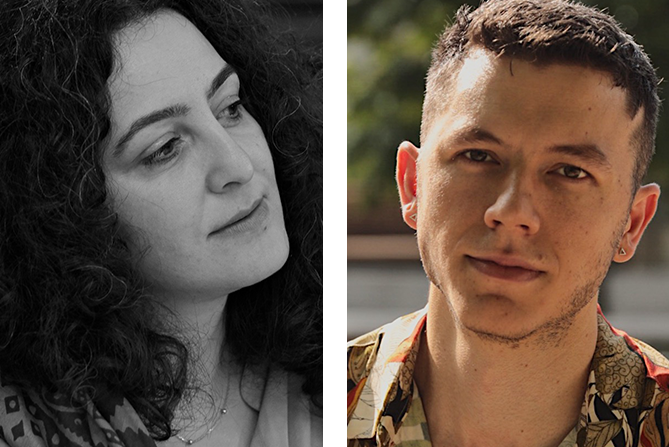
Sema Kaygusuz and Nicholas Glastonbury discuss shame, representation and the Turkish language.
PEN Transmissions is English PEN’s magazine for international and translated voices. PEN’s members are the backbone of our work, helping us to support international literature, campaign for writers at risk, and advocate for the freedom to write and read. If you are able, please consider becoming an English PEN member and joining our community of over 1,000 readers and writers. Join now.
Sema, how did Every Fire You Tend come to be?
SEMA KAYGUSUZ: I have been writing this book since my childhood. I grew up in a secular community, in an incredibly open, loving family. We were close, and we shared things – we had no dramas, violence, or deprivation, but we spoke openly about personal difficulties and emotions. No word was unspeakable. And yet I always felt that something was secret, silent. That all the talking was to cover something up.
In my childhood, every year, for ten days, I visited my grandparents. There is one particular moment that I always remember. My grandmother said to me, with empty eyes: ‘They butchered us’. This one phrase. I began to ask who they and us were, and this is when I realised that we never spoke about the past.
This is when I began to conceptualise the silence – our noisy silence. And, then, years later, I discovered our history. At university, I found the history of Dersim. I found witnesses to it. I found out that my grandmother had seen the bodies of all her brothers and sisters floating in the river-waters. She was the only one to survive.
And then I began to conceptualise shame; to consider the psychology of genocide, and how it related to the silence. There is an important Jewish proverb: the children always want to forget what their parents lived, but the grandchildren always want to remembers what their grandparents lived. I felt I had to remember. This book is my way of doing so.
You mention two words I wanted to ask about: ‘survival’ and ‘shame’. In a way, this is a narrative of survival – of how one can survive when one’s community, language and culture have been violently removed. But it is also one of shame – of how one remembers, or chooses not to; voices, or chooses not to, because one is ashamed of, is told one must be. I wonder what the relationship between survival and shame are? Is shame a way of surviving?
SK: Definitely. I know that my grandmother kept asking herself: Why do I get to survive? To be seen – to say something about survival – is not easy. We all live with the taboo that Turkey has not yet confronted. A national secret.
After the holocaust, Adorno said no one can write poetry, now. But then Paul Celan did. And maybe the silence and shame of my grandmother – what she had to live, as a burden and a legacy in her body – maybe it is a language that I need to decipher. It took me years to understand the shame, the secret, the silence.
I have chosen a way of trying to decipher it. Zeus has two sons, Chronos and Cosmos. Chronos always talks about time in a linear way. He writes his story by linear arrangement, and always about himself. His story is always written through dominance and power. He uses classification, symbolisation, polarisation, organisation, dehumanisation, extermination, and denial. This is what linear time does. I did not want to write this way.
I’d say that linear organisation is also tied up with masculine and colonial narrative – and that they do all they can to homogenise and claim totality. In Every Fire You Tend, there’s a plurality of narrative – these are women’s voices, and they’re many. Is this a response to the male, colonial, official narrative?
SK: Yes – it is. It is Cosmos. I turn my back on Chronos and recognise that time can be elliptical. Cosmos appreciates shame and silence and everything else that comes from history – recognises the small and the large. Cosmos sees things as helical, with pathos and mythos and sensual experiment.
I agree with Walter Benjamin: tragedy is a pile of debris growing skywards before me. My life is okay; but before me is tragedy. I climb up the debris and I see survival. My life – my survival – is a coincidence. And I ask myself how I convey tragedy not for the past, and not linearly, but for the future, and with plurality.
Could you speak a bit more about representing plurality?
SK: I don’t write communities; I write individuals. When you say the Armenians, you make Armenian individuals a material.
You homogenise.
SK: Yes, you homogenise and instrumentalise. I didn’t want to do that to the Zaza community. I don’t want to instrumentalise any community as a cultural product. Everyone has their own special moments, and as a writer I need to touch one spirit that can open the others. My grandmother’s individual experience can speak to the global, but it should not speak for the global.
Nick, when we talk about representation and plurality, we’re talking about something to do with narrative structure. When you came to this book, how did you perceive that?
NICHOLAS GLASTONBURY: The form is significant when we talk about modes of representation: the novel form, at large, is bound up in the same violences of the nation-state, coloniality and modernity that are at the heart of the novel’s critique. By writing something elliptical, you confront some of the assumptions of how narrative is supposed to function.
And though this point is about form, it relates deeply to language – something with which Every Fire You Tend is highly concerned. Could you both talk a little about the book’s language – which is, in the English and the Turkish, extraordinary?
SK: When I go to France, they ask about women in Islam. That’s the role I’m asked to play. But I am not a ‘Muslim writer’ or a ‘Turkish writer’. I call myself a ‘Turkish-language writer’. And this is not a homogenised language: it includes Arabic, Greek, Farsi, Spanish, Armenian, Kurdish. If you speak with a Turkish nationalist, you realise that they don’t speak real Turkish. They don’t know Turkish – just a very narrow version of it. Nationalists get their irons out and flatten everything. The Turkish of Every Fire You Tend refuses this.
NG: Before I even read the book, I spoke to friends in Istanbul about it. They told me that they stopped ten pages into the Turkish version because they couldn’t ‘understand it’. That emboldened me to translate it.
As a translator, the difficulty comes in translating the historical development of Turkish that the book explores. Certain words that were used 100 years ago in the Turkish feel as antiquated as words from 400 years ago in the English.
I suppose that’s another way of capitulating Chronos.
NG: Yes – and being able to move between language histories was the most difficult, but most rewarding, thing the book asked of me. Each section varies tonally, and striking that polyphonic register took me several years.
SK: I never choose a word coincidentally; I always choose consciously. Nick got that.
Did you work together closely on the translation?
NG: We did, and there’s a long WhatsApp thread – the archive of the process – that testifies to that. I also spent several days staying with Sema, in her home, smoking cigarettes and drinking wine and going to the text. But, even though it was an involved process, something I always felt positive about was the Sema encouraged me to seek out my own authorial capacity – my way of making the constructions of the book sensuous or supple in English.
You speak in your afterword, Nick, about the novel being ‘written in the coloniser’s language’. Translation into English is often bound up with a history of colonialism; there’s a reason English is prevalent, and that it offers access to wide markets. I wondered if there was something particularly fraught about translating between two languages that, in a conception, are both colonising languages?
NG: That’s something I spend all my free time thinking about. A lot of the ways in which world literature is framed are about building bridges. But that denies the political, historical and economic violences that subtend cultural contact-zones. It’s totally fraught, and there’s no easy answer. It’s one of the many paradoxes that tear through this book, and make it what it is.
SK: I’d add to that: whilst every word, on its own, is innocent, the context it is written or means with is not. Nick’s job of transforming Every Fire You Tend into English is paradoxic, yes. But the fact that the book absents masculine and orientalist narratives means the job is, perhaps, a little less fraught.
Has is taken a combination of you, Sema, as a writer; you, Nick, as a translator; and Tilted Axis as a publisher to make this book work?
NG: We pitched it a lot. One thing I heard from a lot of editors was that it seemed too experimental. But then wheat is literature if not experimental? If not about new ways of thinking and speaking? Who wants to publish non-experimental literature?
Capitalists?
NG: Exactly. Even if the act of translation is about rendering into a colonial language, there are still ways of avoiding the problematics of capitalistic world literature – like Sema refusing the monikers of Turkish writer and Muslim writer. These kind of refusals are important. One of the central points of Every Fire You Tend is that language is always insufficient, but it’s also always all we have. And that’s true of the life of the book itself, too.
Sema, I want to ask about danger. The environment for Turkish-language writers is fraught, but the Turkish-language literature being translated into English – particularly work by women – is vital and powerful and oppositional. Could you speak a little about your relationship to danger?
SK: I live some difficulties. But I deny speaking them. I cannot say I’m in danger; if I speak my bravery, I’m really speaking my fear. Living in Turkey, at this moment, is easy for no one. But it is the journalists in prison and academics in exile who are those that can really speak about danger. How can I speak about danger?
It’s also larger than Turkey. When I’m invited to speak in Germany – an apparent democracy – I think about the fact that they still sell arms to Turkey. When I speak in Germany, I don’t want to allow my existence to become a vehicle. Anywhere in the world, at a moment of crisis, fascism, sexism, essentialism and speciesism emerge. This is why Berlusconi, Erdoğan, Johnson are all the same man. Their differences are just in tone.
And you’re very sensitive to differences in tone. In being so, you reveal things we aren’t always readily able to see. I was struck by the way you tell violence as silence, and silence as violence. In Every Fire You Tend, atrocious things are described with beauty and lyricism, and lyrical, beautiful things horrifically. I think of the image of the ‘baby struggling to nurse at the breast of the dead mother’. It’s a moment when the beauty of life, with a specific focus on gender and maternalism, is turned into something abject. What do these inversions do?
SK: To write very raw, brutal moments as raw and brutal requires a certain degree of narcissism. So instead of writing them directly, in this narcissistic register, I took a more wayward path.
NG: A part of the work of the book is about trying to disrupt our ways of understanding representation. The wayward ways of representing, which Sema talks about, is a way of calling to attention. You likely wouldn’t have been struck by this passage had it not been written in this paradoxical way.
Yes, sometimes we have to do that. Sometimes, when we are so desensitised to the traumatic, it is only in describing in non-traumatic ways that we’re arrested.
To finish with a question for both of you, is this novel a celebration or a lament? What do its ‘wail’ and ‘sigh’ signify?
SK: It celebrates, even as it laments. Everything on earth is divine – even, in a way, our tragedies. But it is not the church of the mosque that has divinity; it is language, which makes everything.
I think humans want to be gods. But we must ask what kind of god we will be. We do not want to be the sort of prophets who use language that makes us politicians, traders, and slaves to civilisation. If we use the divinity of language, we must look to give the future ethics. We don’t need temples; we need poets. And, really, we are all poets.
So Nick, with this translation, are you on your way to becoming a god?
NG: Maybe. To answer your question, I think it’s both. Sema mentioned Walter Benjamin earlier, and I think that part of his philosophy of history is about encouraging us to see ourselves as agents of history – as agents who can stop the ongoing accumulation of destruction and debris. We have this messianic power; this capacity to do so.
The book, for me, is about how language can provide us with the tools to arrest history. It’s mourning a tragedy, but it’s also a celebration of the human will to make history for ourselves.
Sema Kaygusuz (born 1972) is one of Turkey’s leading female writers and the author of Every Fire You Tend. She has published five collections of short stories, three novels, a collection of nonfiction essays, and a play, which have won a number of awards in Turkey and Europe and have been translated into English, French, German, Norwegian, and Swedish. Her short story collection The Well of Trapped Words was published in an English translation by Maureen Freely (Comma Press, 2015).
Nicholas Glastonbury is a translator of Turkish literature. He is also a doctoral candidate in cultural anthropology at the Graduate Center of the City University of New York, and a co-editor of the e-zine Jadaliyya. He is the translator of Every Fire You Tend.
Interview by Will Forrester, Editor.