Tag: dogs

  • The Threat of the Mob: An Interview with Anuradha Roy

    The Threat of the Mob: An Interview with Anuradha Roy

    Anuradha Roy on artists facing threat, publishing in India, and literary dogs.

    PEN Transmissions is English PEN’s magazine for international and translated voices. PEN’s members are the backbone of our work, helping us to support international literature, campaign for writers at risk, and advocate for the freedom to write and read. If you are able, please consider becoming an English PEN member and joining our community of over 1,000 readers and writers. Join now.

    Anuradha – thanks for talking to me. Your latest book, The Earthspinner, reiterates something that I’ve encountered in your other titles: a deep and complex interest in the role of “the artist”. Could I start by asking you to talk about that a little?

    I didn’t think about the “role of the artist” when I was writing my first book, but over the years it has become clearer to me how tangled the process of making anything is. Not only must the writer or artist mine the force of her imagination – her personal seam of ideas and images – and then do what it takes to turn them into books or pictures or films; the outer world intrudes and alters the shape of things, too. This doesn’t have only to do with time and space and family (as in my earlier book, All the Lives We Never Lived). In The Earthspinner, the potter finds that he has to overcome not just his self-doubt and his lack of material supplies; his dream of making a clay horse runs full tilt into the hostility of his community. The threat of the mob is something every artist now faces, anywhere in the world, and all of this together is fascinating to me: how people continue to create despite everything, including their own senses of themselves.

    Reading the book, I was taken by its remarkable calmness. Did a lot of anguish go into crafting that calm?

    Your question makes me think of a scene from Satyajit Ray’s first film, Pather Panchali (Song of the Road), based on a book by one of my favourite writers, Bibhutibhushan. In the film, Harihar, the father, a penniless village priest, comes home after long travels, unaware his daughter, Durga, has recently died. He mistakes his wife’s silence for annoyance and starts unwrapping the humble gifts he has brought – a rolling pin, a picture. When he brings out a sari that he has bought for Durga, his wife can no longer stop herself from breaking down. Ravi Shankar directed the music for the film, and, at this point, instead of sobs, questions, explanations, there is only the high note of a wind instrument called the taar-shehnai. Durga’s death was one of the most wrenching parts of the book, but in the film it was even more intense, and I can imagine Ray, the director, felt every bit of its grief before he arrived at the powerful restraint and wordlessness of the scene.

    He is so charged up with his vision it doesn’t cross his mind that his speaking horse might be too talkative for some.

    Last year, I spoke to Kritika Pandey about her short story, ‘The Great Indian Tee and Snakes’, which is at bottom about the invisible walls between a Muslim boy and a Hindu girl. Kritika discussed how the story grew from a single image: the girl piecing together the shards of a ceramic cup smashed after the boy had drunk from it. I wondered if (and sensed that) The Earthspinner had been spun from some of the extraordinary images from which it takes so much force? Could you perhaps talk about one of those images – the clay horse?

    I first came across clay horses in my childhood. They are made in Bankura in Bengal, and I later discovered huge clay horses were made in parts of South India for an annual festival. When I read about the horse in Hindu mythology, I encountered a rich set of myths about a “submarine horse” that roams the ocean floor. In The Earthspinner, the potter turns the sacred horse into a secular one; he wants to make it not for worship, but as a gift for his Muslim beloved. And to unite their two worlds, he has verses in Urdu (seen in India as the language of Muslims) inscribed on it. He is so charged up with his vision it doesn’t cross his mind that his speaking horse might be too talkative for some. Would he have made his horse in the exact same way even if he had been aware of the dangers? That’s the question all of us ask ourselves when we function as artists in dangerously repressive societies.

    I know my books are populated by characters who have stepped off the train that is carrying the majority elsewhere.

    The Earthspinner doesn’t deal in political polemic, but it’s of course nonetheless deeply political (as all literature is). Its social and political backdrop is of the 1980s, but that has evident currency in 2021. How does the current political landscape of India bear on you as you write? Or does it not?

    It makes me feel more and more marginal everyday – politically, culturally – though fortunately there are quite a lot of people with whom to feel marginal. This does affect what I write. I know my books are populated by characters who have stepped off the train that is carrying the majority elsewhere. Like most writers, I respond to my times, but I’m not interested in writing polemic or novels that are baldly political. While I want my fiction to speak to the present, I’m also interested in language and form and the excitement of experimenting.

    Some years ago, I found myself in Arvind Krishna Mehrotra’s archive (his words appear in The Earthspinner’s epigraph). There are letters there that discuss the formation of Permanent Black, the publishing house that you and your husband, Rukun Advani, founded back in 2000. To run with a couple of words that come to mind having read The Earthspinner – ‘transformation’, ‘change’ – a couple of decades on, how would you reflect on how the tectonic plates of publishing in India have shifted?

    Arvind’s Illustrated History of Indian Literature in English was one of our first books at Permanent Black, and recently we published his Book of Indian Essays. There are almost twenty years between the two books, and in that time Indian publishing has become much more globalised, dominated by the Indian branches of multinational publishers, as well as Amazon, self-publishing and social media, which did not exist then. Although independent publishers and booksellers have quite a hard time in this context, I think many things are easier for us than before – we are nimble, we can operate on a shoestring from anywhere (because of better internet), and with social media, marketing is a more even game . At the same time, we can see how catastrophically reading as a form of entertainment is dropping. We’ve never known such small print runs, and there is no literary sphere to speak of – at least not in English, the language in which Permanent Black publishes.

    I trust him completely even if I don’t always agree with him, and I don’t feel at peace with a draft I’ve written until I know what he thinks of it. I think my lucky star was hard at work the day I met him.

    Talking of publishers: The Earthspinner is published by Mountain Leopard Press, Christopher MacLehose’s new imprint. I know that Christopher has published all your works in the UK, and I wonder if you could speak a little about that writer–publisher relationship?

    Many publishers now don’t read typescripts at all, nor do they edit; quite a few of my writer friends deal with freelance editors or beg friends for advice and feedback – every writer needs an honest, intelligent reader, someone who is in their corner but not there to flatter. Christopher and his kind are rare, almost extinct. He inhabits the world of a book in the making, responds to it with deep empathy and profound intelligence. From the moment he has read a typescript, there is a steady stream of surprises from him. These continue right up to publication – it can be nerve-racking, but never boring. I enjoy the editorial process with him (many arguments, but the book comes out vastly improved for them). I trust him completely even if I don’t always agree with him, and I don’t feel at peace with a draft I’ve written until I know what he thinks of it. I think my lucky star was hard at work the day I met him.

    It was a powerful ending, but I think I could never do that to a dog, even in a book.

    Finally, talk to me about dogs! (The Earthspinner has been added to my list of novels where dogs are star characters, both in and of themselves, and in how they drive plot – along with Pilar Quintana’s The Bitch, Jesmyn Ward’s Salvage the Bones, several of JM Coetzee’s books, John Berger’s King, etc.)

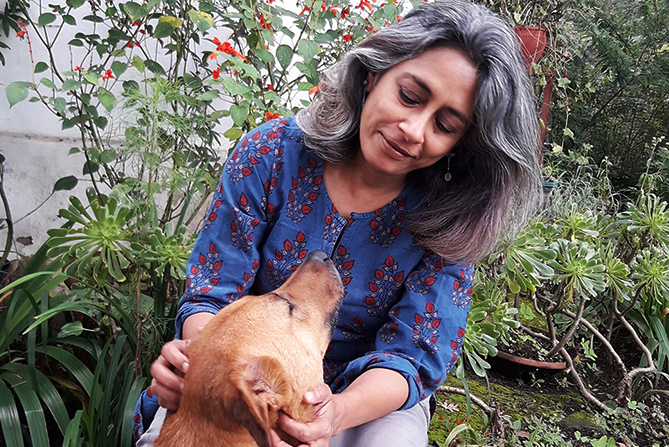
    I actually have a hard time reading books with dogs because the dogs always seem to come to a tragic end. I was very sure from the start that nothing ghastly would happen to the dog in my book! We have four, and they are of the kind you find all over India – strays – who have adopted us, just like Chinna in The Earthspinner. Chinna knows nothing of religion or human warfare. He wanders between classes, castes, localities, managing a biscuit here, a chunk of meat there. He is very much a distillation of all the strays I’ve known – an archetypal element in any Indian landscape and a creature that unites as much it divides. In Coetzee’s Disgrace I found it chilling how absolute desolation takes the shape of a dog pound, and the man sends to its death a young, lame dog with whom he has formed a bond. It was a powerful ending, but I think I could never do that to a dog, even in a book.


    Anuradha Roy is the author of An Atlas of Impossible LongingThe Folded Earth and Sleeping on Jupiter, which won the DSC Prize for Fiction 2016 and was longlisted for the Man Booker Prize 2015. Her last book, All the Lives We Never Lived, won the Tata Literature Live! Book of the Year Award 2018. It was shortlisted for the International Dublin Literary Award, the Hindu Literary Award, and the JCB Award for Literature 2019. She lives in the Himalaya in India.

    Interview by Will Forrester, Editor.

    Photo credit: Rukun Advani.

  • On the Pacific Coast: The English PEN Membership Interview Pilar Quintana and Lisa Dillman

    On the Pacific Coast: The English PEN Membership Interview Pilar Quintana and Lisa Dillman

    Pilar Quintana and Lisa Dillman, author and translator of PEN Translates award-winning The Bitch, are interviewed by the English PEN Membership from their homes in Colombia and the USA.

    PEN Transmissions is English PEN’s magazine for international and translated voices. PEN’s members are the backbone of our work, helping us to support international literature, campaign for writers at risk, and advocate for the freedom to write and read. If you are able, please consider becoming an English PEN member and joining our community of over 1,000 readers and writers. Join now.

    This interview took place during an English PEN Members’ Call with Pilar Quintana and Lisa Dillman, part of our programme of events for the PEN membership

    ~

    WILL FORRESTER: Pilar and Lisa – we’ve just heard you both read, in the Spanish and the English, from The Bitch. Pilar – could I ask you about dogs? What draws you so much to them?

    PILAR QUINTANA: That’s a very good question. When I was growing up, in Colombia, people didn’t have close relationships with animals. Dogs were used on farms, or to bark and keep houses safe. Cats were for hunting mice. But that has changed over time: now, dogs and cats are family. People have birthday parties for them, and when they die it’s a family death.

    When I lived in Colombia’s Pacific Coast – in the jungle – I had pets. It was difficult. In the jungle, animals are less tame than in the city, where I had lived easily with cats. My relationships with animals on the Pacific Coast were complex: pets would get lost, walk out into the wild, get sick. I suffered when they died.

    I wanted to explore that as a literary theme, particularly the relationship between a woman and an animal – a woman who couldn’t have children, who adopted a puppy instead. This is something that has happened to a lot with people around me – family, neighbours, and in particular one of my closest friends. This is something that hasn’t been explored before, at least in Colombian literature.

    WF: Thank you, Pilar. And I think we’ll come onto some more questions around motherhood and animals. I’d like to ask you about some other books – books about dogs, but written by men [holds up J.M. Coetzee’s Disgrace]. But first, Lisa, I wanted to ask you about translating these person-dog relationships. How did context and language intersect in translating The Bitch?

    LISA DILLMAN: That’s a really interesting question. I’d say, in terms of language, it was fairly like-for-like translation. But in terms of the ideas of dog ownership that Pilar just discussed, things were more complex. In The Bitch, we have a character who really wants to love a dog, but exists in an environment in which that’s not the way dogs are treated. It’s a question of sentimentalisation. Where I live, people take their dogs to Doggy Day Care; yesterday, I spoke to a student whose mother had taken their cat to a psychic. So there’s a clash of mentalities to translate – but Pilar’s prose is so spare, that clash somehow became more surmountable.

    WF: You mention ideas of sentimentality, and there’s a question from Jill Nicholls in relation to this that I’d like to go to.

    JILL NICHOLLS: Thank you. I love the unsentimental descriptions of nature in the book – of the sea where the child is killed, of the jungle, of the ants that make Damaris stand on a plastic chair as they ‘clean’ the house. I wondered if you have personal experience of an environment like that, Pilar?

    PQ: Yes, I lived on Colombia’s Pacific Coast for nine years. I lived on a bluff – where my ex-husband and I built our house with our own hands. I think The Bitch is the result of my time there.

    Even for many Colombians, the Pacific Coast is an unknown place. When Colombians think of the sea, they think of the Caribbean Sea. Even if they live in Cali, three hours from the Pacific Coast, the sea is still the Caribbean Sea. So I had to be descriptive and sensitive to the place, even for local readers. Sometimes Colombians do know the area, but, if they do, they know it with a lot of prejudice. It’s a poor area, with a large black community. And I wanted to show something other than a preconception of the region.

    JN: You certainly did.

    WF: Thank you, both. Could I please go to Rebekah Zammit for a related question on nature?

    REBEKAH ZAMMIT: Thanks. Pilar, with a growing awareness of the natural world and its needs – as well as the needs of women and those who experience violence – what can a reader draw out of The Bitch and apply to their own reality?

    PQ: Well, Damaris is born in an isolated area. In my country, if you are from the city, you have certain privileges. People on the Pacific Coast lack opportunity. And not only is Damaris born in isolation, but she’s also born poor and black. She has systemic racism, misogyny and classism against her, and she suffers the violences that come with that.

    What’s sad for me, as a Colombian, is that she’s not a fictional character. She represents the everyday life of many women on the Pacific Coast. When I decided I was going to write about a Pacific Coast woman who couldn’t have kids – but wanted to – I had to be careful in showing how complex systemic violence is for people in the region.

    RZ: And what can we as readers do for people like Damaris?

    PQ: Be aware of them. In Colombia, our racial issues are different than in the UK or the US. So many of us are mixed. From as early as I can remember, I was told that I had Spanish – white – blood, indigenous blood, and black blood. And this is true. In Colombia, I have what in the United States or in England would be white privilege. But when I’m out of Colombia, I’m told I’m black, or brown.

    It’s not just readers in the UK or US; I’ve had many readers in Colombia say the book has made them aware of how racism works in the Pacific Coast, and for that I’m glad.

    WF: Lisa, I want to ask you about translating that complex racial context into the Anglophone, particularly from a US context. You’re based in Georgia – you’re speaking to us from Georgia – and that’s a very urgent context at the moment as well. What was it like translating this nuanced, localised conception of race?

    LD: It was fascinating and difficult. It was something of which I was very conscious, and about which I spoke to Pilar on several occasions. Because the book is very spare, it’s a very minimalist but very direct address to race. There were certain elements that a Colombian audience would understand that an Anglophone audience wouldn’t – like simply being from a certain place signifying a character as black.

    Something else I was acutely aware of was the words used or not used around race. Early on, Rogelio, Damaris’s husband, is described in Spanish as, literally, ‘a black man, big and muscly, who always looks pissed off’ – and, at this this point, Anglophone readers might not yet have surmised that Damaris herself is black. In translation – linguistically and contextually – this could be taken in a vein that was not originally intended, and as signifying something that the original did not signify. And so there were small but conscious and concrete lexical moves I made to temper that – for example, changing the order of a list of adjectives.

    PQ: I didn’t realise that people didn’t know Damaris was black. A Colombian gets it from the first line – she’s from the Pacific Coast, from a fisherman’s village, so she’s obviously black. Lisa told me that this wouldn’t be obvious to people who weren’t Colombian or Latin American, and that she’d like to handle this in a nuanced way.

    LD: To add to that briefly: I didn’t want to add textual markers beyond those in the original that made it overly clear to Anglophone readers that Damaris was black. I think it’s important to question our perspectives – to interrogate any default presumption of whiteness. Why should we automatically presume someone is white? I didn’t want to make overt moves to clarify Damaris as black, because it’s important to complicate those presumptions.

    WF: This speaks to a question from Samantha Schnee – Samantha, could I pass over to you please.

    SAMANTHA SCHNEE: I’d like to ask Lisa a little bit more about the challenges you faced during translation, and, as Pilar is fluent in English, how closely you worked together.

    LD: Race, as discussed, was definitely a challenge. Another was the specificity of the jungle. I’d find myself using Google Images to try to picture it, but, even then, I didn’t have the necessary lexicon to describe it adequately. Pilar was very generous in sending me photos and describing the context; for instance, there are different types of palm that would be used by craftspeople in the tourist town in the book – one for baskets, one for satchels – and Pilar’s generosity was very helpful in conveying this in the English.

    It was important for me not to generalise. The reality of this book is intensely located in Colombia’s Pacific Coast, and it was critical to convey that specificity. I left as much Spanish in as I could, and I was very fortunate to have a wonderful editor in Lydia Unsworth who allowed that, and who obliged my refusal to italicise Spanish words.

    WF: Pilar – how did you find working with Lisa in this way? This is the first of your works that has been translated into English. How was that experience?

    PQ: I loved it. It made me realise quite how many of the words I use are Colombian Spanish, and don’t work outside Colombia. It also made me realise how differently class and race interrelate (and sometimes don’t) in Colombia, compared to other contexts.

    As a writer, when a book is finished, published, it is very difficult to judge my own work. It’s not mine anymore. I don’t want to read it anymore. But the wonderful thing about being translated by Lisa was that I came to it again as a reader. And I liked it. Lisa made me like me work, and for that I am very grateful. She did something magical: she made me be able to read my work with new eyes, and like what I saw.

    MAUREEN FREELY: That’s the nicest thing I’ve heard a writer say about their translator.

    WF: It’s lovely to have you both here, talking to us together. Could I pass to Yvonne Battle-Felton, please, for your two questions.

    YVONNE BATTLE-FELTON: Thank you. Firstly, how did Colombian and Pacific Coast readers respond to the book?

    PQ: I was afraid of how they would react, because it portrays the area in all its complexities. There was a woman from the community, who now lives in Argentina, whose mother gave her the book. She wrote to me and said Thank you. I am living in this cold place, and you brought me back to my town. I walked my beach again. And I saw my father again. I loved that.

    YB-F: That’s wonderful. I was thinking, when you mentioned your friends who longed for motherhood and transferred that love onto a dog, whether any of those friends have read the book? Did they recognise themselves in it?

    PQ: The close friend whom I mentioned always knows about my writing. But I didn’t tell her this time – it was too difficult. When The Bitch was published, she asked what it was about, and I said: ‘Well, I have a confession to make. It’s about a woman who can’t have kids and adopts a puppy’. She wanted to read it, and I told her she didn’t. Then I was in Frankfurt, and I met up with her, and she said she really was ready to read it. She did, and she told me it made her cry a great deal but that she loved it. She’s a very generous person.

    WF: I’d like to finish with an anonymous question.

    ANONYMOUS: How much have the tumultuous politics globally, and on a local level, affected your writing and translating? Do they feed in unconsciously?

    PQ: Well, I’m going to say something terrible. I’ve decided to bury my head in the sand. Because every day, for so long, there has been anguish. So I decided I couldn’t watch the news anymore; I could only do what I could do around me.

    There are many immigrants from Venezuela where I live, and they are suffering greatly. There are pregnant mothers with babies going hungry on the street. And, though I know that giving food isn’t going to solve this, it is what I can do from where I live. So I do a shopping trip for myself, and then I do a second shopping trip for those suffering around me. This is what I am able to do.

    LD: It’s a really good question. I’m not sure that I know the answer. It has certainly affected my psyche every day for the past four years, and that has ratcheted up recently. With the murder by police of George Floyd and Breonna Taylor, Ahmaud Arbery, and other unarmed black people; and with being in Atlanta; and with the voice of white supremacy coming out of the White House, it has been stifling and anxiety-inducing.

    I don’t know precisely how it has affected my translating, but it has affected everything. When my home state, Georgia, turned blue last week, it felt like a weight had been lifted. I know it won’t be plain sailing, but I’m hoping to begin easing out of the tension and constraint.


    Pilar Quintana is a Colombian author. She debuted with Cosquillas en la lengua in 2003, and published Coleccionistas de polvos raros in 2007, the same year the Hay Festival selected her as one of the most promising young authors of Latin America. Her latest novel, The Bitch, won the prestigious Colombian Biblioteca de Narrativa Prize, and was selected for several Best Books of 2017 lists, as well as being chosen as one of the most valuable objects to preserve for future generations in a marble time capsule in Bogotá. The Bitch is the first of her works to be translated into English.

    Lisa Dillman (USA) lives in Decatur, Georgia, where she translates Spanish, Catalan and Latin American writers and teaches at Emory University. Some of her recent translations include Such Small Hands (winner of the 2018 Oxford-Weidenfeld Translation Award) by Andrés Barba; Signs Preceding the End of the World (winner of the 2016 Best Translated Book Award), Kingdom Cons and The Transmigration of Bodies (shortlisted for the 2018 Dublin Literary Award) by Yuri Herrera, and Breathing Through the Wound and A Million Drops, by Víctor del Árbol.

    Chaired by Will Forrester, Editor.

    Pilar Quintana photo credit: Danilo Costa