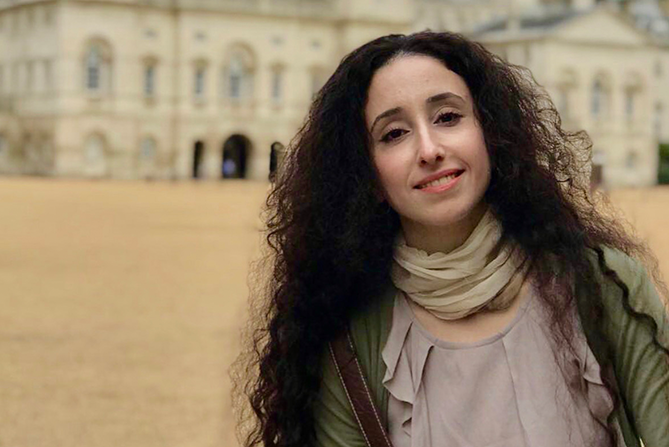
Nayrouz Qarmout writes about Edinburgh, Gaza, short stories, and packing a bag.
PEN Transmissions is English PEN’s magazine for international and translated voices. PEN’s members are the backbone of our work, helping us to support international literature, campaign for writers at risk, and advocate for the freedom to write and read. If you are able, please consider becoming an English PEN member and joining our community of over 1,000 readers and writers. Join now.
The bag carries a heavy load. I had bought it in 2015, arranged my things inside it very carefully, sat next to it, organised my clothes, lined up their colours in a quiet rainbow. The bag barely tolerated colour.
We will go back to a year before this bag was filled with dreams, and I will talk to the girl who is sitting by the window, writing ‘The Story of Al-Yarmouk’ after sailing her cloak in The Book of Gaza. Troubled serenity is turning to memory as she tries to write the story of that camp.
Melodies in her ears, she yearns for a soft childhood crossing the streets between the shops; the bean and chickpea shop; the photos of Arab artists hanging on its walls. Ideas are packed within her, between places, between times, between the possible and the impossible.
Did she leave or not? Come back or not? Does she still cross the memory? Or has she crossed it into a reality that wasn’t hoped for?
~
Explosions shake the region, vibrating imaginations, thoughts and emotions. The melodies disappear, and though the thunder of planes and incendiary balloons remains, she doesn’t fear those planes or their missiles.
An email catches her: Why don’t you write under the bombardment? She starts to write – politics at times, literature at others. The first time with English PEN: she publishes her diaries of the conflict on their site – ‘Life in War’, she calls it – and a short story, ‘Umm Ahmed: Newsflash’. She wrote the story in record time while the planes were destroyed; that steadfast mother in her kitchen had become a window of news, having watched it all for weeks from her tiny screen.
A great flame drowns the house with a haze of glass and wood. And the pressure in her ears – she didn’t hear the explosion, but it hit the air in her body, hit everything.
Language can no longer bear this in literature. Literature preceded language’s grammar, came back and struck its meaning. Metaphor withers, punctuation marks cry, chopping up sentences. The spaces disappear.
~
She doesn’t complete the Al-Yarmouk story. She leaves at dawn every day to regain the blue space between the sky and the sea. The waves are angry while the air hits her face. Her body has swelled to the extent that she collides with all the building of the city. Please, tell me: Who am I? What happened?
Months pass, then she writes ‘Pen and Notebook’ while watching the workers reconstruct a building. It had been levelled to the ground, the stones surrounding her house in every direction. The story started with the cart of the children who collected the stones.
Then comes ‘Our Milk’ – the milk that sprinkled the walls of The King David Hotel in Jerusalem in the forties, mixing with blood when the guitar strings are played. Then the Israeli soldier buying flowers from a Palestinian worker in ‘White Lilies’. ‘Black Grapes’ – a mother crosses bypasses to cross the separation wall and harvest her grapes in the West Bank. ‘Mirror’, where refugees from Palestine and Golan Heights go to places where refugees go. Intransigence and openness in ‘A Summerland Moon’. ‘The Long Braid’ – a girl curls up all the strings of melodies as she searches for a lost homeland. ‘Breastfeeding’ – religion and society punish the milk. The magic eye above the door, the fire from the stove, the anxious mother and daughters, and the uncle’s boots painting scenes: ‘June 14th’.
She doesn’t stop writing – goes back and completes the Al-Yarmouk story, then writes longer pieces. She no longer spends time with her family. For years, she rarely sees her siblings. She chooses a space and time parallel to the presence of everyone around her, begins to disassemble and synthesise.
~
A lengthy discussion with Charis Bryden about translating metaphor – about how the English language captures the eloquence of the imagination of the Arabic language. Every scene is a painting, which a musical melody stands behind, which moves its characters, when their creator sits afar from them and sees what they will tell them.
~
The wheels of the car drive her, carrying her alongside her father to the British Consulate, where she receives the first visa printed in her passport, dated 2015, in order to attend Durham Book Festival. Her eyes fill with doubt while her heart burns for the lost ease of opening or closing a door. She tries to exit through the Beit Hanoun Erez crossing, then the Egyptian Rafah crossing, but she doesn’t succeed.
With a smile refusing to reveal her sadness on her lips, the bag is unloaded.
It was emptied after ‘The Sea Cloak’, where that cloak swells the girl’s senses, exhausted from rowing, while the tufts of her hair confuse her vision. It was emptied after ‘Umm Ahmad: Newsflash’ and ‘Life in War’, where women make Qatayef with rose water, pistachios, and a little butter.
~
It is 2018. She has followed all the necessary procedures to get a visa for the UK, but she has been rejected once, twice, three times – she can’t count anymore. She no longer wants to despair at the rejection.
It is the media – the solidarity of those voices that support her cause – that prompt her visa to be granted. There’s only one day left before she has to be at the Festival. Two weeks ago, she had informed the crossing of her intention to travel, and had submitted the papers and her invitation. It’s three o’clock, and she finally has the visa in her possession. Then it’s half past three, and her phone rings: Your name, now, at the crossing. The bag isn’t ready.
Her brother’s leg is broken (he had been trying to repair a broken motor causing power cuts at a health facility) and he is at home. Her sister is taking a day off – for the first time in many years. They come to pack the bag with her while she empties her closet. She doesn’t know what the weather is like there. She fears for her ability to return to Gaza.
She calls a taxi and goes to the crossing. She’s the last passenger. She answers the questions of the Hamas security, then the National Authority, then sleeps a night in the Rafah hall. She will be granted a pass to cross at dawn. She’s the last traveller in the hall.
She crosses a desert road, the sun devouring her eyes. How many times has this bag been emptied of its belongings? At every checkpoint along the road.
Getting the bus won’t guarantee that she catches the plane. That Al-Araishi who makes coffee and tea looks at her and asks, ‘Why are you still standing? Everyone is sleeping. You must be thirsty – you didn’t drink anything’. ‘I don’t want to sleep’, she replies. ‘I’m waiting for approval to pass’. He tells her he will drive her for 250 dollars; she is worried about the risk, but nevertheless offers him 150. They agree, and that is the way.
A day on a very difficult road, and she reaches a hotel close to the airport. She knows nothing about Egypt and its hotels. She books a room, and everyone looks at her dirty clothes and the chaos of her hair. There were two children in the car, eating and pouring milk and chocolate on her. She smells foul.
What a beautiful bath. Allergy medicine relieves the redness in her eyes caused by the salt of the air in the Sinai desert. Another car for the airport.
~
For the first time, she sees the electronic boards that guide passengers at the airport. No one is waiting for her at Heathrow; she takes another plane up to Edinburgh.
There, the coldness of the air sweeps through her, shrinking every part of her body, the frost after the desert flame bringing her back to her birthplace.
In the taxi, she looks at each and every tree on the sides of the roads. How she longs for nature that isn’t eaten by borders.
She arrives at the hotel and steals some of its warmth. The Festival celebrates her arrival, a crowded lounge listening to what she says. She is on her own, a human regardless of the place. She isn’t begging for support and solidarity; she has just wanted to say: We still live and endure, through our dignity.
~
The crossing is closed. She is forced to postpone things for ten days. She was meant to return to Gaza two days after arriving for the Festival – the same time it took her to get to Edinburgh. She catches a train for the first time on her own. She doesn’t know how to book it – doesn’t have an electronic payment card, only carries dollars. She recalls entering a store to buy something and being told ‘We only take pounds, our country’s currency’. ‘What pride’, she thinks to herself. ‘This is independence. How I long for a currency for our country’.
She arrives at the home of a Palestinian writer, where his Hungarian wife receives her with deep passion and devotion to Palestine. She is tired – she gave a lot of media interviews in Edinburgh.
She walks the streets of London. How precious it is to walk freely.
~
She returns to Gaza. At El-Arish again, she spends the night on the sidewalk; people sleep in the open air, exchanges of fire sound, and the barking of stray dogs fill the night in the Sinai desert. But she insists on standing. A soldier fires bullets next to her to force her to sleep or sit down. On the contrary, the sound of this bullet awakens her reassurance, and she keeps standing. The children are lying under the feet of the elderly on pieces of worn cloth; a wildfire of glass surrounds them; others try to relieve themselves behind car doors, but the moonlight reveals the secrets of darkness, no matter how much its walls turn around their breath.
~
The surprise of 2019: Edinburgh International Book Festival wants to host the launch of The Sea Cloak and Other Stories.
She gets a visa, but her name at the crossing is crossed out (more than once). She pays to be able to travel.
Ali Smith tells her: ‘I know that many voices such as yours exist in the Middle East, and that we haven’t yet heard most of them’. She smiles and points with her fingers: ‘“Black Grape”, “White Lily”; small details, big events. While I was on the train, I tried hard to catch my breath reading your stories’.
In turn, she asks her, ‘What should I add to my writing?’
‘Nothing, just keep writing’.
Val McDermid embraces her firmly – ‘You’re Brave’.
At successive events, there are Kurdish refugees from Syria.
I am reminded of my name – ‘Newroz’ – and what it means for the Kurds. I read my stories to them, and my heart weeps bitterly for the Arab world, and then I silence my grief.
I book a train to London, without saying to the hotel receptionist – who helped me carry my bag last time – ‘How do you book a train?’. My bag is lighter this time; I came more aware of the weather.
~
There are many who are still like that girl, their bags overloaded with everything you can’t imagine.
Finally, I forward a question that I didn’t answer, asked by a senior New York Times staffer in London, when I met him in Edinburgh: ‘Why all this media attention? Is it because of the visa delay, or are they interested in your stories? I am still drawing this answer.
Nayrouz Qarmout is a journalist, author and women’s rights campaigner. Born in Yarmouk Refugee Camp, Damascus, in 1984, as a Palestinian refugee, she was ‘returned’ to the Gaza Strip at the age of 11 as part of the 1994 Oslo Peace Accord, where she now lives. She has worked in the Ministry of Women’s Affairs, raising awareness of gender issues and promoting the political and economic role of women in policy, law, and the media. She has won a number of prizes including the Creative Women’s Award for her debut collection The Sea Cloak, which was the bestseller at Edinburgh International Book Festival 2019.
This PEN Transmissions commission is supported by the British Council.
About the British Council
The British Council is the UK’s international organisation for cultural relations and educational opportunities. We work with over 100 countries in the fields of arts and culture, English language, education and civil society. Last year we reached over 80 million people directly and 791 million people overall including online, broadcasts and publications. We make a positive contribution to the countries we work with – changing lives by creating opportunities, building connections and engendering trust. Founded in 1934 we are a UK charity governed by Royal Charter and a UK public body. We receive a 15 per cent core funding grant from the UK government. britishcouncil.org