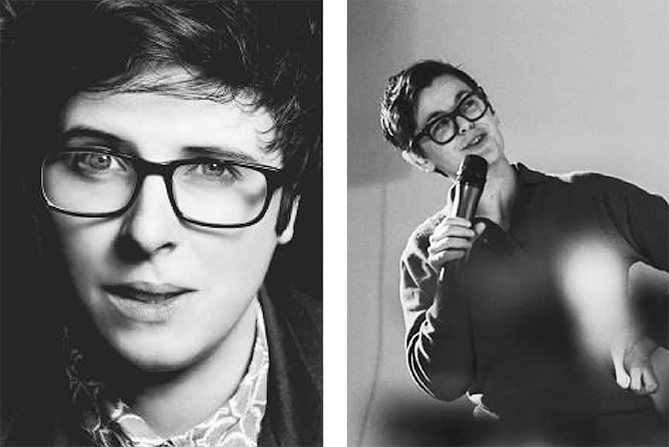
As part of our Digital Literary Salon, Eley Williams speaks to Peggy Hughes about dictionaries, constructing characters, and playing literary Tetris.
PEN Transmissions is English PEN’s magazine for international and translated voices. PEN’s members are the backbone of our work, helping us to support international literature, campaign for writers at risk, and advocate for the freedom to write and read. If you are able, please consider becoming an English PEN member and joining our community of over 1,000 readers and writers. Join now.
PEGGY HUGHES: You’ve said in an interview elsewhere (a Guardian reading group webchat on Attrib.) that short stories are ‘little self-contained moments of chaos or clarity’. I love this image. And also the short story as shot of limoncello metaphor, which reminds me of the time Janice Galloway said a short story was a fine malt, but, like the bottle, you wouldn’t want to drink the whole lot at once, or you would ‘do yourself a mischief!’ Bernard MacLaverty meanwhile, I think it was, said that the story was a dram and the novel a pint:
How did you come to be writing this pint?
ELEY WILLIAMS: Quaffable and guzzle-ready, I think that a lot of my short stories are treatments or considerations of suddenness. A narrator’s passing thought, a character’s impulsive reaction; even a short story about a thousand-year-long destruction of a city seems somehow a study in suddenness just by dint of the brevity of its account as dispatched on the page!
I sketched parts of The Liar’s Dictionary as if they were intended for short stories, but soon realised that what interested me about the subject or characters was their sustained development, and the way that change could occur slowly in a more payed-out way. Short stories about the character might afford glimpses of motivations, tone or consequences, but a novel would allow the reader a good, long, hard stare.
When tinkering with the first draft, I’d also just finished a PhD about dictionaries and their relationship to fiction and ‘fictitiousness’, concentrating on false entries in dictionaries and encyclopaedias. So I think my mindset was probably more ponderous, and habitually leaning towards drawn-out writing forms rather than zippy, punchy thoughts. The central characters of The Liar’s Dictionary often digress, or blame themselves for digressing, or query their inability to express themselves concisely, or blame themselves for being bored or boring: I think the novel allowed more room to explore this, or exhibit it.
How was the process different to writing Attrib.?
With Attrib., most of the stories were written individually and with no expectation that they might be collected together or viewed alongside one another. I think this ‘self-contained’ nature meant that I didn’t have to worry too much about repetition of tone or imagery, and could concentrate on metre of sentences and similar concerns quite quickly and directly – at the time of writing, that is; anxiety around this crept in later, by the ladleful! The short stories’ first drafts were written as feints or explorations: What would happen if I tried to write a short story about someone whose job it is to cook songbirds? for example. With the novel, I realised that things like ‘interesting evocation’ or ‘suggestions of a milieu’ were not going to be quite enough, and that, for the reading to be a satisfying experience, I would have to think a lot more carefully about structure and character arcs. I’m sure for many writers this comes naturally or easily, but I felt a complete amateur. This was refreshing but also exhausting: at one point, I printed off every page of the novel draft, cut it up into paragraphs or lines, and then played a hideous kind of collage or game of Tetris to trial various orders for sections, trying to work out where best they would fit.
What surprised you?
I first had the idea for the novel and made some tentative jottings around about 2011: I do not have a great attention span at the best of times, and tend to pluck at drafts or ideas or sentences in fits and starts, even when working on things that are very important to me. As a result, the novel has appeared after many iterations and permutations. I suppose I’m trying to say that I’m surprised that I actually finished it and ‘saw the process through’ without feeling completely overwhelmed or poleaxed with impostor syndrome! I am indebted to my editors and agent for guiding the final novel home, and for trusting it even when it was at (and I was at) the most sprawling or disingenuous. In hindsight, it has been a fun experience to work with ideas about textual capriciousness and unsteadiness while also feeling a little unsteady marshalling a novel together.
And what was the weather in which it was written (cognizant of the split timeframe of course, I’m interested in what influences, political or social or cultural fed it? I’m thinking here of an interview with Keira Knightley from the Observer last autumn, which I think about on average once a month, in which she said something to the effect of ‘we get the art our times require’ [or was it ‘deserve’?]. I wonder about that a lot)?
Much of the novel is about communication, and about attempts to feel genuine or authentic with the language that we use, while also admitting we are often in language’s thrall or limited by it. A lot of the novel is about naivety too, and gaffes, and weasel words, as well as credulity or gullibility. The novel was written at a time when I was reading more and more about the ways (often unseen or unaccountable) powers might, wittingly or unwittingly, affect ways of thinking or courses of action. As I was writing about fake entries in dictionaries and encyclopaedias, it was impossible not to consider taxonomies of ““““fake news”””” being scrutinised (or not), regarding current events and in a current discourse, as well as general notions of authority and trustworthiness when it came to reported speech or the written word. Facts seemed increasingly funny, indefinite things. There have also been recent discussions specifically concerned with dictionaries and representation – both lexicographical and in terms of social change – which have felt relevant to my research and which I seek to examine in the novel. For example, in 2013, France’s Larousse dictionary altered its definition of marriage to a union of ‘two persons’ rather than ‘between man and woman’ – this was met with some opposition. In 2019, Merriam-Webster dictionary added the singular pronoun they used to refer to ‘a single person whose gender identity is nonbinary’, or to a person whose gender is unknown or is intentionally not revealed. The relationship readers have had with dictionaries or similar resources, and the cultural notion that dictionaries might be repositories of fixed ‘correct’ facts rather than more fluid, mutable representations, has become very important to me.
I read in the New Yorker that Hilary Mantel has this method of getting to know a character, in which she imagines a chair and invites the character to come and sit in it; once comfortable, you may ask them questions. ‘She tried this for the first time when she was writing The Giant, O’Brien: the giant came in, but, before sitting down in the chair, he bent down and tested it, to see if it would take his weight. On that occasion, she never got any further, because she was so excited that she punched the air and shouted “Yes!” But from then on she could imagine herself in the giant’s body.’
How was that character development for you, Winceworth and Mallory? I love how we get glimpses of him, his state of mind and his motivations through his false entries.
I think the characters became more clearly realisable as my research into lexicography developed. Perhaps that is obvious, and sounds a little too ponderous: of course the more I learned about details of their presumed settings, the more clearly defined the characters became to me. But the development and changes were tonal as well as circumstantial. As I learnt about brazenness and idiosyncrasies in real dictionaries, the characters accrued pomposity or giddiness; more mischief. It crept into the writing. Both Mallory and Winceworth feel very constrained by their roles and abilities, and on the whole pretty powerless. As I read more about certain strangenesses in actual dictionaries (for example Chambers’s famous definition of éclair – ‘a cake, long in shape but short in duration’), or the fact that Kenneth Grahame based his character Ratty from The Wind in the Willows on a real-life editor of the Oxford English Dictionary, the characters’ more scurrilous and disobedient elements came to the fore. ‘Dictionaries’ stopped being associated for me with didacticism and precision but rather with creativity, wittiness and partiality.
Thinking about Mantel’s brilliant ‘giant-in-chair’ summoning, it strikes me that both Winceworth and Mallory try to conjure imagined characteristics for each other in a similar way. Although in the novel their timelines are separated by over 100 years, Mallory imagines what kind of person could be writing the false entries in the dictionary, while Winceworth tries to conceive of someone who might ever come across them. They start with stereotypes then ‘flesh-out’ these caricatures into sketches of flawed and hopeless dweebs, which develop into portraits of nuanced and hopeful dweebs, until finally they both imagine the other as recognisable and rounded individuals. And, in the act of imagining and creating, reveal something about themselves.
Your phrase ‘a hideous Tetris’ is pleasing and unpleasing! How did that architecture of the book in which their stories entwined come to be and come to land?
The two narratives jockeyed for room, and for a long time I wasn’t sure if one should take precedence over the other. I trialled both narratives written in the first-person, but it felt like too many people’s thoughts ricocheting inside the text; I trialled both narratives written in the third-person, but it felt too much like a survey of action rather than a delve into a personal experience. There’s even one draft where every paragraph is written in the style of a dictionary, with each section written as a definition of a word! David Leviathan’s The Lover’s Dictionary does this so well.
The final version, I think, has the balance I wanted: where narrators’ claims for subjectivity or objectivity collapse as their belief in notions of subjectivity or objectivity are tested. The narratives don’t compete for attention, but, I hope, run alongside one another in a shared uncertainty. Uncertainty is a big part of the novel. Just as the characters are unclear what their relationship with words should be, so too the reader is afforded aspects of characters’ reasonings, passing thoughts and breakdowns without privileging one over the other.
Dictionaries and you: when did this affair begin? Is a dictionary an unreliable narrator?
The ambition and scope of dictionaries has long been a fascination. Everything in the world often feels messy and incomplete, or incompletable. It’s easy to feel overwhelmed. But, as a tool and object, dictionaries make the claim that at least some things can be collected together in a certain order, and they can be potted and cultivated in a way that is concise, precise and authoritative.
Authority is often attractive, sometimes comforting, and generally profoundly weird. The concept of irrefutability is the same. In his novel Gambit, Rex Stout introduces his fictional detective Nero Wolfe to the reader as looming by a fire and ripping sheets of paper from a dictionary, condemning its pages to a sitting-room fire. In the first few pages of Vanity Fair, Thackeray’s Becky Sharp ejects a copy of Johnson’s dictionary from the window of her carriage. Dictionaries are, in many ways, completely preposterous and to be handled with suspicion.
They are also, of course, completely marvellous because they are a way of accessing thought and meaning (even [especially?] if elements of it are obsolete or arcane or misunderstood or misunderstandable or irreverent). There’s an adage ascribed to Jean Cocteau: ‘the greatest masterpiece in the world is only a dictionary out of order.’ I feel uneasy about anyone believing they have absolute authority, but also very tender towards frustrated, human attempts to create an order or definition for anything. Dictionaries seem to represent all of this.
I enjoy writers who are playful with the perceived and lampoonable ‘authority’ that dictionaries enjoy as cultural artefacts or products. It gave us Series 3 Blackadder and his ‘Contrafibularities’, a suggested entry for Robbie Coltrane’s Samuel Johnson. This is in the best tradition of Ambrose Bierce’s The Devil’s Dictionary (1911) and Flaubert’s The Dictionary of Received Ideas (1913). Intended as a part-parody, part-pastiche, the genius of these spoofs and riffs on dictionaries’ authority comes as both a playful dig and clear indictment of those books’ claims to power. There, you get to enjoy the absurd within the systematised, the unabashedly insincere within the sincere.
A dictionary means that we are prompted to consider the history of the word magpie, the colour of hewn magnussonite and the gift-lists of Magi all with one quick swizz at a column’s inch. Even if dictionaries are not always reliable, they are reliably diverting. The best rattlebag, Wunderkammer or scrapheap imaginable.
You have such a playful relationship with words – ‘giddy with the words’ shapes and sounds, their corymbs, their umbels and their panicles’. It feels like they are multi-dimensional things to you, with basements and wings and colour palettes and hearts and soundtracks: please explain what I mean by this?
Read aloud, you can treat the sounds of words like notes on a stave and noodle around their syllables in a kind of improvisation. Doing that, you’re freed from having to care too much about meaning, or communication: evocation takes precedence, rather than clarity. Words will always have a pace or rhythm to them, which also means some kind of dance is possible. It’s ok to dance uncertainly or haphazardly. And a garbled, giddy idioglossia (or a mixed metaphor) never gave anyone a stubbed toe.
Your house is aflame and you can save three books. They are:
- Ali Smith’s The First Person and Other Stories(2008)
- Juhani Pallasmaa’s The Eyes of the Skin (1996)
- Eleanor Morgan’s Gossamer Days (2016).
Eley Williams lectures at Royal Holloway, University of London. Her short story collection Attrib. and Other Stories won the James Tait Black Prize and the Republic of Consciousness Prize and was longlisted for the Dylan Thomas Prize. The Liar’s Dictionary is her debut novel.
Peggy Hughes is the Programme Director at the National Centre for Writing in Norwich. She is also Chair of Literature Alliance Scotland, Scotland’s membership network for literature, committed to advancing the interests of literature and languages of Scotland at home and abroad. Peggy is also a board member of publishers 404Ink and charity Open Book Reading. She is from Northern Ireland, and before moving to Norwich worked in literature at the University of Dundee, Edinburgh UNESCO City of Literature Trust, the Scottish Poetry Library and the Edinburgh International Book Festival.
This series features voices from the 2020 programme of the English PEN Literary Salon at the London Book Fair (LBF). LBF is the global marketplace for rights negotiation and the sale and distribution of content across print, audio, TV, film and digital channels. Taking place every spring in the world’s premier publishing and cultural capital, it is a unique opportunity to explore, understand and capitalise on the innovations shaping the publishing world of the future. LBF brings you direct access to customers, content and emerging markets. LBF 2021, the 50th Fair, will take place from 9-11 March 2021, Olympia London. LBF’s London Book and Screen Week will run for the fourth year, with the book fair as the pivotal three-day event within a seven-day programme. For further information, please visit: www.londonbookfair.co.uk.