Tag: elif shafak

  • Osman Kavala and the Life of the Mind

    Osman Kavala and the Life of the Mind

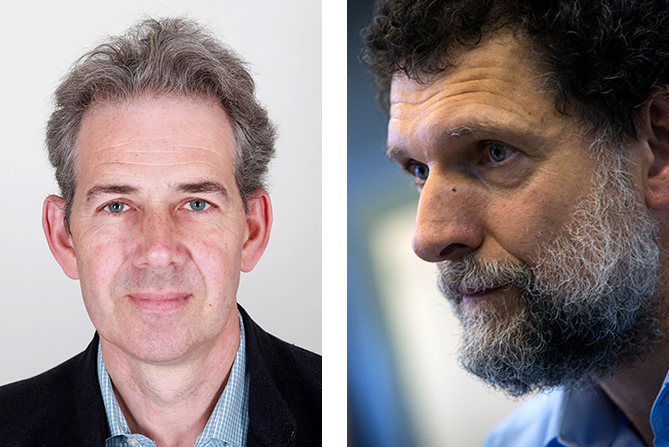
    Thomas de Waal on sending Osman Kavala books to read in Silivri Prison.

    PEN Transmissions is English PEN’s magazine for international and translated voices. PEN’s members are the backbone of our work, helping us to support international literature, campaign for writers at risk, and advocate for the freedom to write and read. If you are able, please consider becoming an English PEN member and joining our community of over 1,000 readers and writers. Join now.

    Since he was arrested in October 2017, the life of Osman Kavala, Turkey’s most prominent political prisoner, has been reduced to a few basic elements. He lives in a small cell, adjoining a tiny outside courtyard where he can take exercise and see a rectangle of sky. He is allowed occasional visits from his wife and his lawyer.

    The Turkish authorities have subjected Kavala to cruel and arbitrary imprisonment. For a long time, no charges were brought against him. Then he was acquitted of one set of charges but immediately arrested, on the same day, on even more grotesque charges of allegedly participating in the 2016 coup d’état.

    Incarceration has stopped Kavala from pursuing the vast range of activities in support of democracy and dialogue with Turkey’s neighbours that made him so prominent and beloved across the world. But his intellectual life is undimmed. Kavala is not allowed a computer, so he writes letters and notes in longhand, giving interviews and commentaries on cultural and political topics.

    For much of the day, he reads. He and his wife Ayşe Buğra, who recently retired as a social sciences professor at Boğaziçi University, find a little solace from the agonising uncertainty by reading books in parallel and sharing impressions when they meet. Initially, he made use of the prison library and reread Marcel Proust. Then he started to receive deliveries of books.

    ‘Every week he reads the books pages of Cumhuriyet newspaper,’ Buğra told me recently in Istanbul. ‘He is more informed than I am about new publications!’ Currently, they are reading the novels of Olga Tokarczuk

    Books are a way to keep in touch with a wider circle of friends, colleagues, and writers abroad, such as Elif Shafak. Julian Barnes’s 2016 novel The Noise of Time, about the dilemmas faced by Dmitri Shostakovich and his struggles with the Soviet establishment, made a deep impression. ‘It’s so relevant to present times,’ said Buğra. Through Shostakovich, Barnes was also describing the tribulations of contemporary Turkish artists facing the impossible choices of whether to leave the country, and if and how to speak up against injustice. The novel again strikes a chord in 2022, as Russian artists face  similar choices. 

    Thanks to English PEN, Barnes wrote a letter to Kavala, thanking him for his warm words about The Noise of Time and sending a ‘metaphorical handshake’. The gesture was deeply appreciated.

    I – and not only I, it seems – had hit on book deliveries as a way of keeping in touch with our friend Osman. The Turkish prison bureaucracy does what it can to make the process difficult, not just by restricting the number of books sent, but also by frequently rejecting books sent from abroad that do not have Turkish tax-stamps demonstrating that they were bought in Turkey. This means one must buy the books in Turkey, or online via an Istanbul bookshop.

    Having overcome these hurdles, I sent Osman a few books ordered via Pandora bookshop in Istanbul. I tried to choose titles that were stimulating but not too depressing. So I sent him Mikhail Bulgakov’s The Master and Margarita, hoping that a story of free spirits battling state bureaucracy would be inspiring. He told me he enjoyed the subversive character of Professor Woland, the Mephistophelean spirit who brings havoc to Stalinist Moscow, and who ‘enables us to see how things are’. Later, in a more frivolous mode, I sent him Eva Ibbotson’s Magic Flutes, anticipating – correctly, I am glad to say – that a patron of the arts would enjoy her description of the improvised staging of a Mozart opera in a decrepit Austrian castle. Osman responded that he enjoyed the intellectual and musical romp.

    He also greatly enjoyed Letters to Camondo written by my brother Edmund de Waal, the story of an artistic entrepreneur who grew up on the shores of the Bosphorus and tried, and failed, to have the French state return the loyalty he showed them. More parallels there for Osman Kavala, the son of a wealthy family who became a major patron of the arts in Turkey.

    Lately, the flow of books to Osman has hit a bit of a traffic jam. I recently visited the headquarters of his cultural foundation, Anadolu Kultur, in central Istanbul. Inside, Kavala’s office lies empty, missing its tenant. His wide desk is piled high with books – I counted about 40 of them – waiting to be brought to Silivri Prison, 90km outside Istanbul, by his lawyer. More arrive all the time. Kavala’s secretary photocopies the front and back covers and includes them in the next package of letters and court documents, so he can choose books to read next.

    Kavala reads between two and five books a week, fewer when he is working on his trial documents. And he is only allowed a maximum of ten books in his cell. (What danger, I wonder, does possessing 11 books in your cell, and not 10, pose to the state? Only an authoritarian regime can answer these questions.)

    In the pile of unsent volumes on his desk I saw titles by Thomas Mann, Seamus Heaney, Kazuo Ishiguro, and a couple of books that I had sent him and were not yet delivered. Let us hope that he never has the time to read all these books – not in his prison cell, at least. The case against Kavala is so absurd, and the international calls for his freedom are so strong, that one day he will be released. Sooner, we hope, and not later.
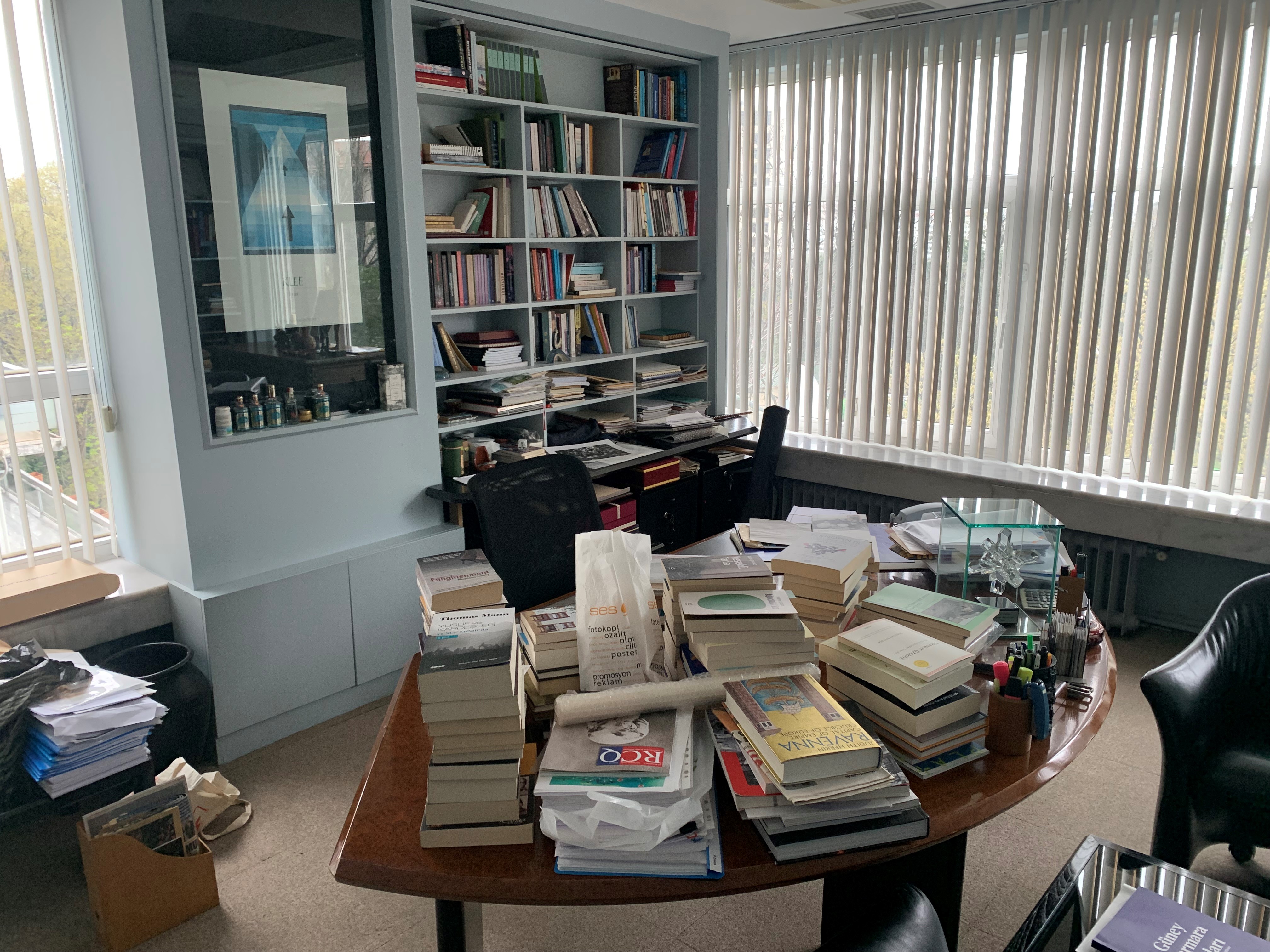
    Osman Kavala’s desk.

    Tom de Waal is a senior fellow with Carnegie Europe, specializing in Eastern Europe and the Caucasus region.

    He is the author of numerous publications about the region. The second edition of his book The Caucasus: An Introduction (Oxford University Press) was published in 2018. He is also the author of Great Catastrophe: Armenians and Turks in the Shadow of Genocide (Oxford University Press, 2015) and of the authoritative book on the Nagorny Karabakh conflict, Black Garden: Armenia and Azerbaijan Through Peace and War (NYU Press, second edition 2013).

    From 2010 to 2015, de Waal worked for the Carnegie Endowment for International Peace in Washington, DC. Before that he worked extensively as a journalist in both print and for BBC radio. From 1993 to 1997, he worked in Moscow for the Moscow Times, the Times of London, and the Economist, specializing in Russian politics and the situation in Chechnya. He co-authored (with Carlotta Gall) the book Chechnya: Calamity in the Caucasus (NYU Press, 1997), for which the authors were awarded the James Cameron Prize for Distinguished Reporting.

    Photo credit (r): Kerem Uzel.

  • But why do you write your books in English and Turkish?

    It is a question I hear often. Each time, I need to pause for a split second, the briefest hesitation within the span of a breathing space… How can I explain? How much can I tell? I try to offer a compact, rational answer that would do. Yet, I also know, deep down inside, that my urge to write stories in a language other than my mother tongue was an irrational choice, if it was a choice at all. I did not exactly decide to write in English. It didn’t quite happen like that. Rather than a logical resolution, it was an animal instinct that brought me to the shores of the English language. Perhaps I escaped into this new continent. I sent myself into perpetual exile, carving an additional space for myself, building a new home, brick by brick, in this other land. Being a stranger and an outsider in the English language intimidates me sometimes. It is a challenge, both intellectually and spiritually. Yet the joy and the pleasure I derive from the experience are so much bigger. And whatever pain there is, it is certainly less than the pain of feeling like a stranger and an outsider in my motherland. Somehow, that is heavier.

    I started learning English at the age of ten as I became a student at a British School in Madrid, Spain. At the time, Spanish was my second language. Yet as much as I loved the sound of Spanish, my passion for and pull towards the English language was something else altogether. It was the flexibility of its anatomy and the openness of its vocabulary that struck me, most of all.

    I started writing poems in English, keeping them to myself. When I took the step of writing and publishing my novels in English first, about 13-14 years ago, I was already an established author in Turkey. Immediately there was a negative reaction in my motherland. They accused me of betraying my nation, an allegation I had certainly heard before. They claimed I was ‘forsaking’ my mother tongue for the language of Western Imperialism.

    But I never felt I was abandoning anything. I never thought I had to make a choice between my two loved ones: English and Turkish. In truth, perhaps even more than writing in English or writing in Turkish, it is the very commute back and forth that fascinates me to this day. I pay extra attention to those words that cannot be ferried from one continent to the other. I become more aware of not only meanings and nuances but also of gaps and silences. And I observe myself and others. Our voices change, even our body language alters as we move from one language to another. At the end of the day, languages shape us while we are busy thinking we control them.

    I write my novels in English first. Then they are translated into Turkish by professional translators, whose works I admire and respect. Next I take the Turkish translations and rewrite them, giving them my rhythm, my energy, my vocabulary, which is full of old Ottoman words. Many of those words came from Arabic and Persian, and they have been plucked out of the Turkish language by modernist nationalists in the name of purity. Critical of this linguistic racism, I use both old and new words while writing in Turkish.

    Over the years I have learned that separation, too, is a connection. Writing in English, putting an existential distance between me and the culture where I come from, strangely and paradoxically, enables me to take a closer look at Turkey and Turkishness. Just to give an example, had I written The Bastard of Istanbul –a novel that concentrates on an Armenian and a Turkish family, and the unspoken atrocities of the past- in Turkish, it would have been a different book. I might have been more cautious, more apprehensive even. But writing the story in English first set me at liberty; it freed me from all cultural and psychological constraints, many of which I might have internalized without even being aware of it. The same goes for all my novels written in English first. Sometimes, the presence of absence strengthens a bond and distance brings you closer.

    In my heart, I am a commuter. This means I have to work twice as hard, spend twice as much time on each book. It is a completely irrational, illogical thing to do. Yet I do it because I love it and love, for me, is the key word.

    Like a child who plays with Lego bricks, I play with alphabets. It amazes me to see how a limited number of letters can create endless meanings, infinite stories. I am in love with words and they are never enough. We keep moving, expanding, travelling together. By nature, I am always aspiring to go beyond the boundary drawn in front of me, curious to know what lies beyond.

    That said, there are things I find easier to express in Turkish, such as sorrow and melancholy. There are things I find easier to write in English, such as humour, irony and satire. It is less a linguistic difference than a cultural one.

    ‘But if you are writing in English first, how can we call you a Turkish writer anymore? You are now one of them, not one of us,’ a critic said to me in Turkey last year.

    The truth is, I don’t believe in this artificial duality between ‘us’ and ‘them’.  As much as I respect writers and poets, such as Mahmoud Darwish, who claimed their mother tongue was their homeland, I also sincerely believe that there can be, and are, other paths in the world of creativity and storytelling. Some writers are just nomads. I happen to be one of them.

    I wish I could write in Spanish as well. And in Russian. Or Japanese. But I have no such talents. What I have is two wonderful, beautiful and magical companions of the road. The English language with its grammatical suppleness and immense and ever-green vocabulary and the Turkish language with its agglutinated masses of microparticles and inverted sentences, like the serpentine streets of Istanbul. I love them both and in very different ways and for very different reasons.

    Today, as more and more people are becoming displaced and replaced all around the world, our need to question static identity politics is also growing per day. Rather than a pre-given, fixed, monolithic identity, we can have multiple and fluid belongings. We can even love more than one person. Our hearts are wide and deep enough to do so. And yes, we can also dream in more than one language.

  • PEN Atlas: literary dispatches from Turkey

    Maureen Freely introduces an exclusive new e-book from PEN Atlas
    , collecting some of the best dispatches from Turkey, at a moment when the country is in the midst of great changes, both political and literary

    There was a time, and it was not very long ago, when even our best-informed and most outward-looking readers could not name a single Turkish writer. In 2004, when Orhan Pamuk achieved quite sudden world fame with his sixth novel (his fourth to be translated into English), more than a few of his reviewers expressed astonishment that a country ‘like that’ could produce a writer of his sophistication. His subsequent prosecution for insulting Turkishness only served to encourage the belief that he must be an aberration, owing nothing to the cultural void from which the knights of world literature had rescued him. This illusion was disrupted by the arrival of Elif Shafak who, though writing in a very different vein, with very different takes on religion, feminism, and indeed literature, was just as good at taking stories rooted in Turkey to world audiences.That and the growing popularity of Turkey as a holiday destination made readers more curious.  The number of Turkish authors being translated into English went from 11 in the last decade of the last century to 41 in the first decade of this one, and 25 in the last three years alone.In the past year, more than 20 Turkish writers have come to this island to launch or speak about their work. Most came under the auspices of the British Council, working in conjunction with the Turkish Ministry of Culture, the London Book Fair, English PEN, and other dedicated partners. There were more than 30 events in 15 venues across 4 UK cities. Most were about literature, not politics, though politics is never far away in the lives and works of Turkish writers. For those who wished to engage more deeply with such questions, there was a roundtable on freedom of expression hosted by English PEN at which a diverse group of Turkish novelists, poets, publishers, and journalists met an equally diverse group of London-based novelists, lawyers, and activists.At this and the many other events I attended, either as a participant or a member of a standing-room only audience, there was one question that kept coming back. Why has it taken the English-speaking world so long to notice Turkey? There is, of course, no single answer. You might say that – especially since the end of the Second World War – it has been very hard to read. Like many of the new nations in the Cold War era, it was economically weak, but it never had to liberate itself from an empire. Before becoming a republic, it was an empire. It was also, officially, a democracy, but with a military that was not shy to step in and shut it down whenever it deemed necessary. It was staunchly anti-Communist, and staunchly authoritarian. It is still authoritarian, except that now the enforcers are not secularists but Islamists.In Turkey today, as in Turkey yesterday, you pick up a pen at your own risk. Though the tradition of speaking truth to power is old and rich, the conversation was until very recently constrained, even kettled. The penal code is still full of laws that can send writers to prison. The new anti-terror laws and the expanding definitions of terrorism now allow for the indefinite detention of writers viewed as dangerous. But that has not silenced Turkey’s dissenting writers, who continue to speak out for democratic change with ever greater ingenuity, imagination, and force.During the recent Gezi protests, the Turkish mainstream media stayed at home. The media moguls were too deeply involved in the ruling party’s development deals to risk angering an increasingly autocratic prime minister. It was the social media that kept the protesters in touch, and (thanks to the efforts of a spontaneous army of Twitter translators) it connected them with the outside world as never before.So today we are publishing an e-book containing our first collection of dispatches, commissioned and posted by PEN Atlas over the past year. Some come from writers who have already seen their books published in English; some are appearing in English for the first time. Some have been translated; some were composed in English. Quite a few were written from the heat of the Gezi protests; others offer quiet reflections, mining the past, or imagining the future. All are open letters, inviting us to write back.From Mario Levi and Hakan Gunday to Kaya Genc and Ayfer Tunc, this collection offers many riches and insights and invites you to read further.About the authorMaureen Freely is the author of seven novels (Mother’s Helper, The Life of the Party, The Stork Club, Under the Vulcania, The Other Rebecca, Enlightenment and – most recently – Sailing through Byzantium) as well as three works of non-fiction (Pandora’s ClockWhat About Us? An Open Letter to the Mothers Feminism Forgot, and The Parent Trap). The translator of five books by the Turkish Nobel laureate Orhan Pamuk (Snow, The Black Book, Istanbul: Memories of a City, Other Colours and The Museum of Innocence), she is active in various campaigns to champion free expression. She also works with campaigns aiming to promote world literature in English translation. She has been a regular contributor to the Guardian, the Observer, the Independent and the Sunday Times for two decades, writing on feminism, family and social policy, Turkish culture and politics, and contemporary writing.