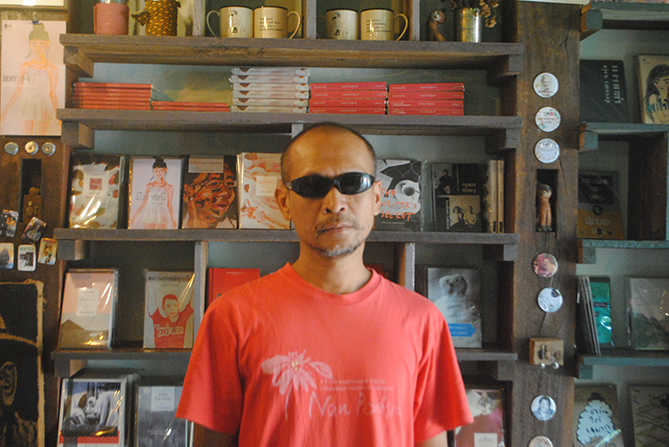
Worapoj Panpong on family, land, and money. Translated from the Thai by Mui Poopoksakul
PEN Transmissions is English PEN’s magazine for international and translated voices. PEN’s members are the backbone of our work, helping us to support international literature, campaign for writers at risk, and advocate for the freedom to write and read. If you are able, please consider becoming an English PEN member and joining our community of over 1,000 readers and writers. Join now.
Poei wrote saying, Dad, can you call Grandma?
Poei’s my daughter, and ‘Grandma’ is my mum.
The message took me somewhat by surprise. Nowadays, when my mother wants to reach me, she has to resort to generational leapfrogging, routing her message down to her grandchild to be relayed to her son?
I was surprised – and a bit guilty – that I’d neglected her, ignored her, to the point that she had to speak up.
Normally, she wouldn’t. And normally, I go long stretches at a time without visiting, or keeping in touch with the family back home. I haven’t talked to my mother for ages. We could go a year hardly talking at all. My silence and distance ought to be normal by now.
That my mother said something, that she brought it up to her granddaughter, means this kind of normal isn’t what she wants.
*
My mother is the eldest of more than ten children. Her father was a teacher and, from what I’ve heard, a strict parent who took his children’s education very seriously.
Unfortunately, he was lost too soon, in a car accident. His family, at that point happy and thriving, saw their financial situation deteriorate fast, eventually to the point of ruin.
My grandmother sold her land plot by plot to support her children. From the hundreds of rais she once owned, all that was left was the land her house sat on. Ultimately, she sold it all, the house and the land, and had to ask to build a hut on my mother’s property.
Of my grandmother’s more than ten children, not one of them went to university. It seemed not to have been something they gave much thought to. Most of them, once grown up enough to look after themselves, went to work as hired hands, using whatever physical strength they had in them, drifting from once place to the next and letting the wind of destiny carry them where it may.
I lived with my grandmother for several years after my parents spilt up. Our family wasn’t intact for long – separation was written into the script of our lives. When I think back to my childhood, I don’t think I understood much of anything. All I knew was that I despised poverty, and was sick of us being debt and being disadvantaged. I refused to accept the circumstances as they were; I wanted to run away, I wanted change.
My father moved in with his new partner. My mother took care of our education, footing the tuition bills for me and my siblings. I still have this image in my head: a country woman, a young a divorcée, riding her bicycle to a farm job for wages of thirty baht a day.
My mother never needed to teach us to ‘economise’ or to ‘be frugal’. I was disciplined on my own. I was used to tightening my own belt. When are the have-nots supposed to splurge?
During my upper secondary school years, my tuition was five hundred baht a semester. All four of us siblings went to school. As April passed and we were getting ready to go into the new school year, I saw the tired look in my mother’s eyes. But she always insisted that our task was to study hard. At that point, she ran a little corner shop, but also earned extra income by selling noodles and food made to order. There were phases when she sold homemade ho mok, or sometimes homemade Thai sweets.
For a time, we lived in a house we rented for seven hundred baht a month – a one-level home at the end of the lane, right on the rice paddies. During the dry season, I turned one of the paddies into a football field. I weeded, put up goal posts, drew lines in the dirt, and my little brother and I ran around whacking our shins into the ball (borrowed from none other than our landlord). I was happy there, but happiness doesn’t stay long. My mother moved us into a ramshackle townhouse, where the rent was three hundred and fifty a month. During that period, as dusk set in, my mother would head out with her noodle cart, to sell rad nah and pad thai.
My allowance for school was ten baht a day. The rides to and from school cost two baht, lunch cost four (five for a ‘special’ portion), and snacks two. If I spent according to that formula, I could save two baht a day. But that wasn’t how I budgeted. Only once in a blue moon did I treat myself to a snack. That was how I saved up for my first pair of jeans, and for my football boots.
It took me a long time, and, of course, putting pocket money aside wasn’t enough. Sometimes, I went and hawked flyers of lottery results, or caught fish or bees to sell. I wanted a guitar desperately, but I wasn’t about to be able to swing that. I never asked my mother for money to buy personal things – not out of pride, or some kind of principle, but just because I knew she didn’t have it.
While at university, I got a thousand baht of spending money a month. Nakhon Pathom (where my campus was) and Ratchaburi (where my mum lived at the time), aren’t far from each other, but my mum used to send me money orders because I didn’t always make it home every month. In my third and fourth years, I started cultivating a taste for beer. I earned money on the side doing street surveys, or staffing the library. Some years, during the holidays, I took a job as a waged worker for the Department of Highways. My duties included digging, using the theodolite, hauling stuff – I did it all, whatever they had me do. A lot of the tasks I can’t remember anymore. What I’ll never forget is the hotness of the sun.
In some moments, the image of my mother peddling her bike to her farm job flashed up in my head.
*
Poei’s about to finish university. After I received my degree, I never asked my mother for money again. I intend to use the same philosophy with my daughter: you’re a grownup now, you’re a graduate, time to support yourself, stand on your own two feet.
Don’t hang your hope on other people, I told her.
I’ve wired my mother money many times over the years. But of late I haven’t. And I’ve hardly spoken to her. The money: she has a little business going, and is largely able to take care of herself, whereas my income has been unsteady, meagre, and I have a child to support. The not speaking to her: I have no reason for it. I mean, when we’re together, we talk (or, mostly, I sit there quietly, listening). But when we’re not, I never feel the urge to call, never feel the urge to visit.
The house in Korat is hot, cramped – I never know where to plant myself down. When I’m there, I can’t physically relax. I decided long ago I wouldn’t – couldn’t – live in Korat. I don’t think it’s a good place to live. When I was a child, everywhere you looked the entire area was cassava farms. And red dust, and hot sun.
These days, I hear, a number of large animal farms have moved into the district. Often there’s a whiff of manure in the air. If you can stand living there, go ahead. It’s not for me. I really don’t like it there.
Especially now that I’ve found land in Nan, my path is taking me elsewhere, far away from Korat. Far, and I don’t miss it.
To me, it’s not a matter of forgetting your family or your roots. It’s more about time and attention, and in the last two or three years mine have been consumed with searching for a new place to settle down, designing, planning, budgeting.
The more thought I spent on my new home, the more the old home receded into the background, faded into the past.
The more thought I spent on my own life, the more my mother seemed a stranger.
Bluntly put, it’s not so unexpected. We simply found our own ways in life, going off to do our own duties.
*
I don’t recall having ever had a fight, or even a disagreement, with my mother. In spirit, I think we’re a lot alike – except I may be more fun-loving.
If there’s one point of contention between us, my guess is it’s politics.
I say ‘guess’ because we’ve never discussed the topic, much less argued about it. I sense it from certain words, certain comments. My mother is conservative – conservative with regards both to government and religion. I’m with the camp that wants democracy. I believe in equality and subscribe to principles of rights and freedom.
To give a concrete example: the matter of Section 112, the lèse majesté law. My guess is my mother prefers the old way, prefers things the way they are, prefers life the way it is; I stand firmly on the side of reform, have collaborated with the Nitirat group of legal scholars, travelled the country to campaign for change, put up rally stages, gathered signatures.
Though it happened years ago, I can still hear in my head the sound of a writer friend sobbing. He supported the reform movement, signed his name to petitions, made video clips. When the news got out, it deeply upset his father. He was upset to have upset his father. But for him to change his stance? He couldn’t, he said he wouldn’t.
My family has kept completely quiet. It’s not because they support or accept what I’ve been doing; more likely, they aren’t abreast of the news, aren’t aware of what’s happening. For the better. Sometimes, I don’t feel like explaining myself. And I consider it a personal matter – I’m an adult; no one, not even a family member, should infringe upon my right to think or act.
If my mother were to question me, if she were to kick up a stink and call me an ingrate to the land, I already know what my reply to her would be: either, 1) she’s the person who raised me, so is she going to have a problem with her own handiwork? That I am the way I am, think the way I think, is because of her (I’ve never studied abroad; all that I am is shaped by Thai society). Or, 2) if her argument is she didn’t raise me, well, that’s even worse – she had a child and neglected him, didn’t teach him proper values. So how is she going to complain now?
That’s how I really feel about the parent-child relationship.
That was how I really felt when I had a child. I’m going to let my daughter be; I’m going to have faith. That’s not to say I don’t care about her, don’t love her, or don’t worry about her. Of course I love her, but her life is hers. All we can do is give our children information, give them choices. As to what they’ll think, what they’ll believe, what path they’ll chose – that’s not our call.
*
Korat was my youth. I was born in a village of cassavas and blistering sun, and spent the first twelve years of my life there. Then I moved into town, and later left the province. Only once in a long while – once a year, and, later on, once in a number of years – would I go back for a visit. I go, and can’t wait to leave.
My life is in Nan now. My mother’s land is over. It’s the past. I barely feel any sentimental attachment to it. Some of my childhood friends have died. Others I’ve lost touch with, even the ones who used to be my close friends. If we were to meet up now, we’d probably feel awkward around one another. We probably wouldn’t know what to talk about. Our hands let go of one another’s long ago.
My mother’s land is important, certainly. But what’s more important is finding a terrain suitable for the type of seed that we are. In the wrong terrain, even a fine seed finds it hard to flourish.
One of my tasks right now is persuading my daughter to move to Nan. In my view, the terrain and the sky there make for a favourable setting for her to thrive. How are you going to live on a graduate salary of fifteen thousand a month? Bangkok’s good for people who make fifty thousand a month. More like seventy if you want it a little prettier, a little more comfortable.
Can you make it on less? Sure. But it’ll be a struggle, and you’re not going to have a good quality of life.
Unlike in Nan. There, you’re set on ten thousand, especially if you already have a place to live.
That’s what I told my daughter, and now she gets to choose.
If one chooses well, buckles down and works hard, people in her generation can earn enough in five or six years to build their own homes, especially if they have roots, have networks, have the investment of their parents’ generation to support them and prop them up, and if our society has rules and structures that are just.
I thought about it: it took me a long, long time to own a home of my own. It took me until nearly fifty. Certainly, it wasn’t only because I come from a poor background. It wasn’t ineptitude or laziness. This country, this land, must have something amiss, something making for an uneven playing field.
That’s why so many people in this land are poor, disadvantaged.
I think my mother had good intentions. She put in the labour. But her children needed a long time – too long – because their potential and desires as human beings were blocked, caged by something. I don’t want to see this this same situation play out for my children’s and grandchildren’s generations. We have to identify the source of the problem and move away from it, leave it behind us.
This year, this month, my mother’s sixty-eight, I’m forty-eight, Poei’s twenty-three.
In the same country, people of different generations have their own obligations to carry out, both in the public and private spheres.
If people make the wrong choices, and flatter themselves that they’re in the right, new trees, new flowers will struggle to grow in this land.
Worapoj Panpong is a Thai journalist and writer known for his personal essays and long-form interviews of cultural and political figures. After working at Manager newspaper and the lifestyle magazines GM and Open in his early career, he became a freelance writer and has over twenty collections of interviews and non-fiction writing to this name. Panpong was honoured with the Silpathorn Award, a national recognition for mid-career artists, in 2019. Originally from Nakhon Ratchasima, he lived and worked in Bangkok for twenty-five years before moving to the northern Thai province of Nan, where he founded and runs the poetry festival Nan Poésie.
Mui Poopoksakul is a lawyer-turned-translator with a special interest in contemporary Thai literature. Her translations include three story collections: The Sad Part Was and Moving Parts, both by Prabda Yoon, and Arid Dreams by Duanwad Pimwana. She is also the translator of Pimwana’s novel Bright. Currently, she is translating a novel by Saneh Sangsuk. A native of Bangkok who spent two decades in the U.S., she now lives in Berlin, Germany.