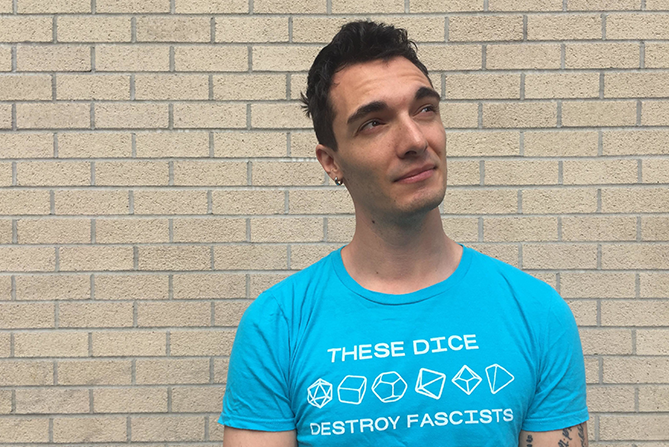
Alex Valente on translating fascism between Italy, the UK and the US.
PEN Transmissions is English PEN’s magazine for international and translated voices. PEN’s members are the backbone of our work, helping us to support international literature, campaign for writers at risk, and advocate for the freedom to write and read. If you are able, please consider becoming an English PEN member and joining our community of over 1,000 readers and writers. Join now.
In the summer of 2019, I translated a short satirical book by Italian author Michela Murgia. The original title – Istruzioni per diventare fascisti, literally ‘Instructions to become fascist’ – is a little different in the English version. The didascalic application is the same, though: Follow these steps, reader, and you too can contribute to the creation of a totalitarian reactionary country.
The book was published in Italy in 2018, at the peak of Matteo Salvini’s power as Minister of the Interior and the height of the far right’s hold on the country’s wants – rampant xenophobia, anti-immigration policies, increased and targeted policing. These all built on years of bipartisan populist appeal to the lowest possible common denominator among the electorate: personal success, external threats, no accountability. On publication, many voices on the supposed left vocally denounced the trick played by Murgia: how dare she suggest that, if you share any of the statements in the Fascistometer (a quiz-style list of statements for measuring your own level of commitment to the cause), you might be complicit? How can she absolve herself (she does not, and explicitly so) while initiating a witch-hunt for anyone who doesn’t think like her, who she brands as a fascist? The point was both effectively made and entirely missed.
The UK version of the book was published in January 2020. Two years after the original publication, we were facing a supposed shift in power and policies in the Italian government, the actual arrival of the Brexit process in the UK, the beginning of the supposed final year of the US Trump administration, and the Western spread of COVID-19.
I was asked, as part of the translation process, to localise the references and historical contexts that were specifically about Italy – about its precedents with historical, capital-F Fascism, with tyrannical rule, with mass propaganda and media manipulation. Some could easily be swapped with a similar equivalent; some, such as the side of the war the country had been on, and most of the book’s last section, had to undergo a complete overhaul.
To talk to ‘them’, whilst remembering there was no ‘them’, I had to locate an appropriate ‘them’ for the translation of context. Who are the populist ‘they’ in the anglophone world?
What the task really meant, I realised, was that I had to inhabit the language of similar individuals, groups and ideologies as those Murgia was targeting in Italy. Years of being Very Online, editing political publications, and working within activist circles was finally coming to fruition: I had a chance to ‘bridge the gap’ – to talk to ‘them’, to talk like ‘them’, to get ‘them’ to listen. All the while, I had to keep in mind the crux of the book: there is no ‘us’ or ‘them’, there is no bridge; there are only slippery slopes and normalisation of language and method-through-baby-steps.
To talk to ‘them’, whilst remembering there was no ‘them’, I had to locate an appropriate ‘them’ for the translation of context. Who are the populist ‘they’ in the anglophone world? Anti-trans movements, religious extremists, anti-intellectual thinkers, political icons, 4chan, incels, debate-me social-media users, YouTube professors, speakers of the free marketplace of ideas – the fertile grounds of radicalisation and the perpetration of harmful ideologies. After all, the truth is paywalled, but the lies are free. Some slogans and words have almost direct correspondents: ‘stay human’ for restiamo umani, ‘reverse racism’, ‘telling it like it is’, ‘will no one think of the children’. But what would ‘they’ call idiosyncratic concepts such as the ideologia del gender, radical chic, prima gli italiani, buonismo? The buzzwords of these platforms are not hard to find. I might choose, then, something like ‘gay agenda’, ‘armchair activism’ or ‘liberal elite’, ‘Britain/America first’, probably some ‘virtue signalling’, ‘sea-lioning’, and, at different moments in time, maybe even refer to a ‘feminazi’, ‘cuck’, ‘soy-boy’ or ‘simp’.
It was a little harder to de-Italianify the specifics of fascist nostalgia, though, trying to avoid making it sound like the butt of a joke about Italians and their trains running on time. I looked to the other side of the pond, where there has been talk of ‘fine people on both sides’, and lines like ‘the Republicans were the ones to end slavery’; where ‘they started out as national socialists’ and ‘so much for the tolerant left’ are dark, memefied jokes based on actual statements by real people with political and media power.
The US version of the book was released in August 2020, to coincide with the GOP primaries and party convention. (That was the plan all along, I was told, with a wink and nudge. I haven’t had the heart, yet, to point out that the Democratic Party is doing pretty well on the Fascistometer too, and has done so for decades.)
Prior to its release, I asked the editors to let me take a look at any changes they had needed to make to adapt the book for a US readership. Surprisingly (though perhaps it shouldn’t have been a surprise), there were very few.
My fear, specifically, was that historical references to the British Empire – to Churchill, to UK-localised allusions and semi-citations – would not land in the US. My work in finding the closest kind of statement and target between Southern European and British might not carry any weight at all, unlike the translators into European Spanish and German, whose countries both share similar histories with Italy. The conversation that I had with one of the US editors, however, highlighted two things: first, that their target readers would be at least ‘familiar’ with American imperialism – a different incarnation, on paper, to the literal empire of the British Crown, but a vicious, culturally pervading one nonetheless. And, second, that the kind of US politics targeted by the book’s satire ‘loves to reference Western Civilization, empires, and Great Men of History like Churchill’. Though the references may not have the same impact as with a UK reader, they do in fact still work. In light of recent global developments, the Churchill references perhaps carry even more weight than I initially intended. I should’ve snuck in something about Columbus when I was asked to remove Matteotti and Gramsci, and slid in a ‘strong and stable’, and mentioned all the best words.
If anything, the US edition drives Murgia’s point even further: the ‘us’ and ‘them’ construct of the past can no longer be applied, if the us is now using the language used by them, while claiming – at the same time – that this is not us and when they go low, we go high. The distinction is made through language and in language: they are deplorable, their words are horrifying, they scare us, we must say and do better, because we are better than them. What we are prone to forget is that their language is our language too, because it is still language.
Fascist language is othering, monstering, ostracising, oppressing. But all language – all the ones we share across communities of practice, across countries, across histories – has the potential also to do so.
One early review pointed out that ‘satire requires worthy targets. While some […] deserve [Murgia’s] barbs, others (people who think that “gender studies is ruining families”) lack a comparable moral weight and take throwaway jabs.’ Yet again, the same reaction: only some forms of language and thought are ‘worthy targets’; only the more explicit, more deplorable statements are truly a sign of fascism. Yet again, the point is being missed. Supposed liberals and progressives are regularly aghast at being made aware of the danger and damage of their own words, their statements, their platforms and their followings. Letters are drafted, appeals are forwarded, the news cycle – slowly reporting on the global rise of totalitarian politics – is eclipsed for another week, everything is cancelled, and new book deals are signed.
As Murgia says in her closing disclaimer, ‘the problem is being able to pinpoint anyone who isn’t even marginally complicit in the legitimisation of fascism as a method’ and its amazing property of ‘contaminating absolutely anything and everything’ by means of gradual or sudden normalisation. Fascist language is othering, monstering, ostracising, oppressing. But all language – all the ones we share across communities of practice, across countries, across histories – has the potential also to do so. The translatorial process just highlighted, for me at least, in screaming red ink, what the book was already eagerly pointing towards.
I am the product (genetically and educationally) of two very specific cultural backgrounds, one of which historically fought the other to stop the spread of European fascism, and both of which are now happily rising together in populism and authoritarianism as they look to, borrow from, and mimic each other’s linguistic practices and slogans.
Inhabiting this specific type of language is not something I’d recommend. Learning, however, the language that aids and abets oppression can teach us how to counteract it, how to defuse it, how to avoid falling into its traps all the way to the normalisation of fascism. It becomes a constant exercise in deconstruction, a form of active translation that subverts the usual labels of commentary. Not thought policing, but awareness. Not cancelling, but checking and helping each other learn. Not simplification, but critical engagement. Not defensiveness, but learning opportunities.
I am the product (genetically and educationally) of two very specific cultural backgrounds, one of which historically fought the other to stop the spread of European fascism, and both of which are now happily rising together in populism and authoritarianism as they look to, borrow from, and mimic each other’s linguistic practices and slogans. If that made my job easier in making this manual accessible to two sides of an anglophone pond, it is not a good thing. At the same time, if it makes even a few readers rethink how they use language, how internalised some totalitarian seeds have become, it might have been worth it.
Alex Valente (he/him) is a half-Tuscan, half-Yorkshire white European currently living on xʷməθkʷəy̓əm, Sḵwx̱wú7mesh, and sel̓íl̓witulh land. He is an award-winning literary translator from Italian into English, though he also dabbles with French, and regularly struggles with Mandarin Chinese, Japanese, and Dutch. His translation of Michela Murgia’s book is available through Pushkin Press (UK) or Penguin Random House (US),and his work can be found in The Short Story Project, The Massachusetts Review, NYT Magazine.