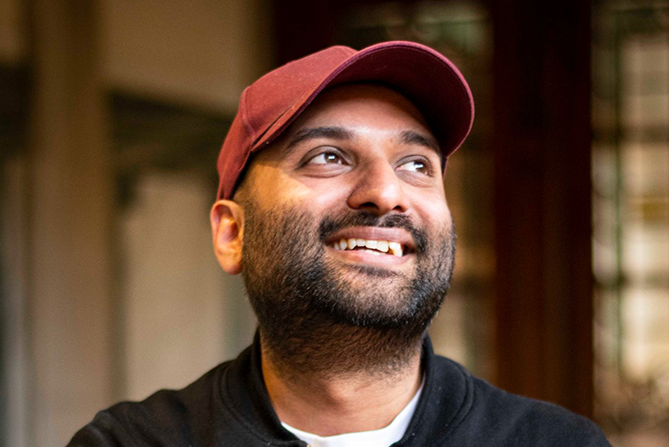
Kasim Ali on home, high streets and food.
PEN Transmissions is English PEN’s magazine for international and translated voices. PEN’s members are the backbone of our work, helping us to support international literature, campaign for writers at risk, and advocate for the freedom to write and read. If you are able, please consider becoming an English PEN member and joining our community of over 1,000 readers and writers. Join now.
Whisper the name ‘Alum Rock’ to South Asians, specifically Pakistani Muslims, anywhere in the UK and they’ll most likely know the place you’re talking about.
It’s a suburb in Birmingham, just two miles east of the city centre, named for the road that snakes through its middle: Alum Rock Road.
Imagine, if you will, a high street filled with all manner of shops, of clothes and food, but not the brands we’ve come to recognise as bastions of the High Street – there is no H&M to be found here, no WHSmith, no Boots or Superdrug, no McDonalds or Subway. There’s a Greggs and there’s a Lloyds Bank, and that’s about as close we get to those mainstream shops. Instead, there’s a plethora of locally owned restaurants and takeaways, internationally sourced Pakistani clothing shops, where people from all over come to shop for weddings, funerals, birthdays, graduations – we have it all.
The people who know Alum Rock are always surprised when I tell them I’m from there. As famous as it is for its clothes and its endless array of food options, it’s also known for being rough, dangerous, unsafe. When I was younger, I took this as a compliment – feeling seen – but as I’ve grown, I’ve come to find it insulting, for all its layers of classism and racism.
I moved out when I left to go to university at 18, disappearing into the white folds of Derby. I then moved to South West London, where I saw no one who looked like me, and then to Newark, a small town on the edge of Nottingham, where people watched me as I walked by, crossing roads to avoid me, security guards floating around me as I shopped. I spent a little while in South Shields, where people often asked me where I was from (I never knew if it was because of the colour of my skin or the sound of my voice). Now, I have settled in North London, on a road that has a mosque at the end of it, not far from a church, five minutes away from a bounty of Turkish and Kurdish shops.
As unsafe and dangerous as Alum Rock was thought to be, it never felt that way to me. It was my home – a place where I knew shortcuts and which corner shop would sell you cigarettes when your dad sent you out for some; which places might give you extra chips if you asked nicely; in which parks to spend a Saturday afternoon without being harassed by older kids who were smoking weed and didn’t want to get caught.
For the last ten years, I have been searching for somewhere akin to home. I have always been the kind of person who learns about and understands the thrum of the place in which I live. I can still tell you how to cut across Newark to get to the train station quickly from my old house, which road in Derby has the pub that me and my friends would go to on Tuesdays when they had half off for students, how to walk to the cinema in South Shields (a 45-minute trek that takes you over a river, across two bridges, and through a particularly quiet patch of forest).
But as much as I map these places out in my mind, I am never there long enough to feel settled – to feel like I have roots. Three years at Derby, two in Newark, nine months in South Shields. I’ve been in London for nearly four years, now – eight months in my first flat, eighteen months in my second, eighteen months in my third and current. I haven’t yet spent the kind of time here I need to feel that somewhere is home to me the way Alum Rock will always be.
~
It was October and my flatmate – who had recently moved in, replacing one of my closest friends – told me she wanted a samosa. We had tried to make samoseh earlier that year, seeking out a recipe on YouTube and making the dough from scratch, but they were too thick to cook all the way through yet too thin to stay together in the bubbling oil, and the kitchen a mess when we were done. Keen to not replicate the disaster, I did what a millennial of my time would and Googled where to find some. A result popped up, just an eight-minute walk away: Salims.
We went that night, and when I saw where the shop was, I was surprised that I’d never noticed it before. It stands right in the middle of my running route. I have no idea how many times I’ve passed it by, its white sign sticking out from the building: SALIMS / OPEN / 7 days a week.
When we stepped in, for a moment, it was as if the last ten years had disappeared from underneath me and I was back home, in Alum Rock, walking into one of its many restaurants and takeaways to order roti and salaan for my father (because my mother was somewhere else that day), or to pick up food because there was a celebration or a mourning.
There were seats at the back and a long buffet-like counter with see-through glass, metal trays of food sitting underneath. It was all familiar to me. I caught snatches of the men behind the counter speaking Urdu, a language that I understand but can’t speak, my speech faltering, my brain always a dozen steps behind the conversation with its lack of practice.
I spoke to one of the men that night – me asking for samoseh in English, and him responding in Urdu that they had none. We left without any food but said we’d go back.
We did, a few days later. This time, we wanted to buy dinner. When I walked in, I looked at the array of salaan sat under the glass – the chicken, the mince, the lamb, the dhal and the vegetarian staple, the aloo saag. All of it sang to me of my mother’s hands, memories from childhood of watching her as she cooked, and the endless attempts I’d made to recreate her dishes in the years since, something always missing.
I bought chicken that night with two naan made right in front of me, the sound of the dough being slapped between two hands a nursery rhyme, a calling of who I was and where I came from. My flatmate opted for dhal, and that night, when I closed my eyes as we ate, I was able to imagine that I wasn’t me now, but me then.
~
I went to Salims again, alone this time, my flatmate in the shower, from where an order of vegetable samoseh floated out. When I walked into the shop, I didn’t notice the woman immediately – I was too busy looking through the glass, trying to find the samoseh my flatmate wanted. It was only when I heard her voice that I looked up. She looked to be in her late 50s or early 60s, a scarf loosely wrapped around her head, Urdu flying out of her mouth with the rhythm of someone who has never spoken another language in her life. For a second, the world turned dizzy. A year and a half before this moment, my grandmother died. Cancer. I saw her everywhere at first – in every South Asian woman who wore a scarf, who spoke Urdu or Mirpuri, who reminded me of the vastness of her life. For a second, here she was again, standing before me, telling one of the men (maybe her son, maybe a nephew) that they were nearly running out of rice, and that he needed to fetch some more.
Her eyes never landed on me. And for that I am thankful, because if she had I’m not entirely sure I would have able to keep my cool and not run out of there. She vanished, into the kitchen to the side of the counter, and one of the men asked me what I wanted. ‘Can I get a portion of the chicken saag, the sabzi, two naans, and one vegetable samosa?’
~
Another time, I stood there by myself, waiting to be served, my stomach empty.
A middle-aged white man stood from the table at the back, brushed down his clothes, picked up his bags, and made his way out of the restaurant.
He stopped by the counter, knocking on it to attract the attention of one of the men. For a second, I caught the man’s eyes, and I wondered if we were both thinking the same thing then: Is this white guy going to start something?
To our surprise, he said ‘Mashallah, the food is fantastic, every time, Mashallah, Mashallah,’ and as he walked out said it a few more times.
When the door closed, the man laughed, and I joined him.
~
I have spent ten years being the cliché.
The child of immigrants, caught between this world and the one that I am meant to have come from, never entirely feeling of either, seeking out the feeling of home everywhere I can find it, except for the one place that it truly exists.
I have spent ten years mapping out roads and finding shortcuts, to feel settled. Maybe I’ll never feel that way, maybe home will always be the Alum Rock of my childhood. But at least now I can step back into those memories every so often to order myself two naan, dhal, and a portion of samoseh.
Kasim Ali works as an editor in publishing. He was longlisted for the B4ME Short Story Prize (hosted by his now UK publisher Fourth Estate), and Good Intentions was shortlisted for the Mo Siewcherran Prize. He’s also had a short story published in the Good Journal.