Tag: hope

  • A revolution awaiting its name

    A revolution awaiting its name

    Seven years on from the Arab Spring, Egyptian writer Basma Abdel Aziz wonders what has happened.

    People used to call it the ‘Arab Spring’: the Egyptian revolutionary movement, which started in January 2011, following the Tunisian one, spread to other nearby countries, and constituted a huge unexpected mass uprising.

    Seven years on from this movement, the flowers have gradually faded, the sunrise we once thought permanent has been replaced with a sunset, and hundreds of thousands of smiles have disappeared into the cloudy atmosphere.

    The situation has changed dramatically. Egypt is unfortunately suffering signs of an aborted revolution, or at least a frozen one. Instead of making wide leaps – or even small steps –  towards a better future, one jump back follows another. Having the military in power again is not exactly a good sign for a new democracy. Extremely repressive measures are being taken; new restrictive laws and decrees are introduced in order to restrict the public domain. In comparison, the former president Mubarak’s era now looks far more flexible and relaxed.

    Intellectuals, writers, actors, singers, poets and novelists are crudely punished for their opinions, frequently put in prisons, and asked to declare their admiration for the authorities publicly. The political system refuses to hear any dissenting voices, whatever they would say. Criticism is not allowed anymore, dissidents are stigmatised whenever they speak up. They are called traitors.

    A few weeks ago, a famous singer, Sherine Abdel Wahab, was sentenced to six months in prison, having been convicted of insulting the river Nile. Sarcasm is not enough to describe the situation. She was talking to one of her fans in a public venue and mentioned that they might get parasites from drinking Nile water. A silly joke, perhaps – but not a crime that deserves arrest.

    Recently, the number of prisons has shown a notable increase. Over the last three years president Abdel Fattah Al-Sisi has ordered sixteen new prisons to be built, so as to compensate for the rising number of detainees. It seems important to mention that people can be arrested, kept ‘under investigation’, in custody, for weeks, months and years, without trial. The law is not in their favour. It allows endless detention, based on legislations produced during the era of Adly Mansour, the former head of the supreme court, who took office temporarily (mid-2013 to mid-2014) after ousting the first and only civilian president to run Egypt, Mohamed Morsy.

    Speaking to older Egyptians, who used to be politically active in their youth, one can but listen to them, sadly, when they describe the current situation as being incomparable to any other era they have lived through. Many of them say that the current state aggression and violence exceeds even what they witnessed during the totalitarian regime of the fifties, when Gamal Abdel Nasser was in power. Actually, as Nasser had a large popular base, a strong social bond with the poor and the middle class, well designed public goals and a desire to achieve real progress on social and economic aspects, his dictatorship never looked as dark. National projects were designed for the sake of the majority of people, and not accompanied by dodgy luxury business deals.

    According to the Stockholm International Peace Research Institute, Egypt had the third highest number of arms import in between 2013-2017[1]. This continued weaponisation is particularly questionable at  a time when poverty is widespread, and severely affecting people’s lives. Even though the government talks about economic recovery daily, there is hardly any evidence for it. Over the past four years, inflation rates have risen significantly, following a devaluation of the currency. There is a 75% rise in external debt, 74% in internal one. There was no significant change in the skeleton of production, no improvements in the medical or educational systems, no job creation[2]. This helps explain why the country is ran with an iron fist. It is the only way to control the oppressed citizens: using violence instead of providing for their basic needs.

    The 2018 presidential elections showed the usual decorative trends: a lot of banners, songs, interviews and talk shows, all calling for the current president to be elected for another four years. Scenes of people dancing in front of the polling stations, DJs carried on cars in the streets, flags of Egypt and photos of Al-Sisi emerging from the windows; all signs of happiness are there, if one decided to stay home and watch it all unfold on TV. But going out into streets, it is quite a different picture.

    In an absurd twist, the only other candidate standing for elections, Moussa Mostafa Moussa, expressed his unconditional support to Al-Sisi, and declared he had voted for him. This was not the only stunning statement he made. On multiple occasions, the only counter-candidate stated that he considered Al-Sisi the best guy for the presidential position. The question to be asked now is: was the ruling system in need of all the propaganda it made? I guess the answer is ‘yes’. A dictatorship such as this one grows up with propaganda, nourishes itself on shaping people’s consciousness, and fades when they stop believing it.

    And also: it lives on because of those who prefer to stay in safe and secured spaces, no matter the price, those who suffer from nostalgia for the patriarchal figure, ever ready to protect them –  they all agreed on changing the previously chosen name, and now it is not a ‘spring’ anymore, but an autumn or winter. For those who associate themselves with the totalitarian authority, no matter the crimes it commits, the Arab Spring is a fake, a conspiracy, a big disaster from which God saved the country. The Arab Spring has been turned into an insult, which is how it will remain, as long as the current situation remains unchanged.

    Maybe the Egyptian spring has left the squares early, but I still remind myself of a simple fact: spring comes every year; it never stops coming.

    I keep telling those who became desperate that even if the mouths which chanted once for liberty are being quieted for now, even if the political authority has regained its holy mission of reproducing the ’state of fear’, we shall continue the struggle against dictatorship. We shall keep fighting for freedom, justice and dignity, as long as the echo of freedom resonates inside our hearts.


    Basma Abdel Aziz is a psychiatrist, writer, and sculptor. A long-standing vocal critic of government oppression in Egypt, she is the author of several works of nonfiction. In 2016 she was named one of Foreign Policy‘s Global Thinkers for her debut novel, The Queue, translated by Elizabeth Jacquette, which was also named to the longlist for the 2017 Best Translated Book Award. She lives in Cairo.


    [1] https://www.sipri.org/news/press-release/2018/asia-and-middle-east-lead-rising-trend-arms-imports-us-exports-grow-significantly-says-sipri

    [2] https://www-madamasr-com.cdn.ampproject.org/c/s/www.madamasr.com/ar/2018/03/25/feature/اقتصاد/كشف-حساب-السيسي-ملخص-للأداء-الاقتصادي/amp/

  • Going home

    Going home

    Rowan Hisayo Buchanan has edited an anthology ‘for and about the people who have heard the cry ‘Go Home!’ too many times’.

    Where is home for you? Is it a place? A person? An idea? A bowl of soup? Your notebook? Nowhere? Everywhere? Has anyone ever tried to make you feel not at home? Taken your home from you?

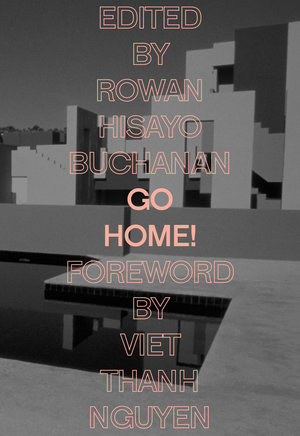
    We asked twenty-four Asian and Asian American writers for work on the topic of home. The result is Go Home!, a collaboration between the Asian American Writers Workshop and the Feminist Press in New York. The pieces show how many things a home can be:

    GO_HOME_front_cover

    Alice Sola Kim’s short story is about Korean adoptees who summon a demon that may or may not be their mother. Alexander Chee wrote an essay about his beautiful, gay, mixed-race roommate and a scarring dog bite. Wo Chan offered a poem about working at a make-up counter. Amitava Kumar’s ’Love Poems For The Border Control’ addressed the ritual humiliation of the border control, but also the letters his mother wrote to him in Hindi. Sharlene Teo wove together London, packaged drinks, teenage love, and drug smuggling.

    As the editor, I hoped that the depiction of so many different ways of being at home might show how facile the famous insult ’Go Home!’ is.

    I took the anthology on a US tour from Tampa, to New York, to Boston, to San Francisco, to LA. At each stop, we were asked a simple question with a complicated answer— ‘Is the anthology a response to Trump and his supporters?’

    We conceived of the book before the recent political and social upheavals. At the anthology’s inception, Trump seemed a distant comical figure. Many of the liberal people in my life declared that racism was, if not dead, dying. Obama was President. Britain was part of Europe. In a few months, Sadiq Khan would be elected mayor of London. People kept telling me the future was beige, as if I, a mixed-race person, should take this as a personal triumph.

    And because we were supposedly moving into this perfect future, there was no need to talk about the everyday exclusion, injustice and lack of representation that many Asian Americans and British Asians experience. An academic who was trying to help me understand the competitive world of research funding explained gently, ‘Post-colonialism isn’t really fashionable anymore.’ He was a white man, but he was supportive, not a villain. He was simply warning me that interests had moved on. I didn’t know what to say. It was like being told that sexism isn’t really a big deal.

    When talking to people who had never doubted their own acceptance, I began to be a little shy about describing my excitement at our having won a contract to create an anthology of Asian and Asian American writers. To say that we needed to collect and to celebrate this work felt like pointing out to the host that the chicken was not fully cooked, that there was blood around the bone. It felt like a faux pas to say that racism had not been grilled out of society.

    I was not alone in feeling the disjunction between the view that racism had almost vanished and what I perceived. Sunny Singh, author and activist, recalls that, ‘I noticed the big shift in rhetoric [towards xenophobic and racist ideologies] in the 2014 local elections and mentioned it in some press appearances. I was met with noticeable disbelief. Yet, the racism continued to build.’

    Then Brexit happened. Bigots took it as a triumph and were singing a victory song full of bile and spittle. Hate crimes spiked. Immigrants, white and non-white, spoke of suddenly not feeling at home in a country they thought of as their own. Across the Atlantic, the American election was heating up, much of the rhetoric pitching so-called Real Americans versus everyone else. Trump won. Had hate won?

    I found it hard to write in those dazed weeks. A Chinese American friend and I ate lunch together a few days after the election. She’d been writing a novel, but she wondered if she should stop. What, she wondered, was the point of art?

    But writers, like the demonstrators on the streets and others who did not want to live in a world of toxic division, began to see that this was also an opportunity to build community. Nikesh Shukla’s essay anthology Good Immigrant got the attention and praise it deserved. Jesmyn Ward’s beautiful collection of black nonfiction, The Fire This Time hit the shelves. Meanwhile, our editorial team was sifting through submissions to our open call. I found joy in reading every one of our five hundred stories, essays and poems. I no longer felt isolated. There were so many smart, lyrical voices giving literary life to so many different ways of being at home in the world. The bones of this book were formed before Trump, or Brexit. But it joins its voice to those opposing the hatred that has come to feature all too often in our public discourse. It is for and by writers who have been told they don’t belong in books, in their hometowns, and in their countries. It is for and about the people who have heard the cry ‘Go Home!’ too many times.

    One Filipino man brought his entire family to our Tampa reading. He personally thanked each speaker because he’d never been able to hear Asian American writers in Florida before. And even on the famously diverse coasts, hands shot up to ask — Did you ever feel the pressure to whitewash your writing? The questioner would usually confess that as a writer, she or he had. Some contributors confessed that their first stories were about white people and that it was only later that they had the confidence to write about people more like themselves. As young people, they’d assumed that literature had to be about people the shade of Lizzie Bennet or Holden Caulfield. However excellent those protagonists are, pinky-pale should not be the only palette available. Many of those who asked the whitewashing question were young writers starting out on their own careers. They told me they’d come to the reading because they needed to hear stories about Asian people.

    When PEN asked me to write about hope after revolution, I knew what I hoped immediately. I hope that we can take this political moment to spread alternative stories to the ones offered up by hate-mongers. I hope we can listen to each other. I hope that when we read each other’s work, we are better able to comprehend the struggles of those around us. I hope it helps us perceive the humanity of those with lives different from our own. And I hope that the next generation of writers never thinks bodies like theirs don’t belong.


    Rowan Hisayo Buchanan is the author of the novel Harmless Like You. She has a BA from Columbia University, an MFA from the UW-Madison, and was an Asian American Writers’ Workshop fellow. Her short work has appeared in GrantaThe GuardianGuernicaApogee, and the White Review, among other places. She has received residencies from the Gladstone Library and Hedgebrook.

    Go Home! is out now with Feminist Press.

    Image credit: Heike Steinweg