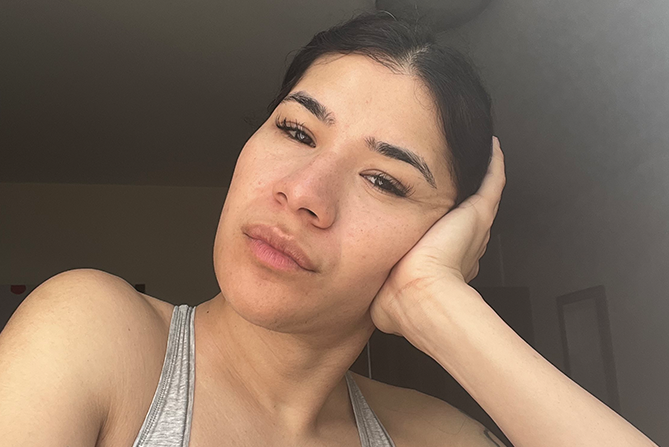
June Bellebono on the pigeonholing of identities, being commissioned on topics other than that which you embody, and Love Island.
PEN Transmissions is English PEN’s magazine for international and translated voices. PEN’s members are the backbone of our work, helping us to support international literature, campaign for writers at risk, and advocate for the freedom to write and read. If you are able, please consider becoming an English PEN member and joining our community of over 1,000 readers and writers. Join now.
On 8 August 2018 – the day after the reunion episode of the fourth season of Love Island – I found myself spending my incredibly quiet shift as a museum library assistant writing a 4418-word Google Doc ranking every contestant from worst to best. I shared it on my socials, as well as on the Love Island subreddit, and received reactions ranging from profound appreciation to serious concern for my wellbeing.
Over the years, my writing has shifted and evolved: I have written about the impact of learning about Burmese trans identities for East Side Voices, about the violence of the LGB Alliance for gal-dem, and about the relationship between my bereavement and queerness for Letters from the Grief Club. I also founded an online platform – oestrogeneration – to highlight transfeminine voices in the UK. I feel pride in knowing I’m producing all this work, and yet that Love Island Google Doc remains one of the pieces I feel proudest of and most passionate about.
Throughout my writing career, I have found that, whether I’m pitching or being commissioned, the focus of my writing always goes back to the identities I hold. They have ended up being my selling point, my USP. As someone who ticks a few of the diversity boxes that allow organisations to feel better about themselves whilst doing little to no uncomfortable work, this is a game I’ve got used to playing. But I feel resentful playing it.
This resentment feels complicated: all the identities I hold do inherently affect the way I navigate the world, the way I think, and, as a consequence, the way I write. I want to discuss my identities because I think they hold power and because they feel inherently political. An existence that challenges the status quo – whether that’s because of a queer, ethnic, class or other identity – has the potential also to disrupt it; that’s why it feels important to promote writing, and art at large, that’s embedded in this existence. What feels frustrating is that, just like white/straight/middle-class/able-bodied/cisgender/etc. people, those of us who hold marginalised identities also go through “mundane” experiences and feelings: we fall in love, we have beautiful friendships and friendship break-ups, we lose people, we hate our jobs, we cry at films, and we get obsessed over Love Island. These aspects of our life affect us emotionally and socially, just like the systemic identities we hold, but our art and creative expression rarely get the chance to delve into them.
When I watch Love Island, the fact that I’m x, y and z inevitably affects the way I watch and perceive the show. On the surface, there’s no reason for me to relate to Megan, Faye or Liam, but I find myself doing so. I find myself relating to the way Megan feels like giving everyone who’s into her a chance, after growing up feeling undesirable. I find myself relating to the way Faye feels paranoid and insecure in her relationship, despite receiving regular validation and affirmation. I find myself, begrudgingly, relating to the way Liam acted like a fuckboy only to then sit in his guilt for days.
My obsession with the show does not feel arbitrary: whilst Love Island presents itself as an apolitical show, politics are central to it. Class, race, sexuality, disability and other socioeconomic characteristics are rarely explicitly discussed, but, deep down, they shape every single interaction. From a working-class contestant feeling anxious about how they’ll be received by a partner’s middle-class mum, to the racialised politics of desirability that ultimately sit at the foundation of the show, Love Island reflects many of the current issues in British society.
Across creative industries, we’re witnessing a heightened demand for “diverse” voices. But what these voices are allowed to discuss feels limited. We might see a Black journalist interview a Top Boy actor, a queer writer publish a think-piece about queer raves, or a disabled activist discuss the latest abhorrent Tory policy, but we will rarely see any of them cover something not directly tied to their identities. The way people with socially dominant characteristics consume marginalised voices is still rooted in voyeurism, rather than relatability. They will appreciate our talent whilst seeing it as less legitimate than theirs, because they don’t think they can empathise with what we’re saying or going through.
The starting point for a true commitment to coalition needs to be one where our humanity is seen in a holistic way, and our voices are seen as worthy in all their facets – not just when discussing topics that we embody.
I recently wrote an article for i about the ways I make sure to celebrate and honour my dead brother on his birthday. One of my trans sisters messaged me, congratulating me on the article, saying how nice it was to ‘see a sis being allowed to put out non-trans-related articles, to remind people that we also experience everyday human problems’. I’m hoping that the next step in the creative industries will allow us to do that more and more: I hope we’ll shift from a movement that pigeonholes “diverse” voices, into one where, instead, we get to speak about all the experiences we go through – including friendships, loss and Love Island.
June Bellebono is a London-based cultural producer, writer, educator – but also a party girl, fashion enthusiast, and lover of friendships. June founded and runs oestrogeneration, an online magazine platform highlighting transfeminine voices in the UK, and founded and hosts Queer Good Grief, a peer support by and for bereaved lgbtq+ people. They have been featured in gal-dem, i, and daikon* and are one of the contributors in anthologies East Side Voices and Letters from the Grief Club.