Tag: Illegal Migration Bill

  • I Did Not Make That Decision Out of Bravery

    I Did Not Make That Decision Out of Bravery

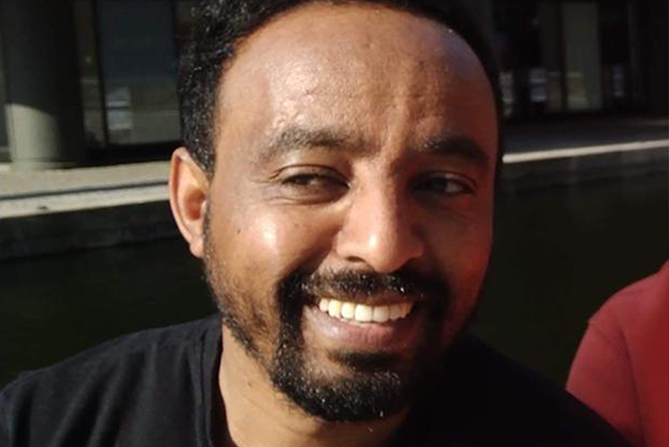
    Awet Fissehaye responds to the proposed ‘Illegal Migration Bill’.

    PEN Transmissions is English PEN’s magazine for international and translated voices. PEN’s members are the backbone of our work, helping us to support international literature, campaign for writers at risk, and advocate for the freedom to write and read. If you are able, please consider becoming an English PEN member and joining our community of over 1,000 readers and writers. Join now.

    This piece is part of a collaboration between English PEN and Counterpoints Arts in response to the UK government’s proposed ‘Illegal Migration Bill’. For this PEN Transmissionsseries, writers have been given an open platform to write an essay in response to the Bill. Counterpoints Arts coordinate Refugee Week, a UK-wide festival celebrating the contributions, creativity and resilience of refugees and people seeking sanctuary. The theme for Refugee Week 2023, taking place 19–25 June, is Compassion.

    ~

    I am sitting in the Art Room at the London Library, facing a big, oblique, off-white glass window. It is the same colour as this Word document, currently blank beyond this sentence, which I plan to fill with words that say something about why and how I ended up in the UK. I am 5,700 kilometres away from my country, Eritrea – or, rather, it is 5,700 kilometres, with no countries you must enter in between, if you fly. It is 8,100 kilometres if you drive, in which case you pass through twelve nations. Or, if you walk, and then get a boat, and then travel by whatever means you can, it is some other distance, some other number of countries.

    I must start like this – oblique, like the window in front of me – because arriving in a foreign land comes at the expense of leaving one’s homeland, and telling the story of that journey means revisiting and reliving its experiences, and, sometimes, these experiences are miserable. So it is hard to for me to go straight into my story of leaving home, of escaping the restrictions of Eritrea, not once, but twice.

    ~

    Through reading books in English, and then studying English literature, I’d become familiar with and, to a great extent, fond of the UK.

    During my teenage years, I’d ask older friends to borrow books from the university library for me – we didn’t have any at school. I cannot claim that I fully grasped what I was reading, and I still can’t, but it helped me familiarise myself with some British writers and their works. They – the Romantic poets, the Victorian novelists, the twentieth-century greats – allured me to the idyllic countryside, and unreservedly allowed me into the socio-political underbellies of the cities and towns.

    In 2002, I joined the English department at the University of Asmara, Eritrea. To my delight, some of the books I’d been reading for fun were included in the course. My then professors, Rathinder N. Bhattacharji and Tej N. Dhar, for whom I have everlasting admiration for their deep-rooted love of literature, reinforced my understanding of writing, unlocking its meaning, essence, sublimity. The more I read Wordsworth, Blake, Shelley, Keats, Owen, Orwell and others, the more I connected to the literary consciousness of Britain. But coming and staying in the UK was not an option for me.

    ~

    I contemplated leaving Eritrea many times between early 2003 and mid-2006, with the wake of the government’s 2001 crackdown on the media growing rather than subsiding. It nagged away at me, this idea, as I became less and less able to tolerate a state in which citizens were denied basic human freedoms, and where those who challenged this could be thrown into one of several hundred secret prisons. For poets and writers like me, it was, and still is, impossible to write, to project one’s views freely in any form of expression in Eritrea. Artists and journalists there face a bitter choice: becoming a propagandist for the government, or fleeing the country with unstained integrity. I went with the second option.

    My then girlfriend of four solid years, Salem, and I agreed that I should leave first, despite initially planning to flee together. We promised each other we would meet again and have a future together. On 7 June 2006, along with my friends Tam and Meron, I set out for Ethiopia, leaving Salem, my family, and my friends behind. We left at night, to avoid being seen by Eritrean soldiers, who would either capture or kill us. After travelling on foot for several hours, we had lost our direction. When the sun rose in the morning, we found ourselves back where we’d started.

    The following night, we again departed. There were a few difficult encounters with hyenas, but they were less dangerous than the soldiers. In the early morning, we arrived in Tigray. A few days later, UNHCR authorities drove us to an isolated refugee camp in Western Tigray. It wasn’t safe: Eritrean secret services had managed to kidnap people from inside. And so Tam and I left for Sudan, while Meron decided to go to Addis Ababa.

    We reached Khartoum penniless. The Sudanese security forces had robbed us along the way.

    ~

    We lived in Khartoum for a year, planning a safe route to Europe. We liked the city and its people, just not the endless exploitation and abuse from the police, and the fear of being deported to Eritrea. Then, in early October 2007, Salem messaged me. Her parents were pressuring her to marry someone else. I called her, and she said that she was devastated – that it wouldn’t have happened if I hadn’t left without her. And so, despite the complexities of getting out of Eritrea, the decision to return was straightforward.

    I met Salem at her workplace the morning I arrived back in Asmara. But I didn’t get the reception I was expecting. I was heartbroken, but still hopeful that she would come to realise I had returned to fulfil my promise to live in love.

    I stayed in Asmara for three weeks. Then, on 9 November, at 11pm, on Harnet Avenue in the centre of the city, towards the end of my friend’s wedding ceremony, four armed government security men appeared and handcuffed me. Harnet, by the way, means ‘liberty’.

    They drove me to Adi Abeto, a notorious prison a few kilometres from the capital. In the morning, they beat me, dragging me along the floor, spitting on my face, pointing a gun at my temple. They asked me why I was back in Eritrea., and I answered pleadingly that I had returned to be with my girlfriend. With my hands and legs tied tightly, they tortured me all day. At 5pm, they moved me to Mai Serwa, a prison that’s no less notorious. I was locked in a shipping container with two others who had already been there for some time.

    During the torture sessions in Mai Serwa, the interrogators read from my diaries. Salem and her mother were arrested for several days, simply for being mentioned in the notebooks. My friend, Tesfalem, was detained for a week – for the same reason, and for trying to discover my whereabouts after the arrest. The interrogators read aloud select passages from my journals that criticised the government. I was told to repent. When I asked them why they wanted me to repent for sins I hadn’t committed, intensified flogging and kicking followed. The torture left me with an enduring injury to my back, which I have suffered with ever since.

    On New Year’s Eve 2007, I was again relocated, to Wia, an underground prison with unbearable heat and inhumane conditions, also known as ‘the Oven’. The number of people confined there fluctuated between 150 and 250. The space was too small to accommodate either figure. We were allowed just one ten-minute break a day, heavily guarded, to relieve ourselves outside. It was the only moment in which we had the chance to connect with the world outside (apart from the occasional visits to our cells from snakes, and the constant residence of rats).

    Once, during my daily break, one of Wordsworth’s poems, ‘The Solitary Reaper’, came to me as I heard a local woman singing in the fields. I echoed a phrase my poetry professor had said in class: ‘How beautiful! This is poetry, my dear!’ This momentary sense of connection reminded me of the power of literature, of its transcendence. The poem stayed with me for months. I would repeat it, in my heart, and then out loud to my fellow inmates.

    ~

    I was released in January 2009. I rejoined my family and friends, but the hope of rekindling the relationship with Salem had moved out of reach.

    By 2013, I had got a job opportunity as a stringer for VOA, covering Eritrea. To get licenced, I had to submit my credentials to the Ministry of Information. To the Eritrean government, ‘Credentials’ means submissiveness. Three directors-general and two subordinates asked if I was ready to present a good image of the government to the world. I replied that I would abide by VOA’s tenets: accuracy, balance, comprehensiveness, and objectivity. They were unhappy with that answer.

    So, in October 2014, I again left Eritrea for Sudan. In Khartoum, I received intense medical treatment for my back injury. After seven months, I was ready to go to Europe, via the Sahara Desert and the Mediterranean Sea.

    I did not make that decision out of bravery. I did not take that decision lightly. I made it in desperation. I decided to throw myself into 9,200,000 square kilometres of desert and 2,510,000 square kilometres of water. I knew relatives and friends who had died, beheaded in the desert or drowned in the Sea. I had heard enough tragic stories of lives cut short in desperate journeys towards safety. I knew I had no guarantee that my fate would be different, that I would safely reach a destination. Because, who gives much thought to a destination when imminent danger looms at the origin? Because, a quick escape is more important than a safe arrival for a desperate refugee.

    ~

    On 5 June 2015, we boarded a lorry and set off for the Sahara. At first, there were 56 of us; we joined another three lorries en route, and the number grew to around 200. Our Sudanese smugglers handed us over to their Libyan counterparts at the border, who beat us with whatever was in their hands and rushed us to board Land Cruiser pickups, packing the vehicles with twice the number of people they could safely accommodate. For those of us hanging on the edges of the truck beds, three quarters of our bodies were outside their walls. People would fall out, and we would bang the roof of the cab, and the smugglers would reluctantly stop to collect the fallers. Then, they told us stop letting them know. When a 5-year-old boy became extremely sick, and we had no option but to do so, the driver shouted back in Arabic, ‘Khaliyu Yemut’ – ‘Leave him to die’. The convoy stopped just three times after that, at three burial sites: a warning not to get sick or fall.

    I’d had no doubt it was going to be a godless journey. No one had promised us a promised land. No Moses was mandated to lead us in the desert, or divide the Mediterranean waters in two. I hadn’t expected a smooth journey, because the smugglers we relied on to lead us to safety were just the modern pharaohs from whom we were running, but wearing different guises. I hadn’t any illusion that our thirst would be quenched in the desert, or our hunger sated in the sea that had fed on the corpses of our brothers and sisters.

    Hundreds of thousands of people and animals have set their feet on the Sahara over the centuries. But the desert never fails to hide the traces of routes travelled. Footprints, hoofprints, pawprints left behind by the striding limbs of creatures disappear on the vast dunes. The desert is incredibly good at keeping its secrets. These days, I watch – and enjoy – David Attenborough’s spectacular documentaries on the Sahara from the comfort of my home. And then I remember being in the desert, famished, dehydrated, starved, weak and humiliated, and the Sahara becomes what it is to refugees: pitiless nature’s punishing instrument.

    After a day and a night, we reached Ajdabiya, the first stop on the smuggling route to Tripoli. We were locked in a small room for two days, with no access to food or toilets. We were told that asking for either would bring our lives to an end. So we waited in patience.

    We were finally boarded onto Isuzu pickups and started the next leg of the journey, to Bani Waled, which we reached after a week. It should have been a quicker trip, but we had to take a long route around the IS-controlled area. We stayed in Bani Walid for five days, while the smugglers arranged for two trucks to be loaded with bricks, and for us to be hidden between them. Then, the moment we entered Tripoli, a militia group stopped the vehicles and found us inside.

    ~

    They kept us for four and a half months. We were locked inside a compound where, deprived of food, water, hygiene and medicine, disease thrived. I was infected with scabies. I remember vigorously scratching, rubbing, and squeezing my privates to alleviate the excruciating itch. The relief never lasted, yielding to broken skin and pain when urinating.

    The group sold us to an Eritrean smuggler, who boarded 350 of us – Eritreans and Somalis – onto a small, unseaworthy boat. It was built to carry 150 people and, to save space, we were denied life jackets. After only a few hours at sea, smoke began billowing from below. Those suffocating in the hull strove to reach the upper deck, but found it crowded with women, children and the infirm. Chaos reigned when the engine stopped and water started to leak in. But two defiant comrades managed to fix the engine, and we continued sailing into international waters. There, a Spanish warship rescued us.

    ~

    In January 2016, I arrived in the UK on the back of a lorry, dishevelled, wearing layers of dirty clothes, my shoes caked in thick French mud. Exhausted and hungry, I went to a McDonald’s in Cannock, armed with six one-euro coins. When the cashier said that they didn’t accept euros, a woman who overheard came forward and bought me food and drink, and gave me three one-pound coins. A taxi driver named Abdu gave me a ten-pound note and bought me a train ticket to Birmingham. At Birmingham New Street, I approached two Eritrean women. Hoping to get to London, and see Tam in for the first time in eight years, I asked them to help me use the ticket machine. They looked at me – at my dishevelled appearance, and my muddy shoes, and my dirty clothes – and asked me if I had just arrived. I said yes.

    They hugged me. They told me how glad they were that I had arrived safely. Dehab, whose train was to leave in a few minutes, gave me a twenty-pound note and left. Elsa took me to Primark and bought me clothes that cost sixty pounds. Instead of going to London, I was advised to seek asylum in Birmingham, and so I did. Tesfit Yohannes, another friend, offered me a warm reception in his house for nearly a month.

    Later, in February, I travelled to London and reunited with Tam. I visited Westminster Bridge in honour of Wordsworth’s famous sonnet, one of my favourite poems from university classes, curious to see if being at the actual spot could offer the splendid view of London’s natural beauty that the Romantic poet promised.

    ~

    Arriving in the UK was not a panacea. The hardships and torture remained engraved in my mind. These things do not fade quickly from memory: human bodies being used to put out cigarettes, heads being cleaved with spades or AK-47 muzzles, threads of maggots dropping from neglected wounds. Every time I heard fireworks, I panicked, and the scarred, mottled skin around my groin constantly reminded me of the pain I had endured. All the while, Eritreans’ asylum claims were in collective limbo, because of the Home Office’s use of a profoundly flawed Danish report suggesting that Eritrean asylum seekers could safely return to the country. Eventually, the political motive was reversed when the tribunals found in favour of the Eritreans.

    Now, six and half years after I was granted refugee status in the UK, it pains me to see refugees who have recently crossed the channel, hoping to have found light at the end of the tunnel, being threatened with ‘removal to their home country or a safe third country’. For most refugees, these two options are not, in fact, options. Eritreans cannot return home. And Rwanda, the UK’s ally in this scheme, has repeatedly failed to be a safe third country for Eritrean migrants deported from Israel, who found themselves dropped into the hands of smugglers and into slavery.  

    Suella Braverman’s ‘dream’ and ‘obsession’ with ‘stopping the boats’ and deportingasylum seekers to Rwanda scares me more than Katie Hopkins’s 2015 article, about wanting to use gunships to stop migrants crossing the Mediterranean. Hopkins’s xenophobia was straightforward. It came from a private citizen. But the Home Secretary’s anti-migrant sentiments are slightly subtler, more insidious. And, coming from a person holding ministerial power, much more dangerous.

    ~

    The etymology of ‘oblique’ is unclear; it’s moved across too many languages, too many regions. We know it comes from the Latin ‘oblīquus’, but we’re not sure exactly what that word’s history is. Most people think it comes from a Proto-Indo-European word, which had a meaning that meant something like ‘to move’.

    There are 1.3 kilometres between the London Library and the Home Office. Or 2.4 kilometres if you drive, or 1.8 kilometres if you walk. You do not have to take a boat. I hope this story can find its way there.


    Awet Fissehaye is a poet, writer, and lyricist born and raised in Eritrea. A lover of English literature and a firm believer in the power of words, he started to write poetry at an early age before studying English at the University of Asmara-Eritrea. He was the first recipient of the National Poetry Prize for Students in 2000. In 2007, he was arrested by Eritrean government security forces, tortured, and kept in inhumane conditions for 14 months. In 2014, Awet left Eritrea for Sudan before continuing toward Europe through the Sahara and the Mediterranean. Awet is an Honorary Member of English PEN and in 2022 he became Executive Director of PEN Eritrea in Exile. He has lived in exile in the UK since 2016.
  • Changing Tides

    Changing Tides

    Bidisha Mamata responds to the proposed ‘Illegal Migration Bill’.

    PEN Transmissions is English PEN’s magazine for international and translated voices. PEN’s members are the backbone of our work, helping us to support international literature, campaign for writers at risk, and advocate for the freedom to write and read. If you are able, please consider becoming an English PEN member and joining our community of over 1,000 readers and writers. Join now.

    This piece is part of a collaboration between English PEN and Counterpoints Arts in response to the UK government’s proposed ‘Illegal Migration Bill’. For this PEN Transmissions series, writers have been given an open platform to write an essay in response to the Bill. Counterpoints Arts coordinate Refugee Week, a UK-wide festival celebrating the contributions, creativity and resilience of refugees and people seeking sanctuary. The theme for Refugee Week 2023, taking place 19–25 June, is Compassion.

    ~

    I began doing outreach work with asylum seekers and refugees eleven years ago, visiting charities across London to give writing, critical-thinking and performance workshops. These were set up in partnership with English PEN, which then, as now, did the important work of connecting the world of literature and its creative writers with vital issues around human rights, social justice, liberty, and freedom from violence. In under-resourced, unheated rooms, fuelled by PJ Tips and photocopied printouts of plays and poetry, we remade the world as we wished to see it: equal, diverse, collaborative, considerate.

    The work was eye-opening and lifechanging for me. It led to my fifth book – Asylum and Exile: Hidden Voices – and to greater depth and new dimensions in my human rights work and political analysis. Here were people from all over the world – Iran, Cameroon, Afghanistan, Congo, more – gathered in one of the most multicultural capitals in the world, not gibbering with misery but full of determination, resourcefulness, humour and hope. It always jarred when I went from these laughter-filled workshops with people who’d survived torture, to a publishing party or art opening attended by exclusionary, po-faced characters who took themselves way too seriously.

    For my students, I wonder if this kind of outreach work was quite so transformative or positive. Gatherings like ours were certainly creative, enjoyable and safe – a respite from the grind of trying to regularise status, establish an existence with some structure and dignity, build a life, gain some rights and a foothold in an asylum system designed to drive people to despair and force them to drop out, to psychologically torture them. The workshops were a rare space free from cruelty, punishment or judgement. But have we changed the treatment of asylum seekers and refugees for the better? Have attitudes improved? Policies? Headlines? No, they are all worse. The political environment is so much bleaker. Xenophobic, insular, rebarbative notions of national identity have been normalised; a backlash against multiculturalism has thrived; anti-democratic, jingoistic, authoritarian dictatorships have risen globally; mainstream political discourse has been polluted by ideas which were once seen as the preserve of the racist far right. Trump and Brexit are the least of it – it’s happening all over the world.

    I have also become wary of the bourgeois creative economy that has sprung up around the refugee crisis and its humanitarian emergency – the endless do-gooding artistic works (movies! graphic novels! albums! live interactive theatre!) that focus on trauma narratives, giving a voice to the voiceless (a phrase I am certainly guilty of using) and otherwise enabling an entire class of privileged and ambitious arts, cultural, media and political players and dilettantes to make their careers off the backs of other people’s suffering. There is so often deep patronage, power-play and a sense of superiority and smugness at its heart.

    I remember speaking at a human rights conference a few years ago, just before the pandemic. The organisers were very careful to counsel speakers not to use aggressive phrases (like ‘hammer home the message’) because they might be triggering for people who had survived violence. But there were no survivors, asylum seekers or refugees in the audience; there were only local charity workers. The sessions in which these white charity workers talked about their courses for refugees – art therapy, cookery, yoga and massage – were packed. But the session I chaired, entitled ‘Educating Our Allies’, was nearly empty. The session was billed as ‘a conversation challenging the one-dimensional and often victimising representations of refugees and asylum seekers […] aimed at examining power and privilege and how they play out in the humanitarian and charity sectors […]  about teaching allies (the audience) how to be better in our approaches’.

    What a joke. For that one session, the delegates, 95% of whom were white, all, as one, got up and went to the café, to make the young non-white woman working there make and serve them coffee. They thought they knew it all about how to be good allies, so they vacated the room despite the four non-white experts on the stage. They were comfortable seeing refugees and asylum seekers as abject victims, nameless and faceless sufferers, craven and grateful recipients, pets to be fed, but they could not sit for just forty minutes, listen respectfully to, humbly hear and learn from, refugees, asylum seekers or indeed any of the non-white people on the panel. That said it all.

    The overt, go-home racism of the right, or the belittling, patronising, self-regarding racism of those who see themselves as liberals: what a choice for the twenty-first century. I can say from experience that micro-aggressions – a depressing euphemism for the casual and obvious disrespect, dismissal, insults, ignorance, negative and demeaning assumptions, degrading stereotypes and bad treatment meted out to non-white people – have increased a millionfold since 2016. Now, they occur daily. It is all just the same racial profiling, singling out and targeting, only in a liberal, progressive guise – like a ‘nice’ rendering of a Home Office interview. There are constant racially targeted questions and biases in interactions with strangers in a workplace setting, and there’s the seemingly universal requirement for people of colour to talk to white interlocutors and audiences about – only about – race, identity, diversity, heritage, homeland and belonging. The underlying drive is always to let you know that you are different, of lower value, alien, other, worse; that you are not the norm and will never belong. Or that you are a fascinating, exotic novelty, a trinket from a magical place, a source of scintillating detail to make white people feel richly cosmopolitan and spice up their lives.

    But for all own my moments of discomfort, refugees and asylum seekers are represented, talked about and treated with outright sadism and inhumanity. This has become so much the norm that, post-pandemic, it no longer dominates the headlines, instead occupying marginal news reports about ‘small boats’ and ‘migrant crossings’, euphemisms which elide the terror, danger, urgency and desperation of such journeys and any questions about why human beings would be driven to undertake them.  

    From the dysfunctional, fear-driven vantage point of 2023, 2012 feels at once very recent and a lifetime ago. But the factors that force people to leave their homes are unchanged from all the centuries past: poverty, war, post-war fragility, a lack of opportunity, persecution, the threat of violence, no future fit for a human being. In other words, reasons that would prompt any person to leave one place and go somewhere else. Those reasons have been joined now by climate change, by invasions and the long tails of flawed invasions, failed uprisings, factional fighting and societal breakdown. The endless churn of human suffering will produce refugees in perpetuity, and yet the reaction to this sadly universal and timeless dynamic is one of hostility, disgust and cruelty, especially when the refugees are not white. When your government is shamelessly touting sending refugees to Rwanda, or piling them up in shipping containers and empty office blocks, you’ve lost all sense of normal human decency – but so has anyone, any party or newspaper, which fails to challenge you. The old multi-polar political spectrum, with its economic and social lefts, rights and centre, is being warped by a toxic magnet in which all debates, all arguments, all methods, all values are being pulled to the far right. The old fringes are the centre; the old centre is gone.

    In many ways, that early period of my work with refugees, from 2012 until 2015, at least contained the possibility that things might change and issues were at least up for discussion. People could be of two minds about complex issues and there was a chance that things might get better.

    It was Theresa May who coined the term ‘hostile environment’ in her role as Home Secretary, a chilling clue as to what was to come: a deliberate strategy of state-endorsed sadistic deterrence taken on with full fervour by not one but two further Home Secretaries. (Hello Suella, hello Priti. So embarrassing, these racist women of colour doing the colonial masters’ jobs for them, thinking that kicking down onto whoever’s beneath them might protect them from the racism of their own white peers, instead of realising that they’re just being used and will be discarded when the job is done and Make Britain White Again is put into play.) But during that period, moving away from the headlines and Parliament, there were also dozens of civil society groups, charities, grassroots organisations and local enterprises that did not feel as Theresa May did. The debate around asylum and exile, flight and forced migration, safety and haven contained nuance, detail, and fact. Public discourse had not yet descended into the vicious, counterfactual, sloganeering mess that it is now – one which repels reasonable commentators altogether. ‘Debate’ back and forth, and get interrupted and shouted down by a basic racist on GB News, or even one of the respected channels? Why would anyone do that to themselves?

    We are in danger of a hopelessness – a numb fatalism – setting in, because almost nobody is standing up for refugees and asylum seekers openly in the mainstream of politics, the media, public life and civil society. Where are those bold, accepted, reasonable voices speaking up together, above the grassroots level? Where are the big beasts, the no-nonsense decent figures? Surely they are not too cowed, too frightened by the actual, literal, torch-bearing Nazis to stick up for what is right? There is a failure of normal human consideration and empathy, of basic decency and recognition. What is everyone waiting for? We could change things in small ways for the better, right now, just by speaking and behaving differently towards others. Is everything and everyone – at every point on the political scale – waiting numbly to get to crisis point and total social breakdown before we start to rebuild? I don’t want to wait for some scorched-earth, tabula rasa, final cataclysm before we begin to entertain the possibility that we can – we must – create a kinder world.


    Bidisha Mamata is a broadcaster, journalist and presenter specialising in political analysis, international relations and human rights. She writes for the Observer and the Guardian and works for BBC TV and radio, ITN, CNN, Channel 5 and Sky News. Her fifth book, Asylum and Exile: Hidden Voices (2015), is based on her outreach work in UK prisons, refugee charities and detention centres and her latest publication is called The Future of Serious Art (2020). As an artist she creates films and stills. Her first short film, ‘An Impossible Poison’ (2017), was selected for multiple international film festivals and her next film series, Aurora, ran from 2020–2023.

    Photo credit: Suki Dhanda

  • There’s No Such Thing as an “Illegal Refugee”: A Conversation with Gulwali Passarlay

    There’s No Such Thing as an “Illegal Refugee”: A Conversation with Gulwali Passarlay

    Gulwali Passarlay responds to the proposed ‘Illegal Migration Bill’.

    PEN Transmissions is English PEN’s magazine for international and translated voices. PEN’s members are the backbone of our work, helping us to support international literature, campaign for writers at risk, and advocate for the freedom to write and read. If you are able, please consider becoming an English PEN member and joining our community of over 1,000 readers and writers. Join now.

    This piece is part of a collaboration between English PEN and Counterpoints Arts in response to the UK government’s proposed ‘Illegal Migration Bill’. For this PEN Transmissions series, writers have been given an open platform to respond to the Bill. Counterpoints Arts coordinate Refugee Week, a UK-wide festival celebrating the contributions, creativity and resilience of refugees and people seeking sanctuary. The theme for Refugee Week 2023, taking place 19–25 June, is Compassion.

    ~

    I won’t start by asking about your journey to the UK – partly because you’ve written and spoken about it at such length and so compellingly elsewhere, but also because that story can’t be shrunk into this little space; no story of refuge and displacement can. I want instead to ask: how far away, now, do you feel from that journey?

    I appreciate you not wanting to start with my story, because people always want to start with my story – and it becomes frustrating, boring. Somehow, I’ve become a public speaker – a storyteller – and so I tell the story of my journey, particularly in schools, because I want the debate about migration to be humanised. But what I really like doing is having a conversation around my story, as we’re doing now.

    Your question is a very good one. It’s been over fifteen years since I came to the UK. Sometimes, I’m very attached to that journey; sometimes, if feels very far away. When I hear tragedies in the news – of people drowned in the Channel, or the Mediterranean – they are very personal to me. They are very close. And so, reading about others’ journeys, mine cannot leave me.

    I wrote a book about my story (it’s 120,000 words and, as you say, you can’t condense that into a minute or two) which was published eight years ago. I wish it weren’t relevant anymore. But things are getting worse. At the moment, one of the things I’m doing is working with Afghans staying in temporary accommodation in the UK who are waiting for their claims to be heard. I try to provide assurance and encouragement. But I am frustrated and I am angry.

    I was scrolling through your Twitter feed, and what you say about the news cycle being so recurring and intimate to you is reflected there; it’s like scrolling around, rather than down.

    It’s incredibly frustrating. What happened to me fifteen years ago is happening now, but it’s even worse. When I came, I was criminalised and penalised and treated as a suspect, because of a culture of disbelief and hostility. But now it’s not culture, it is law: it’s the law of the land to criminalise.

    Yesterday, I saw a friend who lives in Leicester, who came to the UK with me in 2007. We travelled from Rome to Paris together. He made it to the UK, and as soon as he arrived, he was age-disputed and put in a detention centre, ready to be deported to Afghanistan. Lawyers and doctors intervened and proved that he was 15, and he was instead fostered. But when he turned 18, his leave to remain was refused. For eight years we fought his case. And then, in 2016, he was forcibly removed to Kabul. His life, all that opportunity – wasted. He couldn’t live in Afghanistan, and so he did it all again, ending up in Greece. There was still no life for him there; no opportunity to work, and his wife wasn’t permitted to join him. Then, in 2021, as Kabul was falling, he realised that the UK was evacuating people and he thought, You know, I have a chance here. Because the UK has done a lot wrong to me. And now is the time they make the wrongs right and provide some justice. He made it to the UK. But rather than getting justice, he was imprisoned for twelve months for “illegal entry”. He’s now on probation. The idea of probation is that you don’t commit a crime again – what crime would he commit? What crime has he committed?

    There’s no such thing as an “illegal refugee”. The Refugee Convention and international humanitarian laws are very clear: you should not penalise people based on how they enter. And yes, though I’m talking to you now, if I had arrived this year, the way I did in 2007, I wouldn’t be: I would be “a criminal”.

    The Nationality and Borders Act – and the proposed Illegal Migration Bill – create a two-tiered system: if you come via irregular means, you are a criminal; if you come via resettlement schemes, you are a good immigrant. I am so pleased that there are routes and schemes that mean Ukrainians and Hongkongers can be resettled in the UK. But that’s not available to others – to my friend, to those whose journeys are like mine. I met my MP on Refugee Day last year. I was outside Parliament, protesting the Act. I know that he has a copy of my book; he bought it, and I signed it for him. I asked him, ‘Why did you vote for this Bill?’ and he said ‘This is what the people in the constituency want. This will solve the problem’. I replied: ‘Look, in five years, Ukrainians will be in the exact same situation as other refugees. We’ll be having the same conversation, and the situation will be even worse. People will be in limbo. We will have detention centres full of asylum seekers, prisons full of asylum seekers, military bases full of asylum seekers. There will still be no solution, let alone a humane solution’.

    We normally get around 30,000 asylum applications a year. France get 100,000, and Germany 170,000. I listened to the German Ambassador speaking recently, and he said ‘We process more asylum claims in a month than the UK does in a year’. The idea that people should stay in France is absurd; it’s not how the international protection system works. There’s nothing in the law that says refugees should stay in the “first safe country”, and yet the vast majority do – Afghans in Pakistan and Iran; Somalis in Kenya. The attitude the UK policy and its narrative have is one of exceptionalism – of excluding the UK from international duties. Last year, about 250,000 Hongkongers came as “guests” to the UK, and around the same number of Ukrainians. But those 30,000 asylum applications? Those are “the swarm”, “the invasion”.

    I heard the Minister of State for Immigration say the reason we’re not processing asylum claims more quickly is because it would give the impression that more people should come. (People sometimes even tell me that I shouldn’t share my story, because it is a story of ‘success’, and it will encourage more people to come. In 2016 I went to Calais and met refugees and told them to keep hope, not to feel powerless, and the BBC reported that I was encouraging people to risk crossing the Channel and come to the UK.) So keeping people in limbo is the way to go, they think. That’s why 170,000 people are in backlog, why we have 100,000 people staying in hotels at a cost of £5m: because the government wants us to be angry that our taxpayer money is being spent like this; instead of being angry with the government and its incompetent systems, its austerity and its policies, to be angry with the refugees.

    You mentioned earlier your friend being age-disputed, and you’ve spoken elsewhere about your experience of this – of the dehumanising immediate effect of it, and the pernicious resultant effect: you were 13, but flatly told instead you were 16; at the time, refugees were not afforded the legal rights of children, including the rights to education and to care, if they were 16 or older. The proposed Illegal Migration Bill strips the rights of unaccompanied minors even further. Could you talk about your response to that?

    This is fundamentally about the presumption that asylum seekers are lying. And it’s, as you say, politically influenced, by the rights that minors currently have to be afforded. But the intentions of the Illegal Migration Bill go further: the government don’t want to give the impression that they’re soft, because giving rights to unaccompanied minors would, supposedly, encourage more to come. It’s about giving no room for speculation about who might get “better treatment”. It’s heart-breaking. They want to make it harder for families, for children, for women. We talk about opposing the Taliban for not respecting women’s rights or children’s rights, and yet we do this?

    I’ll tell you a short story. I helped a friend – a young man from Afghanistan – with his age dispute. He was living in Newham. He was happy: he was playing cricket, he was registered with a doctor, he was living with a nice foster family. Then the Home Office sent him a letter saying that he looked over 25, and so the social services needed to carry out an age assessment. I read the text of that assessment; it was terrible, inadequate. It said he was over 18, and so he was stripped of his rights, sent to Whitfield and then to Middlesborough. This was right at the start of the Covid-19 pandemic, and I was stranded in Denmark. I managed to stay in contact with him, and he told me he had lost all hope – that he wanted to run away, or commit suicide. I said ‘No, don’t do anything stupid. Wait for me to come’. I finally managed to see him in person six months later. He had lost so much weight that I could hug him with one arm. I called Newham and said this was a safeguarding issue. They said, ‘Oh, we don’t know him. He’s not in our area’. I said ‘Well you must know him. You kicked him out. You didn’t want him to be your problem’. They said that he’d have only had a right to appeal the age assessment within three months. This was during the lockdowns: he had no idea what he had to do, and had been cut off from advice. We fought it, and fought it, and he had a proper assessment which found that he was, even after all this time, only 15. Only then was he finally given a new foster placement, and put into school. And he’s doing so well, now. But there are so many people in his situation, who don’t know what to do, or how to challenge the injustice. With the new Bill, things will only get worse.

    As you talk about that injustice, and that process, I think of a phrase from a piece you wrote in the Guardian years ago. There, you say that you felt the immigration officials you encountered were ‘worse than the smugglers’, who ‘had been heartless, but […] hadn’t tried to change [your] identity’. It’s such an arresting sentence. Current policies are ostensibly about targeting smugglers, giving greater powers to immigration officials in an effort to achieve this. But data shows us that these policies fail to reduce trafficking. What are your thoughts on that?

    That’s a really good point. If I was a smuggler right now, I’d be very happy with the way the UK government is doing things. For the last few years, we’ve been getting 30,000 asylum applications. When the government started discussing the Rwanda plan and the Nationality and Borders Bill, that went up to 45,000. Now, as they discuss even more inhumane policies, it has risen to 65,000. These policies don’t – won’t – stop smuggling; they just make it more dangerous. Before too long, we’ll start seeing boats travelling even greater distances – they’ll be launched from Denmark, the Netherlands, Belgium. Because, however much the government tries to override international law and convention, if you arrive on a boat, and no one finds out, the authorities will have no evidence of you not arriving through “safe and legal routes”. All these policies do is put people in greater danger in the busiest shipping lanes in the world. The only way we can get smugglers out of businesses is to provide safer routes, humanitarian corridors; to make it easier for people to come here and claim asylum and, then, with a proper system, to deal with those claims accordingly.

    As long as there aren’t safe, humane routes for migration, smugglers will thrive, because people will still need to migrate, and will do so through whatever channels they can. And traffickers will thrive, too. Smuggling and trafficking are two different things. The smugglers didn’t come to me, you know. I went to them.

    My final question is about stories and writing. You write stories, you tell them. How important are they – writing them, reading them, telling them, hearing them, sharing them – in working for justice and change?

    There are countries where books and stories are banned, where people are not able to read or write what they want to read and write. In Afghanistan, right now, I would not be able to express my views; in the UK, I’m able to. And that is invaluable. Because stories change people’s minds.

    My book has given me the chance to visit twenty countries. It has given me the chance to speak to you. I always encourage asylum seekers to read and write – not least because it’s the best way to learn English. But also because stories humanise. You are only hostile to refugees if you haven’t met one, spoken to one, heard their stories, read their stories. And I can guarantee you that, however on the right you are, if you read stories like mine, or those of my fellow refugees, they will, to some degree, change your views. You might not say so openly, but they will change you. Stories challenge you in a non-threatening way; they challenge your bias, they make you open-minded.

    This proposed legislation is dangerous. And it flies against our moral duty. We need a system based on human rights, based on compassion, based on the rule of law, based on humanitarian values. The government is scapegoating refugees for its failures, and there are things we can do individually and collectively to challenge that. We have the facts and figures, but they are not sufficient; the challenge needs to be about emotion, and stories, and lives. Otherwise, my friend, who is living with his tag and waiting for the government to make its decision, will, wrongly, be called a criminal. Perhaps he will be the first person on the plane to Rwanda.


    Gulwali Passarlay is an author, advocate, humanitarian and spokesperson for refugees and asylum seekers across the UK and Europe. He arrived in the UK in 2007, after being forced to leave Afghanistan at the age of 12. He is a member of the Afghan Refugee Expert Network in Europe (ARENE), and author of the bestselling memoir The Lightless Sky.

    Interview by Will Forrester, Editor.

  • It’s More Complicated Than That…

    It’s More Complicated Than That…

    Dina Nayeri responds to the proposed ‘Illegal Migration Bill’.

    PEN Transmissions is English PEN’s magazine for international and translated voices. PEN’s members are the backbone of our work, helping us to support international literature, campaign for writers at risk, and advocate for the freedom to write and read. If you are able, please consider becoming an English PEN member and joining our community of over 1,000 readers and writers. Join now.

    This piece is part of a collaboration between English PEN and Counterpoints Arts in response to the UK government’s proposed ‘Illegal Migration Bill’. For this PEN Transmissions series, writers have been given an open platform to write an essay in response to the Bill. Counterpoints Arts coordinate Refugee Week, a UK-wide festival celebrating the contributions, creativity and resilience of refugees and people seeking sanctuary. The theme for Refugee Week 2023, taking place 19–25 June, is Compassion.

    ~

    Often at turbulent times I wonder, am I being too simple? At university I loved philosophy and literature. I loved moral dilemmas – the difficult calculus between two imperfect outcomes. Ultimately, I liked making choices, rather than stumbling into them. But my business and law friends would say the world is much too complex for idealism: full of uncomfortable trade-offs, urgent side-tracks, costly surprises, and shortages of time, money, and information. And they were partly right. To have impact, I grew convinced, one must be mired in the practical. Roll up your sleeves, dig deep, identify every logistical hurdle. So, I bought a black suit and studied economics and business for the next decade. But nowadays I think: is it right for our leaders to be so neck-deep in sticky trade-offs that no one is thinking about the larger picture at all, the universal human ideals on which we built our societies?

    I believe that most people don’t wade into serious debate because they trust others (whom they mistake for smarter) to tell them what to think. They feel unequipped to tackle the complexities, embarrassed about asking big, obvious questions.

    But I like big, obvious questions, and this isn’t an essay about the complexities.

    As I write this, the UK is debating the proposed ‘Illegal Migration Bill’. Anyone who arrives in the UK by a route deemed illegal, including those crossing the Channel in a small boat, will have their claim deemed inadmissible. They will be returned to their country or to a ‘safe third country’. They will be banned from ever claiming UK asylum. They will be denied access to the UK’s modern slavery protections. They will be shut out of the asylum system – no matter what forced them into that boat. And, since one cannot claim asylum unless physically present in the UK, and since the UK is an island, then no person in danger can flee into the UK planning to claim asylum. They must be recognised a refugee before arriving, have family or a sponsor in the UK, or be from specific countries that are part of existing UK resettlement schemes, such as Ukraine or Hong Kong.

    To my simple mind, this means that the UK has closed access to asylum: you can no longer arrive in the country by the means you deem safest for you (as the Refugee Convention intended), tell your story, and beg refuge from a compassionate government. And it means that the UK can bar asylum seekers in ways that countries bordering places of conflict can’t – which means that those countries, who are poorer than the UK, must take on a disproportionate share of the displaced.

    I think about the 1951 Refugee Convention. Do I properly understand it? I know that, in this agreement, the UK committed to protecting the rights of those seeking asylum, to housing and educating them, to providing them opportunities to work, and to honouring the principle of non-refoulement (not sending people back into danger). In the Refugee Convention, the UK promised this:

    Refugees unlawfully in the country of refuge

    The Contracting States shall not impose penalties, on account of their illegal entry of presence, on refugees who, coming directly from a territory where their life or freedom was threatened, . . . enter or are present in the territory without authorisation, provided they present themselves without delay to the authorities and show good cause for their illegal entry or presence.

    I interpret those words first as: There is no ‘illegal entry’ if a refugee immediately claims asylum. They are not to be denied refuge as a penalty for their path.

    Then I try to read this through the lens of a hostile UK politician, someone whose only goal is to keep people out. I close my eyes and imagine Suella Braverman’s laughter as she poses in front of facilities in Kigali being built to house deported asylum seekers. I open my eyes and I read again.

    Ah, now I see where they found their loophole. The phrase ‘come directly’. This must mean that the promise is limited to the first country on whose soil the displaced set foot – probably a fair allocation of newcomers in 1951, when you could stow away on ships and enter a coastal country before facing its immigration officers. Not so fair in 2023, when you can’t get on a plane without a passport, and your only escape is into a bordering country.

    Nowadays, strict adherence to ‘directly’, protects the faraway countries.

    I wonder if, at the gathering of the signers of the Refugee Convention, the countries situated farther from the atrocities were quietly scheming about that loophole. Did they plan one day to use it to offload their responsibility onto others? I don’t think they were; I don’t think they did. In the previous decade, refugees had fled Hitler’s atrocities from all over Europe. No one was untouched by war, and no one was protected by that word ‘directly’.

    Then I think about fairness.

    Is it fair for an island nation to shirk its share of the responsibility? What if that island nation is one of the rich ones? What if that island nation has a long history of imperialist consumption: invading, and taking, and enslaving, and pillaging, enriching generations of its children through the chaos it has left across its so-called commonwealth (I think of the origins of ‘commonwealth’: the wellbeing of many).

    I keep reading the 1951 Refugee Convention and I think about that bedrock principle, nonrefoulement – not sending people back into danger – and how the technical definition of refugee has been used to do precisely that: send people back into danger. A ‘refugee’, according to the Convention, is someone who has ‘a well-founded fear of being persecuted for reasons of race, religion, nationality, membership of a particular social group or political opinion’. Written in the wake of the Holocaust, what could the framers of this document have meant by ‘membership in a particular social group’? Humanitarian lawyers argue that they meant to write a phrase that covered all future threats to life and safety. They didn’t know what horrors the world would face next, and so they created a category that covered everything else (‘social group’ being the broadest term one could come up with in a legal document). But the lawyers for strident gatekeepers have made all kinds of arguments, in the US and across Europe, to limit the definition of ‘social group’. It can’t include women. It can’t include abused women, it can’t include families, and so forth.

    Fortunes have been wasted on arguing such legal details, so that governments can say ‘Yes, we believe you are in danger but not in the right kind of danger. So refoulement doesn’t apply here. Your death is on you, not on us’. And yet, one wonders, has anyone considered what the authors of the Refugee Convention meant to promise? Or their fear after the genocide that Europe had just endured? That’s too simplistic, the lawyers argue, and so they keep parsing the language, with the hope of expelling one more abused mother.

    Often at this point, my simple mind goes to Rawls’s notion of the ‘original position’. It’s a thought exercise so rooted in the imagination that it’s silly to argue over its impossibility – it’s a fantasy. Imagine, Rawls asks, that you could create the systems and structures of the world, and allocate all its resources, before you knew which body you’d be born into. What kind of a world would you create? 

    I’d look at the statistics and think, I’ll probably be a wage-earning labourer my whole life. I’ll probably live in Asia. I’ll be poor, struggling with income insecurity, food insecurity. At some point in my life, I might be displaced.

    Knowing this, I would tax the rich heavily on income and capital gains (leaving enough to give talented people incentive to strive – though I believe they would anyway. Still, my original position society wouldn’t be fully socialist). I’d take inherited wealth above a certain threshold (leaving the rich a few houses, a few boats – nothing grotesque: you can’t own an island or ten planes) and use it to end world hunger. I’d allow asylum seekers to work. I’d make borders easier to cross. If you’re about to scoff about resources and economic externalities and how this plan might affect the middle class, remember that, in the original position, nobody is middle class or British or highly educated or unusually talented. In this thought exercise, we look to the median to guess our situation. In the original position, we are all (most likely) a bicycle messenger or a farmer in rural Asia. Half the world lives on five or six dollars a day, and so there’s a 50% chance of earning below even that.

    From the original position, I would see clearly that the hands greedily dipping into the communal pot belong to the rich, not to refugees. That the wealthy are consuming my labour, while goading me to fight for that privilege with those in more wretched positions: Look, they say, the refugees are taking your jobs.

    But we don’t think about original positions much outside our philosophy classrooms or children’s books. Because it’s too simple. Because, after all, our leaders aren’t in the original position. They have interests: elections to win, friends to enrich, wealth to protect. They want to be seen as the strongmen who stopped the boats.

    Will denying access to modern slavery protections (a cruel phrase to have to write) deter refugees from boarding boats? Does a father pushing a dinghy into freezing water at night-time, his tattered trainers sinking into wet sand, think about the merits of his future case?

    I close my eyes and imagine a person climbing into a small boat. I place my hand on their beating heart and try to find entry into their mind. I try to forget the aggregate – an individual is more easily imagined. I conjure the refugees I’ve met: the mother who ran from a vengeful brother, a moral police officer obsessed with killing her; or the young woman running from the smuggler who wanted to break her, to possess her forever. Both were chased by frightening, resourceful men. I imagine a mother running with a child on her back. Maybe she hears of a charity in London, or a cousin in Colchester. Maybe a friend phones a church in Brighton, and that pastor’s kind voice gives her courage. Not every choice is calculated. Maybe she speaks English and knows she can navigate life better here. Maybe the smuggler is nipping at her heels, and she runs out of breath and throws herself into any vehicle heading far away.

    No one crosses dangerous waters in a flimsy boat because that’s a reasonable option. The boat is always the last – only – choice. Everyone on board a packed dinghy has been forced onto it. No law will keep burning feet from leaping away. When death is behind you, you run, jump, swim. You don’t think of the rules and regulations, the legal difficulties that await on safe shores. Only the safe shores.

    But this is rhetoric, unworkable idealism. The details, the logistics, the resources and definitions – these matter far more, we’re told. Maybe so. 

    Two memories return from my school days.

    The first is from business school. At lunch, a friend studying law told me a useful tactic she’d learned: if you have more resources than your opponent, the best way to win is to outlast them. Use up their resources. Drown them in paperwork. Waste their legal time, so that their lawyers don’t have enough of it to craft a good strategy. You can win a debate that way, too: just throw so much detail at your opponent that they’ll get confused. Too busy fighting each individual point, they’ll forget the larger argument. Distract and win.

    The second memory is from my third-grade maths class, just before my family fled from Iran, and we became refugees. I sat my wooden desk trying to work out a fraction, struggling to visualise 27108. My teacher knelt beside me and whispered into my ear: in order to understand a problem, you must first simplify.


    Dina Nayeri is the author of Who Gets Believed? When the Truth isn’t Enough.

    Photo credit: Anna Leader