Tag: Islamophobia

  • Something Different Altogether: A Conversation with Suhaiymah Manzoor-Khan

    Something Different Altogether: A Conversation with Suhaiymah Manzoor-Khan

    Suhaiymah Manzoor-Khan on Islamophobia, storytelling, and the politics of existing.

    PEN Transmissions is English PEN’s magazine for international and translated voices. PEN’s members are the backbone of our work, helping us to support international literature, campaign for writers at risk, and advocate for the freedom to write and read. If you are able, please consider becoming an English PEN member and joining our community of over 1,000 readers and writers. Join now.

    Suhaiymah ­– thank you for speaking to me. Your latest book, Tangled in Terror: Uprooting Islamophobia, is written with such clarity. It’s really validating, as a Muslim woman, to have someone say exactly what you’re thinking. My first question is simple but not: how would you describe Tangled in Terror, and in what way does it differ from your previous work?

    Firstly, thank you. That means a lot to hear. My previous work has tended quite explicitly to use poetry and creative methods to express and articulate grievances – particularly political grievances – and expose injustices. This book is very different, because it is not so much a creative piece; it is prose, and I suppose more of an “analysis”. What I’m trying to provide is not just an expression, or a feeling, but the actual analysis that helps us to make sense of why it is that Islamophobia feels so violent. So, the way I see this book is that Insha’Allah it is an accessible tool.

    I don’t think there has been a non-academic book about Islamophobia that you can pick up and read and feel like you are being empowered – with a rigorous analysis that gets to the root causes, that isn’t just about superficial fixes. I hope it gives a full, broad, and deep picture of what Islamophobia is; I hope it’s a tool to help us to build broader solidarity and organise movements against all racism, of which Islamophobia is a manifestation.

    I think it’s very much a call to action for all sorts of prejudice. The book doesn’t say that Islamophobia needs to be highlighted above anything else, but it’s a part of one big movement against the injustices that move against all of us.

    Yeah, exactly.

    The scope of this book is huge. Something I thought really underpinned a lot of what you were saying was that colonialism persists within the systemic prejudice that we are facing. How far can we say that modern Britain is postcolonial?

    We are in the colonial world system right now. There’s no ‘post’ to it. I know your question is about Britain, but Britain is inseparable from the world in terms of its economy and border regime that – and I touch on this in the book – are repeated over the world: the UK Government is working in collaboration with other governments to stop people coming to this island. I think a part of this book looks to show that Islamophobia is just an extension of colonialism, its current manifestation.

    I suppose that, when people talk about postcolonialism, they’re talking about the end of the often-physical occupation by British troops, or the UK government’s apparatus running other countries. To an extent, we can say that it’s less visible, but what does it mean when we can trace direct history (which many historians have) between counter-terror policing today and anti-insurgency and colonial policing from only 100, 200 years ago? You start to wonder whether there is that much change or difference. When you think about the ways in which arms and surveillance technologies are sold in the name of securitising the world against a threat that is essentially global, it’s a discourse with similarities to what we saw even 300 years ago. So I don’t feel that we are out of a colonial moment at all, and I think the only way to understand this movement right now is to have a much fuller and very open, honest conversation about what colonialism was.

    You touched on something else I was thinking about whilst reading the book: the colonial tactic of trying to dehumanise certain communities. It reminds me of one of your pieces from the Roundhouse poetry slam where you say, ‘If you need me to prove my humanity, I’m not the one that’s not human’. What struck me about Tangled in Terror is your use of human experiences throughout – for example the story of Ruqayah and her family, which not a lot of people know about. How far does Tangled in Terror articulate that statement from that piece of poetry?

    To be honest, I think the ethos of that poem has underlined a lot of my work since. For me, the use of human stories is not about humanising the experience of Muslims, but about making the book more accessible. Talking about counter-terror laws in this country can be really dry and boring; it’s just lists of so many pieces of legislation, which, frankly, even as the writer of this book, is tedious to read. Storytelling is part of why I write poetry. We remember better when we hear stories of people’s experiences, and we understand better the impacts of things like tedious-sounding laws and legislative language.

    I have tried to veer away from making the case of Look, we are so good, we’re so normal. We’re just like you. We’re good citizens, therefore we don’t deserve to face Islamophobia. I’ve tried to show that it’s more complicated than that. Muslims are everyone and anything. We can be flawed, we can be – whatever. And that’s irrelevant to the fact that Islamophobia is oppressive and unjust. I think that, so often in the conditions that Islamophobia has created, Muslims are in a position where we’re having to prove that we’re not a terrorist and, therefore, we deserve our civil rights – I am not a threat to national security so please don’t stop me on the train or report me to Prevent. So I refuse to play the politics of proving anything about my humanity, my goodness, my worthiness, or that of any Muslims.

    You mentioned storytelling and poetry being a great way to understand, and that brings me on to another question I had for you. As a poet of colour, do you feel that you need to make your poetry political?

    I think that my poetry is inherently political because of the world that I live in. I don’t think any poet can detach their identity from their poetry. Poets of colour don’t receive whiteness as an identity, yet we live in a world in which that’s the normative voice. Even if I wrote love poems, they would be political, because the context in which I’m loving is inherently political. I would say, actually, that lots of my poems are love poems, because they stem from love. I think there’s a perception that writers of colour go out of their way to think or write about topics like racism. In reality, we write from feeling, and I think oftentimes love is one of the strongest feelings we write from, whether that’s a love for other people, a love for the community, even a love of ourselves, or hope that we could love ourselves. And I think all those loves are bound up with other political questions; you’re already being quite subversive in a world system that thinks you don’t hold value.

    I want to talk about the process of writing this book. You’ve contributed to anthologies before, and you’ve had solo outings with your poetry. But I want to know what the process was like this time, with a book that’s solely your work.

    Good question. On a practical level, it was a much bigger project. Something I found quite difficult was, as you referred to earlier, the scope of the book. I was keen to centre the intersectional nature of racism, and the way that Islamophobia intercuts with all violence: with gendered violence, with imperialism and capitalism. I didn’t want to section off separate chapters; I didn’t want to just tokenise topics and link them to Islamophobia.

    I kept asking myself what the key question was that I was asking. And I think what cements the whole book together is in its title: we are enmeshed and entangled in a system of violence that ostensibly exists for our security. We live within countless counterterrorism laws, countless border and immigration bills, nationality bills, wars, imperialist wars abroad, policing and counter-extremism policing – layers and layers of things that apparently make us safer. The question I have is, Well, who has been made safer? And the evidence is clear.

    I also think there’s a difference between writing a book like this as an academic and writing it and as Muslim whose life is directly affected by its themes. I know it will have a lot of Muslim readers, and I didn’t want them just to feel really depressed. But, at the same time, I don’t have all the answers, and I didn’t want to pretend that I did. That’s why I wanted to present alternative questions like How do we really make the world safer? which maybe empower people in believing that we are deserving of an alternative.

    One thing I found interesting was how you unpack secularism, and show how it’s trying to shape the parameters of how we understand Islam. We both grew up post-9/11, and our outlooks and understandings of Islam are different to those who grew up in the years before. I was thinking about the conflicting messaging we see in the community because of this. Often, you’re too Muslim, and sometimes you’re not Muslim enough. Do you think that, as a community, we’ve lost sight of who we are?

    That’s an interesting question because there are so many questions within it. I really enjoyed writing the secularism elements of the book, and it was an important one. The people who are willing to talk about Islamophobia often address the idea of Muslims as racialised subjects as constructed through white supremacy, orientalism, and imperialism. But, when we only do that, we miss the fact that Muslims are also people who believe a whole host of things, primarily that there is a God, which is often seen as positioning them as at odds with modernity. Because of the War on Terror, we’ve been asked to prove that Islam is compatible with so-called “liberal values”, but at the same time there’s the underlying contradiction that those liberal values have never been applied to Muslims. We’re being told to show that Islam can be democratic, that it can be liberal and abide by rule of law, but the governments that are asking us to do are not working in democratic ways. They are violating human rights and the rule of law, across the world and at home.

    I don’t want to say that we have lost who we are, because it would imply that there was an essentialised Muslim somewhere. I don’t want to do that, because I don’t believe that there is one real way to be Muslim, and all other ways are just misguided. But I think that we have to some degree lost the space to articulate what being Muslim means on our own terms. Even in Muslim spaces like mosques, the conversations we’re having are oftentimes dictated by the parameters of the outside racist world. We’re having to debate questions like Do Muslim women have rights in Islam? when it’s a known truth that women do. These are questions that come from premises of the state, and Western discourses that say we are patriarchal and violent. We’ve been diverting so much time to proving that we are not what they say we are. Where’s the space to say ‘I just believe in God, and I just want to worship God without having to constantly justify it’?

    In the book, I talk about how I grew up always hearing the phrase ‘Islam means peace’. It does not “mean” peace (in terms of the meaning of the Arabic word), and the fact that we felt the need to declare that it does says so much about the ways in which the conversations we’re having about Islam are dictated by the War on Terror. I feel I was robbed of having a deep relationship with Islam from a young age because I was never able to ask the questions I wanted to of, or from, Islam.

    A lot of political change can start from messages shared within the arts and through writing. How do you think Muslims can adopt that space and feel heard again?

    I think Muslims are already doing that. The context is that there’s so little space for Muslims to speak freely. Take, for example, the Prevent duty, which essentially criminalises Muslims for saying anything that might be perceived as being ‘against British values.’ Speaking against Prevent itself is cited as something that could be a sign of radicalisation, or a sign that someone is “extreme”, as can speaking in support of countries currently facing occupation and imperialist wars by the West. Many legitimate protest movements and groups are being framed as extremist and potentially criminalised. And in that context, it’s difficult to find many spaces in which to express yourself.

    I think that anywhere in the world where we’ve seen police states, we find that it’s poets, writers, artists, songwriters and creatives, who often lead the resistance, because art is mistakenly perceived as apolitical. Sometimes, it becomes the last space to articulate truthfully the violence of the world that we’re in. I see a lot of young poets writing amazing pieces in my workshops, and I hope that’s because they are spaces where people feel empowered to express themselves. But I would add the caveat that through counter-extremism policing in the UK, these spaces are getting smaller and smaller, because you now have youth groups and art clubs funded in incongruous ways by the Home Office, with the people leading those spaces being told that they have to look out for signs of radicalisation.

    This reminds me of a quote from Elif Shafak at one of our Library of Exile events in 2020, in which she said ‘the novel is the last democratic place’ that writers have. Will we ever see you venture into fiction?

    I have a lot of anxiety about fiction – I feel like I have no imagination! I will say that I’m writing some plays at the moment, and that comes back to the point about storytelling sometimes being the most powerful way to get across messages. The histories that have stuck with us the most, and through which we have most understood the depth of structural violence, are often known through the most intimate and interpersonal stories.

    Finally, what is the main thing, if anything, you want people to take from Tangled in Terror?

    There are two things (I’m going to defy the question – sorry!). I want people to come away from it and think that, even by its own standard, the current world system is not working. That, though it says all these measures are in place to make us safer, even by that standard, it fails, because we see every day that we’re not safer. More people are more exposed to violence because of border policing, counter-terror policing, internal policing, surveillance, the arms trade, wars and persecution.

    And, secondly, that, as people who believe in justice, this world system cannot be enough. That what we can wish and hope for shouldn’t be limited simply to reforming it. I think we sometimes fall into that trap of thinking that if there were more of us at the table taking part in the conversation about how to end terrorism that would be better. But my provocation is, Don’t we deserve a broader horizon? Isn’t it the case that we could come up with something different altogether?

    I wanted to trace the history of how we got to this moment in order to say that this moment was made; that it is not inevitable, it is not natural, it is not the only way that history could have led us. We need to say that security on these terms does not keep us safe; that we want security on our own terms, and we know what it looks like. I use examples throughout the book of ways in which people do already look after each other. Someone who really inspired this book is Imam Shakeel, an Imam at a mosque in Lewisham, who does what I would call transformative justice work. He doesn’t immediately bring police to intervene in the lives of young people who may be involved in crime or gangs, and instead understands that these people need to be approached with love and care. I think we sometimes believe that another world system is too difficult to imagine. I’d like us to think it’s not. In fact, as difficult as it may be, that’s the only option we have, otherwise we’re heading towards more misery and persecution and, quite simply, we deserve more than that.


    Suhaiymah Manzoor-Khan is a writer, poet, educator and activist, disrupting ideas of history, race, knowledge and violence. Her poetry performances based on her book Postcolonial Banter have millions of views online and she was the National Roundhouse Poetry Slam runner-up in 2017. Suhaiymah has written for the Guardian and gal-dem and her work has featured across radio and TV stations. She has been commissioned to write plays by theatres including the Royal Court.

    Interview by Nadia Saeed, Co-editor.

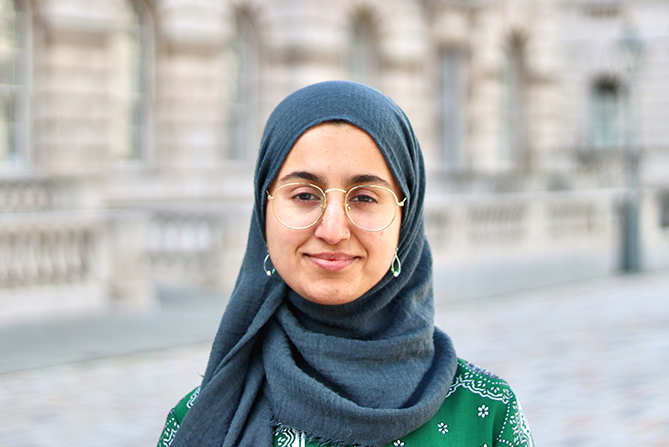
    Photo credit: Suhaiymah Manzoor-Khan.
  • The Global Desi Story: A Conversation with Kritika Pandey

    The Global Desi Story: A Conversation with Kritika Pandey

    Kritika Pandey, winner of the 2020 Commonwealth Short Story Prize, talks about transgressing cultural norms, protesting, and Hinglish.

    PEN Transmissions is English PEN’s magazine for international and translated voices. PEN’s members are the backbone of our work, helping us to support international literature, campaign for writers at risk, and advocate for the freedom to write and read. If you are able, please consider becoming an English PEN member and joining our community of over 1,000 readers and writers. Join now.

    Firstly, congratulations on winning the Commonwealth Short Story Prize for ‘The Great Indian Tee and Snakes’ – which is an extraordinary story. I know you’ve spoken elsewhere about why you entered the prize, but I want to start by asking what winning it means.

    It’s the biggest accomplishment of my career so far. My trajectory has been a little unusual; I feel like many people come to writing after having studied literature, or at least the humanities, but I was an engineer. It’s the reality for so many people in smaller cities in India: if you can write tests and pass examinations, then you should become an engineer. It’s the thing to do. You should go to Silicon Valley, earn a lot of money, and send it back home. So that’s what I did.

    And then I realised how miserable I was. So I gave it all up, took a risk, and became a writer – whatever that means. I read – contemporary writers and old writers. I read all sorts of different ‘literature’, creative and scientific. I think that’s meant my writing has been informed by many different disciplines. Eventually, I took an MFA.

    These decisions arose problems. For the longest time, I was ostracised – and still am in my community – because I refused to get married at the age at which I was supposed to get married. My parents also got a lot of flak for it, because they weren’t keeping me in check. This prize tells me that this was all worth it; that the unusual things that we all do, in our own capacities, lead us to places that are worth exploring.

    Are MFAs ‘worth it’?

    My immediate follow-up question is ‘For whom?’ It is for some, not for others. At the time I applied, I was in Delhi, having left my hometown, Ranchi. My parents kept showing up in Delhi and taking me to the mall to meet guys they wanted me to marry. I was sick of it. I just wanted to run away. I had the privilege of a decent education in the English language, and had always wanted to be a writer, so I put together a short story and sent it to MFA programmes. I thought: this way, I can leave home for three years, and not have to meet some Brahmin guy who wants me to cook for him.

    And so, in that sense, I got what I needed from an MFA: I tricked my parents into postponing the whole marriage conversation until I was safely out of the marriageable age-bracket.

    But anytime I found myself in a workshop, I was miserable. People either didn’t know the socio-political or historical context of what I was writing about, or they were too terrified to offer constructive criticism because I am a person of colour – which is such a lazy approach.

    What’s interesting about that response is that, so often in an interview, you brace for profound answers, and then there’s instead something ostensibly pragmatic in a response. But those pragmatic answers are underpinned – as in this case – by nuanced and complex experience, which in turn manifest as profundity in writing.

    I’ve been fortunate to read a few of your stories, and something that unifies them is an interest in transgressing cultural, religious and repressive gender norms. That speaks to this idea that profundity lies underneath practical decisions. Could you talk a little about your thematic interests, and in what ways they catalyse your writing?

    These frameworks – the frameworks of religion, gender, cultural norms, orthodoxy – are frameworks that have influenced my whole life.

    Jharkhand, of which Ranchi is the capital, is one of the poorest parts of India, where value is seen only in terms of what can be extracted. It’s one of those places where men dig up bauxite and coal, and men set up steel factories, and men build big dams that drown entire villages where indigenous people live. On one side of my house was a lawyer. On the other side were the slums. So I was conscious of the divide – the class divide – between these worlds.

    My parents are very believing Hindus, and I learned to pray very early on – without questioning the idea of God. Then – obviously – I became a disillusioned teenager. And so grappling with religion and its complicated truths is something I continue to do.

    The same is true of cultural norms. I was hyperactive as a little girl, always bumping into furniture and covering myself in bruises. My parents would tell me act like a lady. And I hated this idea that I had to be a certain way, because I was a certain gender, in order to be loved. I was told that, if ever I went out, I should never, ever make eye contact; I should always stare at my feet, and always make way for men and boys to walk past me. Despite this, my mother was a feminist through-and-through. She would stand up for me, telling my father to let me pursue what I wanted, study what I wanted. I wasn’t allowed to wear shorts, had to wear sleeves – but my mother would secretly stitch me relatively revealing clothes, so that I could look cool. These are the things that I grew up with. So these are the things that shape my writing.

    When you talk about those things shaping your life, a lot is about shaping your young life – your childhood and teenage years. Your writing is very much about that, too. And I wonder if that is a conscious decision?

    I’ve never really thought about this. But, because the most charged experiences of my life happened when I was a teenager, I think it is a decision that’s conscious, at least in part. I’m interested in how young people make sense of the world. It’s a very fragile state of existence, being young. And some of the inferences that we make about the world as young people are quite profound, and worth thinking about.

    Are young people your ideal readers?

    I think that my ideal reader is the person who is open to thinking like a young person.

    Turning to your story, now: the murder of Tabrez Ansari is a touchstone for ‘The Great Indian Tee and Snakes’ – a terrible touchstone. Do you think stories like yours can change the conditions from which those sorts of horrors emerge?

    That is a question I think about every day. I’m still trying to make sense of my grief for this young man, who died in my own backyard when I was visiting my parents. How can my writing prevent such things from happening?

    When I first read Arundhati Roy, I learned – as an upper-caste person – something I needed to learn about caste. Thereafter, I moved through the world with a new sensitivity to privilege. Maybe a reader learns something from a story, and then maybe they work in a grassroots organisation, and then maybe there is a chain reaction (that we can’t necessarily put our finger on) that leads to change. I can hope that my story might, in that way, contribute to change.

    I shared the story on Facebook, and with my family members. There are people in my family with aggressively Islamophobic ideas; I shared the story with them, particularly. The last line in the story is the question ‘Are you happy?’ That question is for them. You know – don’t ask the girl with the black bhindi if she is happy; she is asking you. Hundreds of people have died from this violence since 2015. Are you at peace with that?

    The chain reaction point is an interesting one: it’s true that it doesn’t matter that one person is writing a story; it matters that many people are reading it. I suppose that, to be a bit trite, you need 1) a writer, 2) an activist and 3) a lawmaker in order to effect change. But it is so often the writer at the start of that chain. And that is why I think the question that ends your story is so invaluably powerful.

    You’ve touched on something I wanted to ask you about. In sharing your story – with your family, and the world – have you received backlash?

    Not from family members. But, after I was announced as the Asia region winner, I was almost immediately attacked online by right-wing groups in India. They said: Why could the girl not be Muslim, and the boy be Hindu? And the context of that is this Indian right-wing narrative that Muslim men are enticing Hindu women in order to convert the entire population. They call this phenomenon ‘love jihad’.

    In 2017, when I was in the United States, my political sensibilities were becoming more and more nuanced, and I was being more and more vocal in family WhatsApp groups. As a result, one of my aunts asked my mother if she thought I was a ‘victim of love Jihad’. So the right-wing response to the story – the blanket dehumanisation of Muslim men – really stuck with me.

    There is that old platitude that, when you solicit such responses, you know you’re doing something right. But that doesn’t make them any less awful.

    I want to ask two related questions about imagery in your story. The first is about the image of the ‘broken-unbroken’ ceramic cups – which is immensely powerful. Was that a seed for the story? I’m always interested, particularly with the short story form, about such images, and whether the story grows from them or they from the story.

    The second is about the ‘new prime minister’s face’ – which looms large but silent and, whilst mentioned repeatedly, fades with the second half of the story, when things become horrific and its mark has been left. Could you talk a little about that image, too?

    I think that my most of my writing stems from of an image – that the story is shaped around it. In the case of ‘The Great Indian Tee and Snakes’, it was indeed about the cups: it was the image of the girl putting together the broken pieces, and cutting herself doing so.

    The broken cup is a very lived reality in small towns in India. We have seen our mothers and fathers make sure there’s a different set of cups in the in the kitchen for Muslims. It is an image of how we are made to feel alienated from our friends – how we are prevented from forming profound relationships with them. We might not be involved in incidents like the murder of Tabrez Ansari, but we must ask ourselves how these practices make us complicit.

    The new prime minister’s face is there in the background in the same way that political upheavals happen around us whilst life just goes on. I wanted to write a political story without evidently political actors; that is why the face disappears: people are affected by politics, but they are not necessarily engaged in conversations around electoral politics whilst committing atrocities.

    Growing up, I saw my father sitting in living rooms, surrounded by other men, talking about who will win the election, who the candidates are, what their promises are, etc., etc., Meanwhile, my mother was always in a bedroom or in the kitchen, very much not talking about politics. But that doesn’t mean that politics weren’t influencing their lives equally.

    I want to turn to language. There is of course a long history of Indian literature in englishes – with a lower-case ‘e’. You write in Hinglish, to use your own term. Could you talk to me about linguistic communities and literary communities, and how they interrelate?

    I have a very long relationship with English. At school, I was taught in English. If you spoke a word of Hindi outside Hindi class, you had to pay a 20-rupee fine. So I didn’t question it. We knew it would help us get ahead in life, so we learnt our gerunds and infinitives. We accepted that Shakespeare compared a women’s beauty to a summer’s day, even though summers in India are scorchingly unbearable.

    And then, after school, I realised that I couldn’t communicate something substantial – something profound and literary – in this language we were taught. Not in the form in which we were taught it. When I first wrote a story entirely in Hinglish, it was met with shock by those who read it – either because they had never encountered the language in this way, or because they had: because it was their language, which was so intimate, but which they had never encountered outside those intimate parts of their lives. I think the literary world is of course accepting this experimentation with English more. But there is still some way to go.

    I want to ask a question that relates to that idea of ‘acceptance’. In another interview, you’ve said that ‘Our characters can finally live and die within the geopolitical borders of the subcontinent and be trusted to have interesting lives’. I want to ask about not the geopolitical borders of writing, but the geopolitical borders of reading. Is it important to reach readers outside this context?

    It’s hugely important to me that my stories are read by others in the Global South. What I really want is to be part of the ‘global desi story’; I am a part of a postcolonial English writing culture, and whilst there is a discourse in South Asia about not writing ‘for the West’, I don’t think that should come at the cost of making ourselves inaccessible to people outside South Asia who happen to be, for one reason or other, in the Anglophone West. I think that would be a foolish, foolish thing to do. I have gained so much from reading literature from other contexts, and would not want to debar myself from being read elsewhere.

    And, apart from anything, it is a fundamental truth that culture moves across contexts. So I have Beyoncé in my story, because in small towns in India young people dress up like Beyoncé, and want to be like Beyoncé, and are fascinated by Beyoncé – so why not incorporate that? Saying ‘no’ to those sorts of cultural exchanges only upholds a West-centric view.

    You used the phrase ‘postcolonial’. Do you put stock in that word?

    As a writer, it’s a convenient phrase. But I also believe that there is no ‘post’ – in that we are still very much in a repackaged, 21st Century colonialism. It’s a useful term in reminding us that there are ongoing tensions. I can understand why an academic would want to give up on it, but I’m not an academic – so it works for me.

    And as that relates to language, what are your thoughts on postcolonialism and the English language. Is writing in English a sort of radical linguistic occupation of the coloniser, or is it a colonial hangover? Is translating into English about access, or about imperial legacy?

    I will be thinking about these questions for the rest of my life. As Chinua Achebe said, just because postcolonial nations were invented by the British, it doesn’t mean that the people in those nations were also created by the British. It also doesn’t mean that those people cannot write in English whilst inhabiting the language in a way that questions its context and legacy. The English language, decade-on-decade, has submitted to the language of the ‘colonised’ precisely because of these forms of writing. So this is not a question I can answer with a ‘yes’ or a ‘no’.

    If I wrote in Hindi, my friend in Rwanda would not be able to read my story. In order for me to engage with Juan Pablo Villalobos, I have to read him in translation by Daniel Hahn. And I am so glad that I am able to read Juan Pablo Villalobos. I think we can exercise our respective agencies in our respective but relating contexts by using the English language; we can speak truth to power using the English language.

    I agree. One of my self-critiques, when battling with the ethics of translation, is that a conception of into-English translation as necessarily problematic (in a postcolonial context) implies, almost inevitably, a problematic homogenisation of the different language communities within a postcolonial nation-state. We shouldn’t really be talking about the problematics of translating Hindi into English; we should be talking about supporting translation regionally and locally, between South Asian languages.

    To return to ‘The Great Indian Tee and Snakes’ again, something I love about the story – and, when done well, about many short stories – is your use of the third-person present. Where did that stylistic choice come from?

    A much as I say that I’m not an academic, I am moving in academic circles. And so I can’t help but think in terms of representation. The girl in the story is a working-class girl. What do I know about being a working-class girl? The third-person present gives me the right distance, I think; the narrator is not the girl.

    But there are moments in which those perspectives come close to one another.

    Yes, and it means that the final question isn’t just about speaking to a character; it’s also about speaking to my family.

    As we’ve discussed, the story is deeply political. But it’s also deeply emotional. You treat very profoundly and seriously emotions and feelings and affect. Is that a part of why you write? To interrogate the truths, as far as they can be truths, of fundamental human emotions – like love, and how it is gendered?

    I think that I became a writer – or that I started writing – because it seemed like the only outlet for the deluge of emotions that I feel every single day. My friends always seem happy, and, for that, I’m happy for them. But I’m not able to feel that way. I’m sad. And I don’t want to apologise for that anymore. In the context of my home, conversations about mental health are very new. I don’t only want to talk about my emotions in the therapist’s office, because the whole process of therapy – of sitting across from someone for exactly an hour, and paying them a certain amount of money – doesn’t make any sense to me.

    In the days after Tabrez Ansari’s murder, I cried myself to sleep. We don’t talk about this; about the fact that politics do not end with politics, but that they instead end up in tragedy that makes us emotional. So, for me, the beginning and the end of writing is emotion.

    On love: in the story, at first, it’s not really about love; it’s about physical attraction. The girl is physically attracted to the boy. And framing sexual attraction as love is, as you, say, a gendered thing. Men can feel attracted to women, but women must always feel love for men. Love is just a neat euphemism for lots of other things.

    By the way, when I talk about writing to interrogate emotions, I should say that I don’t find writing therapeutic. It’s tough. It’s often deeply unhappy.

    And to finish with, potentially, another unhappy question: What do you fear most as a writer?

    I am always going to be political; for the time being, that means I’m going to be controversial, and targeted and attacked for my writing. So, what I fear most is that, in the worst possible turn of events, I will be killed for what I write.

    If I was organised enough, I’d be an activist. I’m a very angry protester. Protesting George Floyd’s murder, I’ve of course been anxious about coronavirus, but that has been outweighed by my anger. I think my life as a writer will never be complete without stepping outside to protest. In February, before lockdown, I went to India for five days. I told my family I was visiting them – and I did visit them. But I really went to protest with the women of Shaheen Bagh. I could not sit in the US whilst the biggest democratic movement since 1947 was happening in India. I had to be on the streets, protesting with the students, sitting with the women, saying: I refuse to let Modi decide to whom this country does or doesn’t belong.


    Kritika Pandey is a Pushcart-nominated writer from Jharkhand, India, and a graduate of the MFA for Poets and Writers, University of Massachusetts, Amherst. She is a recipient of a 2020 grant from the Elizabeth George Foundation. She is the overall winner of the 2020 Commonwealth Short Story Prize. She is the winner of the 2020 James W. Foley Memorial Award, the 2018 Harvey Swados Fiction Prize, the 2018 Cara Parravani Memorial Award in Fiction, and a 2014 Charles Wallace India Trust Scholarship for Creative Writing at the University of Edinburgh. 

    Interview by Will Forrester, Editor.