Tag: Kenya

  • An Irresistible Contradiction: An Interview with Idza Luhumyo

    An Irresistible Contradiction: An Interview with Idza Luhumyo

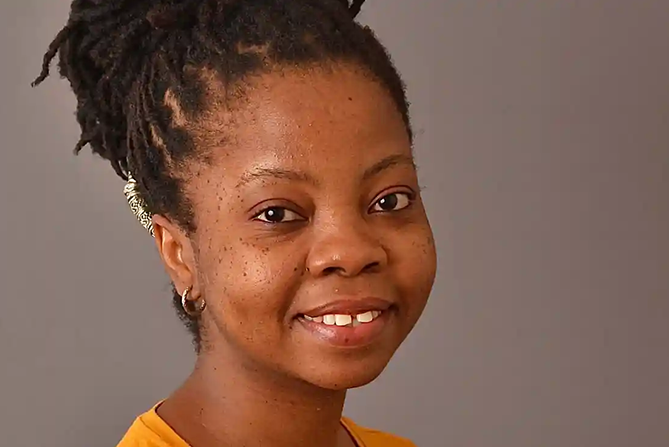
    Idza Luhumyo, winner of the 2022 AKO Caine Prize for African Writing, discusses short stories, agency, and power.

    PEN Transmissions is English PEN’s magazine for international and translated voices. PEN’s members are the backbone of our work, helping us to support international literature, campaign for writers at risk, and advocate for the freedom to write and read. If you are able, please consider becoming an English PEN member and joining our community of over 1,000 readers and writers. Join now.

    Idza – thanks so much for talking to me. ‘Five Years Next Sunday’ is such a beautifully paced story – and it also has something that compelling short stories rarely have: a big canvas. A large amount of time elapses across a very few pages, and this allows us to see how characters, relationships and imperatives change. Was this big canvas something you intended to work with, or was it rather that the story you wanted to tell demanded it?

    It’s something that the story demanded. Once I had the main character – knew what she wanted, and knew exactly where she was located – then the story opened up and had to speak to bigger questions, even as it remained welded and attached to these few characters.

    Perhaps relatedly: you can usually sense of from what a piece of short fiction has developed (a single image, a single setting, a single character, a single quirk), but I couldn’t guess the seed from which this story had grown – maybe the rich and complex ideas of hair and water, if you made me guess!. Where did it all start?

    It started with the hair. I had been thinking about the practice of witch hunts along the Kenyan coast for a little while. People – usually elderly folk – whose hair starts to grey are said to be practicing witchcraft, and are banished to these remote outposts and, technically, left to die. With Pili, I wanted to create a character who has the ability to make rain but is shunned by her community for that very ability. It was an irresistible contradiction I simply had to pursue.

    What is it that draws you most to the short story form?

    It’s the form I started out with – that is, without counting the awful poetry that I did in high school. I think the short story form is good practice for a writer just starting out. But even more than that: I think there’s something poetic about the form; it demands you to distil what you want to say/question/explore to the bare fundamentals; it’s a form that doesn’t reward lingering, and so you have to work hard to make it tight.

    The relationship between Pili and Honey puts into conversation several intersecting issues – race, gender, sexuality – in such a short space of time, in a way that complicates them, with these intersecting lines often being where the story takes sudden, sharp turns. Could you talk about that a little?

    I wanted to think a little differently about how race works, especially when we’re talking about a place such as the Kenyan coast, where there has long been a white presence because of tourism. Even though we have two women with diminished power – but who are in no way powerless – we find that the expectations are flipped: because of her hair, Pili is actually the one who has more power. I thought it’d be interesting to see how their relationship played out with this reversal as a framework.

    Agency – who has it, the ways in which it is circumscribed and the ways in which it can be exercised, how duty and expectation and community affect it – feels like something else in which the story is deeply interested. Is that something you were particularly keen to explore?

    I was – and, truthfully, I want to keep exploring it in my future work. What does agency mean when you have to coexist with others? And what’s the best way to move through the world with agency while also being aware of, and attendant to, other people’s needs and expectations? I don’t think these are easy – or even answerable – questions, but I believe they still need to be posed so that we can sit with them.

    You’re currently doing an MFA in Texas, and I always like to ask this question: do you think MFAs are worth it?

    I think it depends on what you want to get out of them. Writing has no roadmap and MFAs certainly won’t work for everyone, but they offer an unrivalled opportunity to centre writing in your life, at least for a couple of years. What’s more: if you’re lucky, you leave with a couple of lifelong readers.

    You’ve been recognised by a number of awards championing African literature – the Margaret Busby New Daughters of Africa Award, the Short Story Day Africa Prize, and now the Caine Prize. What do those recognitions mean to and for you?

    They motivate me to keep the faith, to keep pursuing the ideas that interest me and, more importantly, to get my work out there.

    I once heard Hisham Matar describe the process of writing fiction as being like having an oscillating ball of water above your head, trying to shape it into the shape you want without its surface-tension breaking and the water coming pouring down over your head. As I read ‘Five Years Next Sunday’, this image came back to me – not just because of the reference to water, but because the story holds together so many threads and drivers and themes (characters, plots, gender, mysticism, scarcity, race, relationships, water, family, duty, hair, isolation, sexuality, capital, identity, value…). So my question is: how did you hold all these threads together without them unravelling?

    A simple (and maybe a tad unromantic) answer: rewriting and rewriting. But there’s also the fact that the stories that I like reading tend also to be layered and I guess that was my model as I worked on this story. The other thing is that that’s just how life is. Things are almost never about one thing, and I guess achieving the sort of verisimilitude that works requires bringing that life-like quality to storytelling.

    And finally, having said that ‘Five Years Next Sunday’ is about so many connected things, if you had to boil it down to just one, what would you say this story is about?

    I would say it’s about power. Everyone has it, and some have more of it than others for sure, but everyone’s always using however much of it they have or can access to various ends.


    The AKO Caine Prize for African Writing is a registered charity whose aim is to bring African writing to a wider audience using our annual literary award. In addition to administering the Prize, we work to connect readers with African writers through a series of public events, as well as helping emerging writers in Africa to enter the world of mainstream publishing through the annual Caine Prize writers’ workshop which takes place in a different African country each year.

    Idza Luhumyo is a Kenyan writer. Her work has been published by Popula, Jalada Africa, The Writivism Anthology, Baphash Literary & Arts Quarterly, MaThoko’s Books, Gordon Square Review, Amsterdam’s ZAM Magazine, Short Story Day Africa, the New Internationalist, The Dark, and African Arguments. Her work has been shortlisted for the Short Story Day Africa Prize, the Miles Morland Writing Scholarship, and the Gerald Kraak Award. She is the inaugural winner of the Margaret Busby New Daughters of Africa Award (2020) and winner of the Short Story Day Africa Prize (2021).

    Interview by Will Forrester, Editor.

  • The past and the present side by side: a conversation with Peter Kimani

    Kenyan writer Peter Kimani talks to us about how he tackled the past in his latest novel, representing otherness, and freedom of speech in Kenya.


    Dance of the Jakaranda is a complex book of interwoven stories that spans generations. How did it come into being?

    In 2007 I went to a writing programme in Iowa. Writers from different parts of the world spend a semester writing, giving readings and community engagement activities. I lived in an Iowan hotel for three months, and that was the genesis of the idea, of a hotel being the setting for a story.

    I returned to Kenya at the end of that year just as there was another disputed election. There was violence, people were killed. That challenged our presumptions as Kenyans: Who are we collectively? Who are we individually? And why are we still wrestling with those simple questions? This gave impetus to the direction of my story. I had sought to write something simple, but it inadvertently evolved into something complex.

    I found that writing about Indians living in Kenya was a useful group to write about when exploring the Kenyan identity. They were imported into the country by the British as part of the indentured labour, and have now inhabited that place for over five generations.

    The structure of the story was also something that evolved gradually. The book imitates the railroad: with two parallel stories, the past of the 1890s and the present of the 1960s, side by side. I was examining those two perspectives – not just black and white, but the brown in between.

    I also incorporated African oral storytelling tropes into the book. These tend to dance around a topic, with repetition and cyclical motions to the narrative, all deliberately so. You even have specific echoes of African storytelling, like when somebody says hadithi hadithi and there is a call and response hadithin jo, and I occasionally tease out such a device.

    And both timelines have unreliable narrators…

    The character of Nyundo the drummer powerfully reclaimed a place for himself in the story. Traditional communities used to communicate through drums, and he is the folk historian who witnesses history as it happens. Meanwhile, the colonial administrator who records the same events has another version of the history. So through Nyundo, I contest the validity of history as we know it, because what is recorded officially is never told from the perspective of the victim, it is always from the perspective of the victor. In other words I am teasing out the absurdity of a continent whose story has been told through the outside view and hardly their own. In the earlier drafts, Nyundo was dead for many years, but then he insisted on living in the text! To me, this symbolises the resurrection of African memory. He shifts the reader’s perspective because he is saying, ‘I saw it happen, I am the witness who experienced it, this is my story I am telling’ … and so challenging presumptions about Africa’s own story.

    The main characters in this story are Indian, not from an indigenous East African group. How did you approach writing them, and ensure that you did justice to the characters and not slip into ’cultural appropriation’?

    Actually I am currently teaching a course called ‘representing otherness’, examining how Africa’s colonial past has been exploited by white writers, and how black writers in the same space are writing about white characters. With regards to the Indians in Dance of the Jakaranda, people ask, ‘Why are you writing about what is not your story?’ My simple response is that Indians are part of the collective of what makes Kenya. So they are as Kenyan as I am and their story is my story to that extent.

    When trying to give voice to another person, one is challenged to do it with integrity and faithfulness. My fidelity to my characters is to have no set notions of what their story is, because I am writing partly to discover. In my current book, I am exploring the life of a deaf and a mute person, and that will be a revelation. If it helps examine that community and the challenges they navigate through, I would have empowered somebody who doesn’t have the skills to state it as I do. So I will state that story and let others respond to it.

    Ngũgĩ wa Thiong’o now writes in his mother tongue of Giyuku. What do you think of that and would you consider writing novels in your own mother tongue?

    I started my writing in Swahili as a journalist for Taifa Leo (the sister publication to English-language Daily Nation). I did that for a year and a half and I’m very proud of my contributions to that publication. So I do sympathise with Ngũgĩ’s cause and the concern that we should not keep all this knowledge in ‘foreign granaries’, where it can only be accessed by those who speak those languages. What does it mean for those populations that cannot access the material in those languages, coded in a foreign tongue?

    I partly addressed this in Dance of the Jakaranda. I deliberately deployed literary ‘indigenisation’. The book signals that it is being told in a colonial language. English is delivering the story, but the characters were originally speaking something different.

    Kenya needs to invest in an infrastructure that can promote development of its own languages. Tanzania adopted Swahili as its official language in 1961 and there is now a thriving publishing scene there that we do not have in Kenya. The government should be doing more. Look at Hebrew – it is spoken by around 5 million people, about the same as the number of Gikuyu speakers. But look at the number of texts that are in Hebrew, because of the investment in the language.

    How difficult is it to make these criticisms of Kenya? As a former journalist, what is your view on the state of freedom of expression?

    I should say expressly that I think the current state of affairs in Kenya as far as press freedom is concerned is probably one of the worst in 25 years.

    They propose to be a ‘digital’ government – meaning young and modern and sophisticated. But they are more repressive than the stone age politicians like Moi, who did not deal with the internet. The absurdity of this is that when one tries to muzzle voices in the age of the internet, then your mentality must be from the stone age, because you cannot stop me and other writers from expressing ourselves! They have displayed a twentieth century mentality of information.

    What we are seeing now in Kenya is the systematic shutdown of different voices, journalists being sacked at the Daily Nation and the Standard. Daniel Arap Moi, by virtue of his longevity, was more relaxed towards the final years of his rule, especially when he witnessed the inevitable shift of global politics, which has implications on the conduct of politics in Kenya. But the younger people have more energies and are very thin skinned, more so than the older generation, which is an irony.

    Literature to me seems to be the only free thing left in the world. Journalism has been complicated by the shift in technology, both the way we consume and disperse information, and the growing anxieties funding for a lot of media ventures. Literature to me seems to be the only free thing left.


    Peter Kimani is an award-winning Kenyan novelist and journalist. In 2011 he received the Jomo Kenyatta Prize for literature, Kenya’s highest literary honour, for his children’s book Upside Down. Kimani was one of three international poets to compose and present a poem for Barack Obama’s inauguration in January 2009. A prominent journalist on Kenya’s national news circuit, Kimani’s work has also appeared in the GuardianNew African and Sky News. His latest novel, Dance of the Jakaranda, was published by Telegram.

    Interview by Robert Sharp.

  • PEN Atlas Q&A: Ngũgĩ wa Thiong’o

    ‘I entered Makerere University College in July 1959, subject of a British Crown Colony, and left in March 1964, citizen of an independent African state. Between subject and citizen, a writer was born.’

    Birth of a Dream Weaver is the latest in a series of chronological memoirs by Ngũgĩ wa Thiong’o. The first, Dreams in a Time of War, published in 2010, describes Ngũgĩ’s childhood in rural Kenya in a traditional family consisting of his father, four mothers and twenty four children. The House of the Interpreter follows Ngũgĩ’s time at a segregated elite boy school, Alliance High, run by British missionaries. In this latest volume, Ngũgĩ remembers his time at Makerere University College in Uganda. The series offers a fascinating insight into the cultural and political shifts that created modern Africa, while also following the path of discovering one’s voice as a writer.

    Interview by Tasja Dorkofikis.


    Whilst a student at Makerere University, you were also a playwright, journalist and a budding novelist. Did these multiple writing forms complement one another for you?

    Ngũgĩ: I saw them as complementary. My first love is fiction, the novel in particular. But it was drama and theatre that first launched me into the public eye; and the two have had more impact on my life including my writing of fiction, than the fiction. Theatre would later lead me to prison without trial, and then into Exile. My writing in Gĩkũyũ began in prison and flowered in exile.

    Makerere University was a point when all your influences converged: English and European literature, your political awareness, local pre-colonial and oral cultural tradition – did you think at the time that these cultures were conflicting?

    Ngũgĩ: No, not really. I have always enjoyed English and European literature, and many other literatures. I still do. But what I would later question is the priority given to European literatures and cultures, English mostly, over African ones. I reject the conception of relations among languages, cultures and literatures in terms of hierarchy.  Literatures and cultures should relate on an equal give and take basis of a network. Network Not Hierarchy. That is my take.

    The time at Makerere University allowed you to meet many thinkers and writers from all over the world and became a moment where you started expressing your political opinions publicly. Was it dangerous to do this?

    Ngũgĩ: The anti-colonial nationalism, the mass movement, the energy that this generated was bound to impact young lives. Poorly armed soldiers of the Kenya Land and Freedom Army, (Mau Mau) had taken on the might of the British Empire, after all. It never occurred to me that writing could be dangerous, contrary to feelings I used to express earlier in my arguments with my friend Kenneth, about the license to write. See Dreams in Time of War. Then, I used to argue that one could be imprisoned if they wrote books without a license to do so.

    Your writing has always been strongly engaged politically with your country and with the development of postcolonial East Africa. What do you think the role of a writer is today? Do writers have wider political responsibilities?

    Ngũgĩ: A writer’s primary responsibility is to the dictates of their imagination. But no writer does so in a social vacuum. Their work is impacted by their own belief systems, their world outlook. But in the end, art has a magic all its own. At its best and most potent, it embodies and celebrates change and allies with the liberation and enhancement of the human spirit.

    There is a moment in your book when you decide on writing a daily journal. Have you been keeping journals all your life?

    Ngũgĩ: No, but I wish I had. I would urge all young writers to keep a journal, of some kind.

    In 1977 you renounced writing in English at the Nairobi opening of your play, Petals of Blood, saying that you wished to express yourself in a language that your mother and ordinary people could understand. Now you write in Gĩkũyũ and auto-translate into English. How has this shift influenced your writing style?

    Ngũgĩ: I would say that a sense of orality has become more prominent in my writings, especially in my three novels: Caitaani Mũtharabainĩ/Devil on the Cross; Matigari ma Njirũngi/Matigari; and Mũrogi wa Kagogo/Wizard of the Crow. It is not surprising that my Gĩkũyũ language fable, ‘Ituĩka rĩa mũrũngarũ/the Upright Revolution’, has been translated into more than fifty languages in the world.

    What advice would you give to young writers from Africa confronted with the dilemma of having to choose the language they write in? And to what extent can one talk, realistically, of ‘choosing’ the language in this context when colonial languages remain culturally dominant?

    Ngũgĩ: I advocate writing in African languages. It is African languages that need African writers, not European languages. But I recognise that there is a whole generation of African youth brought up as European language speakers. These have no choice but to write in the language they have. Writing in African languages faces formidable difficulties of unhelpful government policies, zero publishing houses in African languages; and an international order that takes European languages as the norm for the world.

    You translated two Molière plays, Tartuffe, and Doctor in Spite of Himself, into Gĩkũyũ through the English translations. Is translation a political act of mediation?

    Ngũgĩ: I describe translation as the common language of languages. I also tell African writers: use English to enable but not to disable. Translation has always been a fact of literary life in Africa. The Bible and the Koran are well known all over the continent, but mostly through translations. And currently, the Jalada translation project has resulted in my fable being available in over fifty world languages (40 African; 6 European; 6 Asian; and 2 Middle eastern). Translation is the way of the future.

    Do you have any thoughts on how the growth of African publishing industry can be encouraged?

    Ngũgĩ: We need a fundamental change in governments’ language policies. A positive government policy will mean changes in education policies and these will impact publishing.

    Can we expect the next in the series of your memoirs and if so, when?

    Ngũgĩ: Detained is being reissued next year, with a new introduction, and a few additions.

    Find out more about Birth of a Dream Weaver and read an excerpt here.

    Read more about the PEN award-winning Dreams in a Time of War on the World Bookshelf.

    Read Jalada Africa editor Moses Kilolo for PEN Atlas on the Jalada TRANSLATION issue, which featured Ngũgĩ wa Thiong’o’s short story The Upright Revolution translated into over 50 African languages.

  • A Golden Age for the African Short Story

    Over the past decade and a half, the Caine Prize has championed the finest short story writers that Africa has to offer, not only through giving a prize to the shortlist and winning story, but through the facilitation of workshops across the continent. Each year twelve or more up-and-coming African writers are invited to a workshop to compose a short story for inclusion in the anthology, which is then published annually by New Internationalist and seven co-publishers in Africa.

    The Caine Prize was established in 1999 to award African creative writing and is named in honour of Sir Michael Caine, Chairman of Booker plc and the Booker Prize management committee for nearly 25 years. The Prize is awarded for a short story by an African writer published in English – a short story defined here as between 3,000 and 10,000 words long. An ‘African writer’ is normally taken to mean someone who was born in Africa, who is a national of an African country, or whose parents are African.

    This year it took seven months for the record breaking 140 entries, from seventeen African countries, to be whittled down to the final winner. Five judges, chaired by Jackie Kay were given with the job. They were particularly impressed to see real originality with so many writers bringing something different to the form; they all agreed that this is a golden age for the African short story. Eight writers whose stories that didn’t make the shortlist received a letter of encouragement from the judges and some of these writers will be invited to take part in the workshop that takes place next year. The Caine Prize intends to continue holding writers workshops annually and, subject to funding, begin a series of editing workshops to improve editorial skills on the continent.

    In April, after much deliberation, the 2014 shortlist was announced by Nobel Prize winner and Patron of the Caine Prize, Professor Wole Soyinka, as part of the opening ceremonies for the UNESCO World Book Capital 2014 celebration in Port Harcourt, Nigeria. To commemorate fifteen years of the Caine Prize this year, £500 was awarded to each shortlisted writer. It is hoped that this award will continue to be made annually.

    The final judging process took place in Oxford on the day of the announcement. Announcing Okwiri as the winner, Jackie Kay praised the story, saying, ‘Okwiri Oduor is a writer we are all really excited to have discovered. ‘My Father’s Head’ is an uplifting story about mourning – Joycean in its reach. She exercises an extraordinary amount of control and yet the story is subtle, tender and moving. It is a story you want to return to the minute you finish it.’ ‘My Father’s Head’ explores the narrator’s difficulty in dealing with the loss of her father and looks at the themes of memory, loss and loneliness. The young woman works in an old people’s home in Kenya and comes into contact with a priest, giving her the courage to recall hidden memories of her father.

    Okwiri lives in Nairobi, and has received a great amount of interest already from agents and publishers in the UK.  She will take part in the Storymoja Hay Festival in Nairobi in September and the Ake Festival in Nigeria in November this year.

    Similarly, the Caine Prize has brought African writers into the spotlight, discovering new talent and encouraging people to write – something the Western world often takes for granted. Okwiri noticed herself that ‘there are more Africans writing and more Africans reading and there’s a hunger for these kinds of stories.’  She added that she is ‘so hopeful and grateful about this thing we call African literature.’

    Kenya’s leading newspaper The Daily Nation wrote, ‘Global recognition as comes with the Caine Prize should act as the foundation on which the great repertoire of work and talent on offer is rolled out to wider audiences.’ Over the past fifteen years, the Caine Prize has achieved this by launching the careers of esteemed winners such as Leila Aboulela, Binyavanga Wainaina and NoViolet Bulwayo.

    We look forward to spotlighting the talents of hundreds of other African writers in years to come.

  • The Achebe I Knew

    Ahead of the Africa Writes festival 2013 (5-7 July) PEN Atlas hears from African writer Ngũgĩ wa Thiong’o on his friend and mentor Chinua Achebe. Ngũgĩ will appear in conversation with his son Mukoma wa Ngũgĩ on Saturday 6 July at the British Library.

    A version of this article was originally published in The Nation in March 2013.

    I first met Chinua Achebe in 1961 at Makerere, Kampala. His novel, Things Fall Apart, had come out, two years before. I was then a second year student, the author of just one story, Mugumo published in Penpoint, the literary magazine of the English Department. At my request, he looked at the story, and made some encouraging remarks. What I did not tell him was that I was in the middle of my first novel for a writing competition organized by the East African literature bureau, what would later be published as The River Between. 

    chinua-achebeMy next encounter was more dramatic, on my part, at least, and would impact my life and literary career, profoundly. It was at the now famous 1962 conference of writers of English expression. Chinua Achebe was among a long line of other literary luminaries, that included Wole Soyinka, J P Clark, the late Eski’a Mphahlele, Lewis Nkosi and Bloke Modisane. The East African contingent consisted of Grace Ogot, Jonathan Kariara, John Nagenda and I. My invitation was on the strength of my short stories published in Penpoint and in Transition. The novel most discussed in the Conference as a model of literary restraint and excellence was Things Fall Apart.

    But what most attracted me was not my being invited there as ‘writer’ but the fact that I would be able to show Achebe, the manuscript of my second novel, what would later, become Weep Not Child. It was very generous of him to agree to look at it because, as I would learn later, he was working on his  novel, Arrow of God. Because of that and his involvement in the conference, he could not read the whole manuscript, but he read enough to give some useful suggestions.

     More important, he talked about the manuscript to his publishers, William Heinemann, represented at the conference by June Milne, who expressed an interest in the work. Weep not Child would later be published by William Heinemann and the paper back by Heinemann education publishers, the fourth in the now famous, African Writers series, of which Achebe was the Editorial Adviser.

    I was working with the Nation newspapers when Weep not child came out. It was April 1964, and Kenya was proud to have  its first modern novel in English by a Kenyan African. Or so I thought, for the novel was well published in the Kenyan newspapers, the Sunday Nation even carrying my interview by de Villiers, one of its senior feature writers. I assumed that every educated Kenyan would have heard about the novel. I was woken to reality when I entered a club, the most frequented by the new African elite at the time,  who all greeted me as their Kenyan author of Things Fall Apart.

    Years later at Achebe’s 70th
    birth day celebrations at Bard College attended Toni Morrison and Wole Soyinka among others, I told this story of how Achebe’s name had haunted my life. When Soyinka’s turn to speak came, he said that I had taken the story from his mouth: He had been similarly mistaken for Chinua Achebe.

     The fact is Achebe became synonymous with the Heinemann African writers series and African writing as a whole. There’s hardily any African writer of my generation who has not been mistaken for Chinua Achebe.

    I have had a few of such encounters. The last was in 2010 at Jomo Kenyatta Airport. Mukoma, the author of Nairobi Heat, and I had been invited  for the Kwani festival whose theme was inter-generational dialogue. Mukoma, my fourth son and I fitted the bill perfectly. As he and I walked towards the immigration, a man came towards me. His hands were literally trembling as he identified himself as a professor of Literature from Zambia.

    “Excuse me Mr Achebe, somebody pointed you out to me. I have long wanted to meet you.”

    “No, I am not the one,” I said, or words to that effect, “but here is Mr Achebe,” I added pointing at my son.

    I thought Mukoma’s obvious youth would tell him that I was being facetious. But no, our Professor grabbed Mukoma’s hands, before Mukoma could protest, grateful that he had at last shaken hands with his hero. The case of mistaken identity as late as 2010 shows how Achebe had become a mythical figure, and rightly so.

    He was the single most important figure in the development of modern African literature as writer, editor, and quite simply a human being.

    As the general editor of the Heinemann African Writers Series, he had a hand in the emergence of many other writers and their publication. This meant sheer investment in time, energy, commitment and belief. He never bragged about it, even refusing the unofficial title of ‘father of African literature’. As a human being, he embodied wisdom, that comes from a commitment to the middle way between extremes, and, of course, courage in the face of personal tragedy!

    Achebe bestrides generations and geographies.  Every country in the continent claims him as their author. Some sayings in his novels are quoted frequently as proverbs that contain a universal wisdom. His passing marks the beginning of the end of an epoch. But his spirit lives on to continue inspiring yet more African writers and scholars of African literature the world over. 

    About the Author

    Ngũgĩ wa Thiong’o is a Kenyan author, dramatist, essayist, translator, academic and political commentator. Born in 1938 his first novel Weep Not Child was published in 1964, followed by The River Between (1965) and A Grain of Wheat in 1967. After performances of his play I Will Marry When I Want – highly critical of Kenya’s ruling political regime – he was imprisoned for a year. Whilst incarcerated, Ngũgĩ wrote Devil on the Cross, a coruscating critique of the poverty, corruption and greed that he believed had infected Kenyan society. His short memoir, Detained, describes the time he spent in prison. After his release, Ngũgĩ returned to his teaching role at Nairobi University where he produced his highly influential pamphlet Decolonising the Mind – an argument that African authors should write in their own languages. This is something that Ngũgĩ himself continues to do – writing in his mother tongue, Gikuyu, before translating into English. After a twenty year gap between novels, in 2006 Ngũgĩ published the sprawling satire Wizard of the Crow – a comedic masterpiece and magical realist interpretation of the post-colonial state. He is currently Distinguished Professor of Comparative Literature at the University of California, Irvine. Ngũgĩ wa Thiong’o’s memoir Dreams in a Time of War received a Writers in Translation award in 2010. 

    Additional information

    Africa Writes 2013 takes place between Friday 5 July and Sunday 7 July at the British Library.  Africa Writes will hold a tribute event for Chinua Achebe on Saturday 6 July at 3.30pm. Ngũgĩ wa Thiong’o will appear in conversation with his son Mukoma wa Ngũgĩ on Saturday 6 July at 6.30pm

    Please visit the Africa Writes website for more information about the festival and to see the full programme of events.