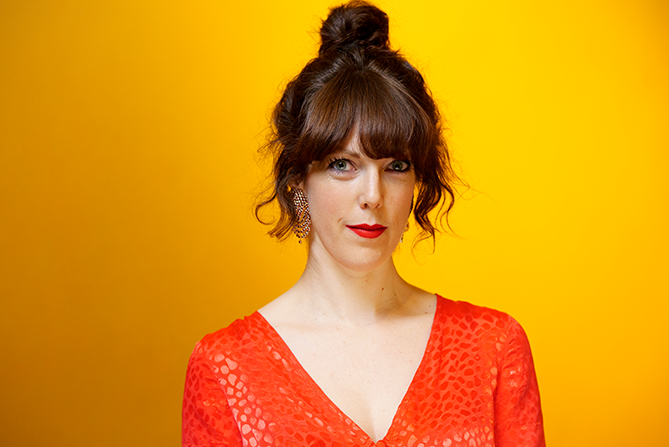
Johanne Lykke Holm on gender, witches, and doppelgängers.
PEN Transmissions is English PEN’s magazine for international and translated voices. PEN’s members are the backbone of our work, helping us to support international literature, campaign for writers at risk, and advocate for the freedom to write and read. If you are able, please consider becoming an English PEN member and joining our community of over 1,000 readers and writers. Join now.
Johanne – thank you so much for talking to me. Your novel Strega is an enchanting and eerie exploration of girlhood, violence against women, and the aesthetic of artificiality. I’d like to begin by asking you about the novel’s opening. ‘A woman’s life could at any point be turned into a crime scene’ – you’ve previously said that this is an obvious and straightforward sentence to you. How does this idea inform the rest of the story? Was violence against women something you actively set out to write about?
I wanted to write about this internal construction which I believe all women (and I use this word with no regard to biology) carry within them – this embedded patriarchy, this misogyny implanted in the flesh, which shows up, in my experience, as a sort of evil filter: it informs the way we see things.
I wrote that image on the first page of the book, where Rafa looks down on her messy girlhood bed and simply lists what she sees and, all of a sudden, this filter is activated inside her, the internal construction, informing her that this presumably innocent image carries violence inside it. It isn’t innocent at all; it actually looks like a crime scene. The women in the book go through the world with this filter always activated, as if the ‘real’ world is obscured or transformed by how they have been taught to view things, this notion that they’re always in danger. They see the world through this darkened mirror, where everything is potential death or violence or exploitation.
This also means that there’s a doubling effect. Say that I’m standing by some alpine lake, looking at a panoramic view in blazing sunlight, and I’m suddenly overflown with scenes of dead women buried at the bottom of the lake, and so the lake transforms: the panoramic view of a glittering lake becomes the panoramic view of murdered women. I realise that it’s macabre, but I also know that this way of seeing, this proximity to darkness, is at the very core of my writing. It’s like I’m trying to write what has been placed in the shadows instead of what lives in the light.
The world in Strega is very much a women’s one. There are the young girls, the three hoteliers, and the nuns who live in the neighbouring convent. Only once do we hear a male character speak directly, and his one line is somewhat absurd. Was this a conscious choice?
Yes, it was, a very conscious choice. The men are subjected to strongly patriarchal treatment in Strega. When they appear – which, as you say, they hardly do – they are reduced to stereotypes or archetypes. The Hunter, The Father, The Lover, etc. And The Murderer, of course. The archetypal killer. I feel for them, these male paper dolls. It’s not intended as a punishment; it’s not a turning of the tables. It’s more about writing the patriarchal structure as a prison inside which we all suffer inside – including the men, the boys, the tormentors. A prison where all the doors are wide open, and we could choose to leave whenever.
When I wrote the book, this was all very intuitive. It feels important to mention that: when I’m writing a book, I know very little about it. Writing is not an intellectual practice to me, not a practice of the critical mind. It’s all very physical and uncanny and thrilling. In my first novel, there is a sentence about ‘the dark matter of the brain,’ and that’s where I imagine my books are coming from, meaning I’ve realised most of these things much later, when talking about the book and reading from it. I know what I set out to do, but I’m not sure what I’ve done. The reader always knows the book more intimately than me.
It feels like the novel portrays women as being inextricably tied to their material belongings – even in death, the two seem to go hand in hand. As Rafa says, ‘Strega was a murdered woman and her belongings. Her suitcase, her hair, her little boxes of liquorice and chocolate.’ When one of the girls, Cassie, goes missing, her possessions seem to gain a mythic quality and power. Could you speak a little about the relevance of objects in the novel and their connection to girlhood?
This is a wonderful observation. I’m obsessed with objects, or more specifically objects in literature – the listing of things on the first pages of Rainer Maria Rilke’s The Notebooks of Malte Laurids Brigge; the way Elfriede Jelinek turns post-war Austria into an uncanny postcard in Wonderful, Wonderful Times; the eerie sweater that appears at a market far from home in Marie N’Diaye’s Ladivine.
And yes, in Strega the objects absolutely belong to the realm of the girl. In that realm, in the girly spaces, I believe the objects are sacred. And things like transcendence and enchantment are deeply connected to things, to materiality. To do things with your hands, to collect amulets and trinkets, to regard a trivial object as precious. And, of course, to be an object in the eyes of others.
I think my obsession with objects might also be rooted in this ongoing visceral reaction to the old, false (but somehow not dead) idea of the writer as some disembodied thinking entity that exists outside the world, on top of the world. Some disembodied and white entity, I should say. This idea of the writer as a disciplinarian, a puppet master, someone in complete control of people and objects – it infuriates me. To me, writing is quite the opposite. It’s all about conjuring something unknown, or something known but not yet visible, through surrendering, through letting go of control, through being very much inside the world and inside your own body. And it’s very much about language as a magic material that’s impossible to discipline.
There’s this quote from Borges that I love. It’s from his Norton Lectures at Harvard in the late 60s. He says:
Language is not, as we are led to suppose by the dictionary, the invention of academics or philologists. Rather, it has been evolved through time, through a long time, by peasants, by fishermen, by hunters, by riders. It did not come from the libraries; it came from the fields, from the sea, from rivers, from night, from the dawn. Thus, we have in language the fact (and this seems obvious to me) that words began, in a sense, as magic.
I also wanted to ask you about doppelgängers, and the idea that women exist simultaneously as their true selves and as a constructed image only performing themselves. The girls are often described through doll imagery, or with a sense of artificiality – Rafa says she feels tired of having to ‘arrange oneself into a woman each morning,’ and the hotel is described as looking ‘like a doll’s house.’ One scene that stood out to me in particular was Cassie’s dance recital during the ball, in which she is replaced by a doll – (spoiler) the last time we see Cassie alive. Do you think all women have a doppelgänger? And do all women have this potential to be replaced by their fake version?
The dance scene you’re mentioning is actually a nod to the ballet Coppélia, or The Girl with the Enamel Eyes, which is based on E. T. A. Hoffmann’s doppelgänger classic, ‘The Sandman’. It’s such a weird and uncanny ballet, and I remember being obsessed with it when I wrote the book.
And yes, I love a good doppelgänger. Take Deborah Levy’s incredible August Blue, where the doppelgänger is everything. She is the key to everything; without her, no book. Levy makes the protagonist hyper-visible to the reader by giving her a double, an illusive sister, a mirror image. We have the ‘true’ Elsa M. Anderson and we have her shadow, this sweet but eerie clone, this wise replica. In some scenes she’s like a friendly spirit, and in others she’s this all-knowing and somewhat uncanny twin. Elsa is written from the inside and from the outside, all at once. And so, the doppelgänger is a wonderful reminder that literature has nothing to do with psychology or realism. An anti-psychological and mysterious embodiment of the weird situation of being a woman. It’s the most wonderful literary trick!
In Strega, on the other hand, Cassie is actually replaced. Girl becomes doll; authentic becomes fake; alive becomes dead – which I think is different, maybe because it’s a vanishing trick instead of a doubling. Cassie the Girl is replaced by Cassie the Doll Corpse. She is replaced by a replica of a beautiful dead girl, but we never see her again; there is no actual corpse, and we don’t know if she’s dead or alive. It’s like she gets swallowed by her evil doll twin, or disappears into the stage floor like the protagonist in Ingeborg Bachmann’s Malina disappears into the wall of her study. A murder without a body, without consequences.
But to answer your question more directly: I think that everyone who has experienced any kind of exploitation or marginalisation has a deeper understanding of what it means to be double. You learn to put on a mask or a costume. You learn to hide. You might have to become a doll, become fake, become several people.
Beauty standards are also a constant preoccupation for the girls, fears of ugliness lingering even after death (Rafa talks about her desire to be ‘a beautiful corpse’ – ‘I would take care not to be ugly when it happened’). It feels like the girls are always performing to a male gaze, even when no men are present; the potential arrival of a male guest seems to loom constantly. The hoteliers even force the girls to lose weight, giving them a jar of dieting powder for their breakfast. How do your perceptions of girlhood and growing up inflect this?
I grew up in Scandinavia in the late 90s and early 00s, meaning that I grew up in what was viewed as a very progressive feminist context. I also grew up in a context where magazines for tween girls consisted of dieting tips and articles about how to make boys want you. I’m a child of this weird era, where these very radical feminist fanzines co-existed with these horrible commercials with models who were made to look like very thin, attractive corpses. I remember one issue of a magazine in which the models were placed in a chaotic hotel room that looked exactly like a crime scene. Their makeup looked like bruises and their dresses were pulled up by force. They were passive, like mannequins slumped over furniture. It was hot to look like a dead girl back then. It was also hot to be an anarcha-feminist. I sometimes think that I became a teenager on the cusp of two conflicting realities. The generation of lost girls.
I also have this vivid memory of walking through a snowy Stockholm in my late teens, on my way home from a party in high heels and too-little clothes, when I noticed a car driving slowly behind me. I remember being terrified, but I also remember thinking: ‘How do I look?’ Not ‘How do I escape?’ but ‘How do I look?’ It turned out to be some tourists looking for an address in the middle of the night. So yes, I think there is a direct link between my lived experience and that of the girls in the book. I’m just as fucked up as they are.
While some might see the novel’s female collective as a kind of feminist ideal, you’ve spoken elsewhere about the complicity the girls seem to display towards violence against women. In one scene, Rafa and Alba play at behaving like men and fantasise about killing a barmaid, before working on their list of murdered girls. Why do you think the girls display this complicity? Is it somehow a means of protecting themselves from a violence that is otherwise inevitable?
I don’t think it’s just a book about sisterhood. It’s also a book about being complicit in your own destruction, just as you say. The girls are playing with fire, in different ways. They have a fantasy of changing places with the killer, of becoming the violent ones, not just to avoid victimisation, but because they imagine it would give them power and pleasure. There’s this hunger, this bloodlust. They don’t just become sad when Cassie disappears; they also get excited. It’s the most confusing part of the book, to me. I’m not sure what I think about it. But no, the book isn’t just a feminist critique of patriarchal violence. It is also an obsessive investigation of that violence, a longing to be close to the violence. It’s all very sick, I think. Haha!
Finally, I’d love to ask you more about the novel’s title, ‘Strega’ – ‘witch’ in Italian. While you were writing, were you thinking of the girls or the hoteliers or the nuns as kinds of witches? Or all of them, perhaps?
Oh yes, they are all witches. The nuns especially, in my opinion. They are intellectuals, herbalists, sisters. But they are also living in a patriarchal order so strong that no man needs to be present to uphold it. Daddy is someplace else, but that doesn’t matter, they follow his rules anyway. The book takes place in all these separatist spaces that remain patriarchal – the prison doors are open but no one leaves. The patriarchy is written as a form of haunting, maybe. I mean, without patriarchy there wouldn’t have been any witches. The existence of witches is proof of the patriarchy. Outside of that murderous system, they would just have been weird people, you know.
Johanne Lykke Holm (b. 1987) is an author and literary translator who is establishing herself among the most promising up-and-coming literary authors in Sweden. She has translated Yahya Hassan, Olga Ravn, Josefine Klougart and others into Swedish. Her novel STREGA was published in 13 languages and shortlisted for the Nordic Council Literary Prize, the European Union Prize for Literature and the Strega Prize in Italy. Film rights have been optioned. She lives in Malmö. Her fourth novel, Smoke & Mirrors, will be published next year.
Interview by Eleanor Antoniou.