Tag: myanmar

  • Creativity Rests in Hunting for the Freedom We Want to Have

    Creativity Rests in Hunting for the Freedom We Want to Have

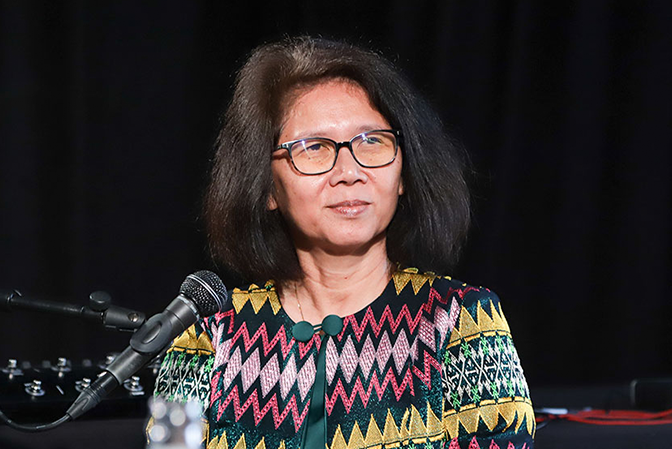
    Ma Thida on freedom, art, and Myanmar.

    PEN Transmissions is English PEN’s magazine for international and translated voices. PEN’s members are the backbone of our work, helping us to support international literature, campaign for writers at risk, and advocate for the freedom to write and read. If you are able, please consider becoming an English PEN member and joining our community of over 1,000 readers and writers. Join now.

    Freedom is generally seen as the fundamental right of each person to act, speak and think without hindrance or compulsion. People need freedom to chase their dreams and voice their convictions. We normally believe that to nurture and enable the growth of imagination and innovation, freedom is essential. But the reverse is true, too: freedom finds its fullest expression through creativity. This is why I say: creativity rests not just in the freedom we have, but also in hunting for freedom we want.

    Before 20 August 2012, the environment for freedom in Myanmar was grim: enduring, extensive and prolonged censorship, alongside comprehensive state propaganda. Then, on that day, the pre-printing censorship process was suspended. But though the so-called freedom of the press was introduced, writers and the media could still not feel free; they remained tightly bound by their subconscious minds, shaped by decades-long state censorship, and the pen remained chained to the hand of censorious peers and the censorious self. Self-censorship was ingrained, and it took time to find an exit. And peer-censorship was even more sensitive – it was novel, stemming from new forms of group pressure, and would require new forms of resistance.

    While ‘media freedom’ became a positive catchphrase among political activists who had lacked the opportunity or privilege to apply for publishing licences throughout the military era, there were other sides to it, too. Many military-backed media outlets were recklessly disseminating the horrific news from Rakhine state without adhering to journalistic ethics, fanning the flames of hatred ignited by racial and religious discrimination. Censorship – all the barriers to a free press – was an obstacle in addressing hate speech propaganda – something the PEN Charter sees as an ‘evil’ of the free press. I doubted the new ‘freedom’ we had in 2012.

    ~

    In 2013, with the establishment of organisation registration laws, PEN Myanmar was formed. We employed creativity and engaged in numerous expressive projects to pursue the true freedom we desired. PEN Myanmar’s first project, the Conflict-Sensitive Media Monitoring Survey, aimed to uncover evidence of how media freedom had been exploited to fuel hatred and social discord, identifying both the perpetrators and the media platforms utilised for such purposes. Across 2014 and 2015, we undertook various projects – ‘peace writing contests’ for short stories and poetry, poetry slams, ‘literature for everyone’ (Yatha Asone Asan) initiatives, literary evenings – designed to fight the fight against hate speech, promote peace through creative expression, engage with minority language communities and, crucially, provide a platform for communities to exercise their right to free expression while nurturing an essential and vibrant literary culture.

    One standout project was Literature for Everyone Creative Expression (LFECE). Literary talks have been popular throughout Myanmar’s history – albeit usually adopting a lecture-style approach. While some reading groups would hold discussion-based events, they were not accessible to the broader public. With civil liberties a fundamental principle for democracy, PEN Myanmar endeavoured to establish LFECE as an inclusive, aesthetically driven, secure platform.

    Over the space of a decade, PEN Myanmar organised over 150 LFECE events, across fourteen states and divisions and in the Naypyidaw region. Participants from diverse backgrounds – students, farmers, labourers, office workers, religious practitioners, writers, literature enthusiasts from different ethnic groups – joined these activities. But as that decade passed, regulations were imposed on such literary talks, due to the perception that they often veered into political discourse – advocating for democracy, criticising the military, and scrutinising the government of the time. Obtaining permission to hold them became harder. Our LFECE events took place in small communal venues – monasteries, libraries and churches, with smaller groups of attendees. We had to be creative. But it meant we could engage with local writers, poets and – especially – youth who were aspiring to become authors.

    The fundamental requirement for participation in this project was wholehearted engagement. Members of PEN Myanmar – renowned writers and those writing anonymous– would recite their works or sometimes works they admired, inviting the audience to respond either through commentary or by presenting their own pieces (regardless of whether they had been published). Occasionally, members would deliver poetry or visual performances, encouraging active participation from the audience. And in many instances the audience responses exceeded expectations. In one village, an illiterate farmer joyfully contributed impromptu poetry, likening her experience to the rising sun despite her age being akin to sunset. Her expression of freedom was applauded by the entire audience.

    The true success of this endeavour lay in the community’s belief that, through LFECE, they had begun to recognise the role of creativity and literature in advancing and safeguarding freedom. They had gained the opportunity to share their creative expressions on an equal footing with well-known writers and poets, and had learned how to engage in respectful, mutually listening discussions on other political, economic and social issues. In many instances, community members were moved to tears, their voices genuinely heard and valued, a newfound freedom they had never before encountered.

    ~

    PEN Myanmar’s leadership was able to establish relatively accessible channels of communication with the National League for Democracy (NLD) government. Consequently, we intensified our advocacy efforts, conducting initiatives such as a ‘Freedom of Expression Roadshow’ to fourteen regional parliaments, campaigning for the Right to Information Bill. We continued to focus on informative, analytical and creative endeavours, including Edu-entertainment programmes promoting federal democracy, conducting ‘literature inclusiveness surveys’, and facilitating capacity-building programmes that trained student union members to become champions of freedom of expression. We continued to organise numerous literature-related activities – LFECE, the Link the Wor(l)ds translation workshop, Collective Dream poetry performances, literary cafés, literature evenings, a short-story writing curriculum, screen-writing courses, and creative writing workshops featuring both international and local authors.

    Many writers’ organisations in Myanmar prioritise purely literary endeavours, often misconstruing PEN Myanmar’s initiatives as reliant on foreign funding. But our primary objective has always been to safeguard and advance freedom of expression, fostering a vibrant literary culture and establishing a connection between formal education and literature. Despite criticism, we have merely employed creativity in our activities to pursue the freedom we aspire to achieve.

    I steadfastly believe in the power of creativity as a means to broaden our freedoms, recognising freedom is not fully attainable only through practical means – especially in my country. The act of being creative doesn’t require permission from external entities, including censorship boards. But once our creative acts are published, our physical and social freedoms become endangered. Repressive regimes curtail our civil liberties, arbitrarily arresting us and imprisoning us as means to control and suppress dissent. And so when it comes to creativity, freedom is not simply a matter of chance. It is a result of a conscious choice.

    ~

    After the coup in 2021, several writers met untimely deaths. Others endured arrest and imprisonment. Others found themselves without platforms to exhibit their work as the military revoked news outlets’ licenses. But, despite the upheaval, many writers remain in Myanmar, continuing to write without expecting publication, financial gain, recognition, applause; without fear. They have harnessed their creative freedom to explore diverse means for readers to interact with their creations.

    Before the coup, many writers and poets actively contributed to online platforms, attracting sizeable audiences. But the surge in arbitrary arrests linked to social media posts has led to a reluctance – on 13 April 2023, Kyaw Min Swe, an editor and journalist, was apprehended by the military shortly after he changed his profile picture to a black image in solidarity with the victims of airstrikes on a village in Sagaing Region. Meanwhile, the doubling of data prices and the rising cost of SIM cards, combined with the decrease in writers’ incomes, has greatly restricted online accessibility. Nevertheless, over time new online magazines and YouTube channels (operating from foreign countries) have emerged and gained traction, notably supporting fundraising efforts for the Spring Revolution against the resurgence of military. From time to time, these channels also release audiobooks of well-known novels and short stories.

    In March 2021, the military announced that issues falling under the purview of the News Media Law and the Printing and Publishing Law would be subject to adjudication in military courts. These courts possess the authority to impose capital punishment. Despite the prohibition of certain pro-revolution writers’ works in local bookstores, some publishing houses have managed to release novels and other literary works. While some writers still find it necessary to remain in hiding, book launches have become spaces where some can safely engage with the public.

    ~

    The enactment of the Organisation Registration Law in October 2022 intensified requirements on associations like PEN Myanmar, with severe penalties for activities that diverge from the regulations. Now we require additional creativity to sustain our work, with our members dispersed across various locations. I cannot divulge the current activities of PEN Myanmar. What I can affirm is that we continue to employ our creativity in pursuit of the freedom we aspire to achieve.

    Writing demands reflective time. For writers, creativity is not only about freedom but also about the pursuit of it. Censorship restricts the publication of literature, but not its essence of freedom. Tragically, in June 2023, Nyi Pu Lay, president of PEN Myanmar, passed away due to a medical emergency while in hiding. But we discovered that, in that time, he had penned numerous short stories under pseudonyms, and sketched landscapes from various parts of the world. He had used his artistic ingenuity to carve out the freedom he sought.


    Ma Thida is a medical doctor, writer, human rights activist and former prisoner of conscience. In 1993, she was sentenced to 20 years in prison for practicing freedom of speech but was released in 1999. She was awarded international human rights awards, including the Reebok Human Rights Award, the PEN/Barbara Goldsmith Freedom to Write Award, Freedom of Speech Award and Disturbing the Peace; Courageous Writer at Risk Award. She was the inaugural elected president of PEN Myanmar from 2013 till 2016.  She served as a board member of PEN International from 2016, until she was elected as chair of their Writers in Prison Committee in 2021. She was a research associate at Southeast Asia Studies council at Yale University for 2021–2022. She moved to Germany as a fellow of Martin Roth Initiative for 2022–2023, and is currently a fellow of the Writers in Exile programme of PEN Germany. 

  • The peacock and the pen

    ‘Look, I wrote a poem about a peacock and a lion!’ your youngest granddaughter says, rushing into the room, brandishing her school notebook.

    They’ll see right through that, you want to tell her. Cut the peacock and pick something subtler. But you hold your tongue, and pull up your reading glasses. She’s only little. She probably doesn’t even understand what writing about a peacock means. More to the point, it doesn’t matter any more! She can write what she likes. As can I, you remind yourself.

    ‘Do you think it’s good, Grandma?’

    You peer at her scrawls more closely. ‘Why don’t you go and type it up, dear, on the new computer, so I can read it in large print.’

    She scampers off.

    You remember what you were told when you first started to write seriously:

    You’re not allowed to publish anything without 50 copies of it being sent in advance to the censorship board. You’re not allowed to write anything containing an explicit mention of sex. You’re not allowed to write anything that could possibly be seen as critical of Buddhism or the military or the government. Don’t even think about mentioning inflammatory names, like Aung San Suu Kyi, or any of the other names used to refer to her, like the Lady, the Rose, or the Peacock – even in allegorical stories. In fact, be wary of metaphor generally.

    If you really want to write fiction, here’s what it should look like: realist short stories in accessible but appropriately formal literary language about ordinary workers who struggle valiantly to leave good lives in the noble service of the state. Write these well enough and you might be nominated for the National Literary Prize.

    Or, if you’re more interested in sales than prizes, you can try writing romances, comedies (provided they’re not satirical), fantastical horror stories (provided there’s no hint of allegory), and Buddhist self-help books. You might make a living from that if you work hard enough.

    But although you were desperate to write, you hated the government and you didn’t want to go down any of those roads. You read up on postmodernism, and learned how to write poems so obscure that you could pack them with radical messages about freedom and democracy without the censors having a clue. A publisher picked them up and you published two collections. The problem was, most of your readers didn’t have a clue about either the messages or postmodernism in general, so you sold pitifully few copies.

    You wondered whether you should risk writing something more accessible that pushed the boundaries, and see if your publisher would agree to print 50 copies to send to the censorship board. If he agreed, you knew the best case scenario: they would return a copy to him with a few sentences painted out and you would have to accept all the changes. Next best: they would ban the book and you would have wasted your time. Worse: they would blacklist your pen name and your writing career would be shafted. Worst: a kangaroo trial followed by prison. And you knew what went on in prisons.

    You were introduced to a family friend who told you how she had been trafficked to Thailand where she was horribly abused. Her story moved you, and a novel poured out of you in less than a month. Your publisher read it, and said it was good but too controversial. You insisted it wasn’t directly political, or at least, it didn’t criticise the government, just the traffickers, and none of the sex was explicit. He finally agreed, reluctantly, to try sending it in. But within two weeks you’d got a blacklisting letter, and your publisher was given a warning that if he tried anything like that again his publishing house would be shut down. Never again, he said, testily.

    You decided to write a cheesy, uncontroversial romance under your own name, just to get some more words in print. It was quite fun, actually, sold pretty well, and led to your first agony aunt column.

    As the years ticked past, and you churned out more formulaic love stories and columns, you became increasingly frustrated. You had a growing sense that the outside world was changing, and that Myanmar was being left behind.

    A young friend of yours was selected to take part in a writers’ programme in the United States, and came back raving about how grand and gleaming it was, how interested people were, how you could write anything you wanted. You wondered about applying for the same programme, but felt you were getting too old. You wished there was at least more contemporary fiction around for you to read.

    And then the rumours began about a ‘transition’. I’ve heard that one before, you thought. But the rumours persisted, and in 2012 there was a by-election, in which Aung San Suu Kyi was allowed to run, leading the National League for Democracy. She won by a landslide, and though this only meant a small minority of seats in parliament, it was progress.

    One day, you heard even more astonishing news: the 1962 censorship law had been repealed. Scrapped. We can write anything we want! a writer friend of yours exclaimed in a local teashop, as incredulous as you. The following week, another writer friend was released from prison after ten years behind bars. You all got together, treated yourselves to a mountain of deep-fried okra, and celebrated for a whole afternoon.

    Still, you found you couldn’t really believe that it was real, this freedom. For a while you waited, you watched. When a young poet was imprisoned for a poem mocking the president on Facebook, you muttered: I knew it.

    Even when the NLD won again at the national election in 2015, and the world cheered that Myanmar was finally a democracy, it wasn’t really. Not yet. The military had still kept a grip on 25% of seats in parliament, and you couldn’t trust them.

    Other writers, especially the younger ones, were going for it regardless. Breaking through the old taboos, writing about politics, drugs, sex – the works. They all seemed to be safe. I should try it, you told yourself. I’ve waited long enough. So you got in touch with your publisher, and your banned novel was published straight away. It was quite something, to see people reading it freely in teashops. Your toes curled with delight, every time.

    But when you got out your pen, and sat down at your desk with your notepad to start something new, you found it wasn’t so easy. What to write about? All you could think about was telling people about the regime’s abuses. There was no need to disguise it in postmodernist complexity any more, and yet you still feared being explicit. Perhaps, you thought, I’ll try to write about the future instead. But what will the future look like?

    Your granddaughter prances back in, waving a piece of paper. ‘Grandma, here you go, in big print!’ she says. ‘I just posted it on Facebook and it’s already got twenty likes. Tell me if you like it too?’

  • The hidden languages of Burma

    Following recent political reforms, Lucas Stewart investigates the impact on writers in the country, and whether there is real change in the air for ethnic literature and languagesHis name is Saw Myint Zaw.  He is from Karen State in Eastern Burma.  He writes in the Sgaw language. You probably have never heard of him.  I hadn’t either until a few months ago.  Yet he offers a symbol of what we don’t know about ‘Burmese’ literature.  A literature that belongs to 40% of Burma’s people and yet is barely read or recognised within their own borders.  A literature that has been systemically repressed by successive governments in an attempt to ‘Burmanise’ the 135 ethnic groups in Burma. A literature without translation.I came to Burma two and half years ago.  I now co-ordinate Hidden Words, Hidden Worlds, a 3-year British Council project encouraging freedom of expression for ethnic groups in Burma through short stories.  Eager to dig into this genre, but shamefully constrained by my poor Burmese, I bought every anthology translated into English that I could find.In the beginning I found two wonderful short story collections by Daw Khin Myo Chit, both over 40 years old and largely set in Yangon, the city she lived in; a 60-year-old Columbia University reprint of Journal Kyaw Ma Ma Lay’s biography of her husband, U Chit Maung, also written and set in Yangon, and a cultural guide to Burmese festivals.In all, I discovered only 24 translated works of any genre, spanning six decades, of which only two were short story collections published in the last 10 years: Myanmar Short stories translated by Ma Thanegi and Classic Night at Café Blue’s by San Lin Tun.Burmese novelist and literary activist Dr Ma Thida (Sanchuang) defined the reasons for this in her recent Guardian article on literature and censorship. But things have changed now, right?In the time I have been here, the Press Scrutiny and Registration Division has been abolished, writers such as Nay Phone Latt, Zarganar and U Zeyar have been released from jail, and ethnic minorities have been given the legal right to teach and develop their own literature. Sweeping, total changes that demand to be applauded.And yet, for every literary reform policy that bursts free from Thein Sein’s office – and is so duly celebrated by the international press – those reforms, when looked at closely, aren’t always what they seem.Pre-publication censorship has been abolished, true; but a new media bill, drafted by the Ministry of Information without consultation with writers, editors or journalists, and recently passed through the lower house of parliament, threatens to replace the old, draconian 1962 Printers and Publishers Registration Act with similarly repressive parameters.  Only now, you can be arrested and imprisoned after publication, not before.Writers have been released, but some political prisoners have been forced to sign an official release letter which states that any future arrests, regardless of the offence, will result in the offender being returned to jail to see out the remainder of their sentence.  Put simply, the blogger Nay Phone Latt, sentenced to 20-and-a-half years for ‘creating public alarm’ but freed after four, could spend another 16 years in jail for not paying his parking tickets.Which leads me to the writers from ethnic communities.On 15 June 2012, the Minister for Education, Dr Mya Aye, announced that ethnic languages and literature would be taught up to second grade in state schools for the first time.Teaching ethnic literature in schools has been forbidden since 1964, because of a fear of communities rallying behind an identity that is not ‘Burmese’.  Similarly, the publication of ethnic language texts, both educational and literary, was banned.   The effect this has had on the creative output of ethnic writers, who have been forced to write in Burmese or publish in their own language in the underground press, needs no exaggeration.To halt the decline in their literature, these ethnic communities formed regional cultural and literature organisations in the 1950’s and 60’s.  Surprisingly, the central government turned a blind eye to the activities of these associations; as one Karen literature committee member put it to me recently, “It’s a grey area.  They know exactly what we do, they have informers, but as long as we don’t do anything political they leave us alone.”And yet, I have still to read a significant work of fiction, in translation, from an ethnic author.This might be because all but one of the regional literature associations are still illegal, despite the recent reforms.  The associations are wary of placing themselves under the central control of a government noted for its corruption.  A five-decade-old policy of linguistic and literary suppression has bred a suspicion in the associations that will be hard to dispel.  One Karen Literature committee member suggested to me they would consider registering their association when Karen state elects an ethnic Karen Chief Minister. To give an example of a different region – in the Kayin State the current  State Chief Minister is U Zaw Min, an ex-general, a USDP party member, personally appointed by Thein Sein and presumably recommended for the position by the Tatmadaw army chiefs. No surprise literature associations are cautious about registering.But by refusing to register, they receive no assistance, money or resources from the Ministries of Culture or Education.  As illegal organisations they are also unable to receive external funding through the regular channels.As a result these regional literature associations survive solely on community donations from villagers, merchants and religious institutions.  Each with varied degrees of success…The Karen Culture and Literature Association, formed in the early 1950’s, is better funded than others due to its proximity to the Thai border.  Black market trade has allowed the association to print Karen language proverbs; a Karen-English dictionary is in the draft stage; while the bulk of the Association’s budget goes towards an annual summer camp.  For four weeks between April and May, up to 10,000 junior and high school students in 30 to 40 villages across Karen state are tutored in the local languages though creative writing, short stories and essay competitions.  The summer camp ends in June with a 3-day regional summit for 2,500 people at a cost of $30,000.Others, such as the Kachin Culture Association and its sub-committee, the Kachin Literature Association, far in the north of Upper Burma, still operate within a civil war environment where cross-border trade has become negligible and people have become dislocated from their communities through forced resettlement.  They have yet to see the benefits of last year’s ‘historic’ edict.“We work out of churches, most of our teachers can’t even write Jingpaw [the dominant language among the 6 major Kachin ethnic groups] and we have no money,” a Kachin Literature sub-committee official told me.  “What about English translations of Kachin literature?” I asked.  The committee member replied, “We can’t afford the paper.”And they are not the only ones.Political instability, remoteness and a non-existent market for ethnic works in Burma’s main cities have only served to isolate the regional literature associations from their peers in the literary centres of big cities like Yangon and Mandalay.  Yangon-based publishing and writers associations, such as the Myanmar Publisher and Booksellers Association and the Myanmar Writers Union, both formed only a year ago out of the ashes of the government-regulated Myanmar Writers and Journalistic Association, are facing their own struggles in terms of indigenous readership.   General print runs of paperbacks in any genre, literary or commercial, range from only 500 to a 1000, with national bestsellers rarely running at more th
    an 5,000.  With the sale cost of a printed work in Yangon running at an average of $2,40, 50% goes to the publishers, 15-20% to the author and the rest to the bookseller.  Literature doesn’t make anyone rich in Burma.Add to this a decayed educational system that values rote learning, a dearth of qualified translators, a decentralised process by which works get selected for translation, and a depressed editorial profession that is only just starting to breathe again.  It is no wonder that the entire Burmese-language-literature in English translation is reduced to post-war reprints and cultural commentaries, such as Dr Maung Maung’s fascinating Aung San of Burma and A Trial in Burma.For the ethnic writers, their situation at the moment is even more dismal.  Translation from their regional language into Burmese has a limited market and limited interest in the major Burmese cities.  Translation into English is the territory of 19th
    Century ethno-linguistic academics like Jonathon Wades Thesaurus of Karen Knowledge. For now, the ethnic regional literature committees are on their own.Yet, Thein Sein has triggered a cautious renaissance that will be difficult to subdue, regardless of what happens in the coming years.  The growth of regional literature associations is intertwined with the growth of publishers and professional writers’ organisations in Yangon.  One hopes that as publishing companies start being in touch with the international literary world, so too will the regional associations be provided with translation opportunities for their own writers.Writers such as Saw Myint Zaw.About the authorLucas Stewart have lived in Qatar, Iraq, Brunei, Philippines, Indonesia, South Korea and Myanmar.  He is currently working as Literature Advisor to the British Council’s Hidden Words Hidden Worlds ethnic literature project and assisted British Council in organising the first Burmese Book Slam. He blogs at sadaik.com (an English language blog on Myanmar literature).Additional informationDr Maung Maung’s Aung San of Burma and A Trial in Burma, both originally published overseas in 1962, was reprinted in Burma through Unity Publishers last year.U Thaw Kaung’s  Myanmar Wonderland, 38 short essays written in the 1980’s and 1990’s for the Today Journal and was published collectively this year.Thesaurus of Karen Knowledge, published in 1850 is accessible through  www.burmalibrary.org and small, overseas ethnic community organisations such as the Karen Drum Publication Group.