Tag: Nedim Turfent

  • Something Shadowless, Like You: Nedim Türfent Writes Back to Ai Weiwei from Prison

    Something Shadowless, Like You: Nedim Türfent Writes Back to Ai Weiwei from Prison

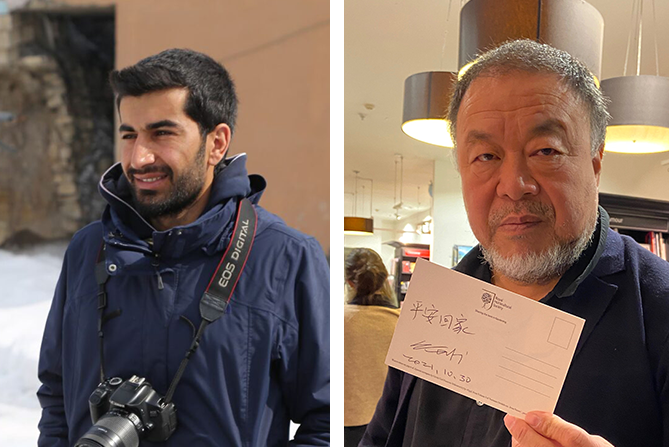
    Kurdish poet and journalist Nedim Türfent writes to Ai Weiwei, who has sent a postcard to Türfent as part of the PENWrites campaign .

    PEN Transmissions is English PEN’s magazine for international and translated voices. PEN’s members are the backbone of our work, helping us to support international literature, campaign for writers at risk, and advocate for the freedom to write and read. If you are able, please consider becoming an English PEN member and joining our community of over 1,000 readers and writers. Join now.

    Kurdish poet, journalist, and Honorary Member of English PEN Nedim Türfent was arrested on 12 May 2016 after reporting on Turkish special police forces’ ill-treatment of Turkish and Kurdish workers. Soon after his damning video footage was published, Türfent began receiving death threats from the police and was the target of online harassment. One day after his arrest, Türfent was charged with ‘membership of a terrorist organisation.’ At a show trial intended to punish him for his truth-telling journalism, the court sentenced him to eight years and nine months in prison, where he remains today.

    Nedim Türfent is a featured writer in the PENWrites campaign, English PEN’s international letter-writing campaign in solidarity with writers in prison and at risk around the world. Join Ai Weiwei in sending a message of solidarity through our PENWrites campaign.

    ~

    Dear Ai Weiwei,

    First, I want to say kia ora to your unique and poetic heart. Though I don’t have adequate conditions or opportunities to follow everything you are doing, I know you are doing your best for me. Not only for me, but also for all who are in a quest for justice. I know very well that, as you said two years ago in your interview with the Guardian, when you ‘see people victimised’ by iron fists, you are a ‘soldier in defending their freedom’.

    To tell the truth, I heard of, knew of, and met you for the first time whilst in prison. What a pity! What a big shame for me! Two years ago, I read that interview and knew you more. And later, I was informed that you had carried out an act of art for me, in order to draw attention to my situation and my story.

    In the most extensive sense of the word, I’m grateful to you.

    This is an honour for me. I pay my respects to your solidarity and support. I hope that your voice makes an impact in this long road to justice.

    My dear friend, I’m sure you can imagine that it’s hard for me to pen a letter in inadequate English and with inadequate knowledge. I am so excited! Beads of sweat are on my forehead. My little heart is a marathon runner. But I have the big smile of a toothbrush advert on my face. Words are not enough today. I need something different. Something shadowless, like you.

    I have been behind bars for years. Not easy for the tongue! There’s no stated date for my release. But know that your hand of solidarity makes my humble world brighter, more resistible, more tolerable. Together, we can overcome this grotesque injustice. Justice. I have been demanding justice for years. But they are delivering just ice. That is all.

    Today, if I have even a handful of motivation to compose poetry, or to hope, it is due to you. Without you, I’m nothing and nobody.

    With you, I am hopeful, despite everything. I have imagination. I have words and I have friends like you. What’s more, I ‘have a great monster to fight’. That’s enough for me.

    In my humble opinion, we share the same dream about the world, and we are aware of the same nightmare.

    According to the interview, if I’m not wrong, ‘weiwei’ means ‘future’. So, for now, my great face-to-face meeting with Ai Weiwei will take place in the weiwei. I look forward to this great day.

    My dear friend, please accept this modest letter as a token of my deep gratitude. Thank you so much for everything. Or, in my mother tongue, Kurdish, zor spas.

    Always yours,

    Nedim Türfent


    Nedim Türfent is a Kurdish poet, journalist, and Honorary Member of English PEN and PEN Melbourne. He was arrested on 12 May 2016, shortly after reporting on Turkish special police forces’ ill-treatment of around 40 Turkish and Kurdish workers. One day after his arrest, Türfent was charged with ‘membership of a terrorist organisation’. The indictment was first produced 13 months after his arrest, by which time Türfent had already been jailed for 399 days. Of the 20 witnesses called in his trial, 19 said that their initial statements against Türfent had been obtained under torture. Nevertheless, the court sentenced him to eight years and nine months in prison. 

    Türfent was denied the right to attend his own trial in person, one of many fair trial violations. On 21 May 2019, Turkey’s Supreme Court of Cassation upheld his sentence. His case is still pending before the European Court of Human Rights. 

    While in prison Nedim Türfent has written ‘Kuş Aynası,’ a collection of poetry. Three of his poems – ‘Let My Heart Give Life’ (translated by Barış Altıntaş), ‘Following the Traces of You’ (translated by Caroline Stockford) – and ‘Prisoners Roaring for Freedom’ (translated by Caroline Stockford) are available in English translation.

    Photo credit (r): Sim Eldem, by arrangement with Ai Weiwei’s studio.

  • Hope in a Bottle of Honey

    Hope in a Bottle of Honey

    Kurdish writer Nurcan Baysal responds to a letter from Nedim Türfent

    PEN Transmissions is English PEN’s magazine for international and translated voices. PEN’s members are the backbone of our work, helping us to support international literature, campaign for writers at risk, and advocate for the freedom to write and read. If you are able, please consider becoming an English PEN member and joining our community of over 1,000 readers and writers. Join now.

    I met Nedim on Twitter during the 2015-16 Kurdish curfews. He was passing news from Hakkari Yüksekova, or Gever, a Kurdish city that was under military curfew for months. The last curfew there was between 13 March and 30 May 2016. In these 79 days, 5,000 houses were destroyed, 20,000 people became homeless, and more than 100 people died – one of whom was my children’s babysitter, Dilan.

    At the beginning of May 2016, I received a message from Nedim, telling me that he feared the special operation teams would kill him. I shared this information – that Nedim Türfent, a local journalist, was receiving death threats. Nedim was detained on 12 May 2016.

    I hadn’t heard from Nedim for a year. Like many Kurdish journalists, he was forgotten behind the bars. A year after his arrest, in May 2017, I received a letter from him. He asked for my help in telling his story. He told me that he was alone in a tiny cell, his only company the mice and insects. There were no radios or newspapers in his cell – nothing to read, other than the writing on the cleaning products that kept him going. He longed for a voice, for a face.

    After reading his letter, I was ashamed. With our daily struggle taking its toll, I too had forgotten Nedim in that tiny cell. A day later, I wrote an article about his situation on T24, a Turkish daily internet newspaper. Journalists began to call me and, on 14 June 2017, a group decided to go to Yüksekova and participate Nedim’s first trial. With this, his situation reached a national and international public, and organisations began to take on his case.

    ~

    2017 was very difficult for me. Many of my friends left the country; court cases were opened against me because of my journalism; I lost loved ones during the war. I was depressed, and traumatised, and couldn’t see hope for the future. It was during those days that I received a package from Yüksekova. When I opened it, I found a bottle of honey – of famous Yüksekova honey – with no name, no details of a sender, just a handwritten message: thank you.

    I called the cargo service, and they eventually gave me the phone number of the sender. When I rang it, I reached a honeyseller from a company called Bereket Bal, who told me that a man had visited him, given him my address, and asked him to send me the best honey he had. I put a photo of the bottle of honey on my social media accounts, saying: To those who sent me this wonderful honey, I don’t know who you are, or what I did for you, but thank you – you gave hope to me. I’ve never found the sender. The nearest I came was a private message, from a Twitter user with a fake name, who said: We are a family.

    ~

    Before too long, Nedim and I were regularly writing letters to each other. He misses reading, so in each letter he tells me the books he wants to read, and I try to find them for him.

    In February 2018, the media reported that books including mine and Ahmet Altan’s were prohibited in Turkish prisons. I learnt that the Van prison administration had withheld copies of these from Nedim, because they were ‘a threat to the indivisible unity of the Turkish State’.  The book of mine in question tells the story of the Yazidis, particularly that of the Yazidi women and their suffering at the hands of Islamic State. I still don’t know how this book could possibly be a threat to the indivisible unity of the Turkish state.

    Letter-writing and book deliveries are harder with COVID-19 – a situation with dire impact on Turkey’s prisons. But I still talk every week with Nedim’s family and his sister Şehristan. His health is good, I understand, but the state is using the pandemic as an excuse – as it has in many ways – to limit visiting days at prisons. His family hasn’t seen Nedim for a long time, and though they speak to him by phone every Wednesday, it is only for ten minutes.

    ~

    After a very hard day, on a hot evening in Diyarbakir, whilst writing this piece and thinking about Nedim, the doorbell rings. It is the postman – the first letter since the start of the pandemic. The letter, of course, is from Nedim.

    On the first page, there is a photo of trees. Finding this picture, sourcing the glue, and pasting it onto the letter must have been hard in prison. But he did it. He has given me hope again.

    I can’t reply directly to Nedim, but if I could speak with him I would ask him if he had sent that bottle of honey or not. I would say to him:

    Dear Nedim,

    I hope to meet you on free days, and have breakfast with wonderful Yüksekova honey, among the trees. We are a family.


    Nurcan Baysal is a Kurdish Human rights defender, journalist and writer, reporting from inside the Turkish-Kurdish conflict, from the city of Diyarbakir. She is one of the founders of Diyarbakır Political and Social Research Institute and the Platform to Save Women Kidnapped by ISIS. She is the author of O Gün (That Day), Ezidiler: 73. Ferman (Ezidis: 73rd Decree), O SESLER (THOSE VOICES)  and co-author of Kürdistan’da Sivil Toplum (Civil Society in Kurdistan). 

    She was awarded the Brave Women Journalists Award by the Italian Women Journalists Association in 2017, named 2018 Global Laureate for Human Rights Defenders at Risk by Front Line Defenders, and won the DW Freedom of Speech Award in 2020.

    She currently faces a number of criminal prosecutions in relation to her work.