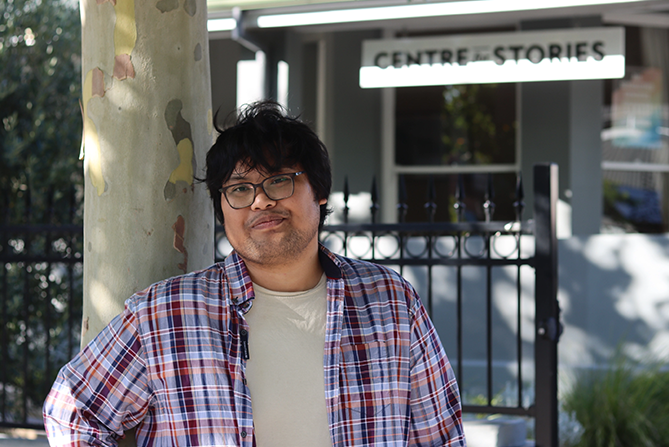
Norman Erikson Pasaribu on a mother’s choice and how writing saved them
PEN Transmissions is English PEN’s magazine for international and translated voices. PEN’s members are the backbone of our work, helping us to support international literature, campaign for writers at risk, and advocate for the freedom to write and read. If you are able, please consider becoming an English PEN member and joining our community of over 1,000 readers and writers. Join now.
Norman Erikson Pasaribu was English PEN x Essex Writers House international writer in residence, in partnership with Metal as part of English PEN’s year-long centenary programme Common Currency. Common Currency featured events, residencies, campaigns and conversations across the UK and Ireland, and was s supported by a National Lottery Project Grant from Arts Council England, British Council, Cockayne Grants for the Arts – a donor advised fund of London Community Foundation – and PEN International. ‘About My Mother (and Other Things in Parentheses)’ was commissioned as part of this residency.
*
1. My mother had me a few days before she turned 24. At that time, she had spent a few years living in the Greater Jakarta area and had tried anything she could get her hands on, to no avail. (1) She wrote poems in her diary – none of them got published. (2) She taught at a primary school in Seroja, Jakarta – her salary was pennies. (3) She applied to public service openings (significant things in Indonesia, because people equated them to a more stable life) – she didn’t pass the written tests. (4) She looked for a theology school that would be excited to accept female students – her older brothers and sisters said there was no money. (Here, as she mentioned in her diary, she stood in a bus stop near the Christian University with an intense nauseous feeling. She wrote that it was sad to be young while having no money. And a few pages after this passage, as I remember it, she started to mention her ex-boyfriend, the one she had in her Old Life.) Around this time, she tried dating – and this particular door (which wasn’t on her list of things to do immediately in her New Life) was wide open for her. And it was with one of her brother-in-law’s acquaintances. And this person was my father.
2. Mamak’s old life, or the Old Life, was narrated to me by her and my aunts as I was growing up. I found her old diary in the unused, small room in our house where she and my father used to store stuff. Her diary was among the things we lost to the Blue Thief, the countless floods we have had since we moved to Bekasi in 1992. Her Old Life, as I remember it now, was peculiar. She was the eighth kid in her family and her Siringo-ringo mother was the eighth wife of a Nainggolan man who, according to one of my aunts, used to be rich but became poor after seven divorces with his ex-wives – none of them gave him kids. And, ironically, not long after having a set of offspring from my grandmother, this man left this world, leaving my grandmother a poor, young widow. In the Old Life, Mamak woke up in the middle of the night to go with my grandmother to sell vegetables in a morning street-market in Medan. In the Old Life, Mamak would take a shower immediately after they got back to their home in Lubuk Pakam so that she could then go and sell home-made snacks door-to-door as she walked to school. And goes on the list of her Old Life: (1) she worked for a brick factory when she was in middle school, (2) she moved to the grander Medan by herself to study in a Teacher’s Academy (equivalent to a vocational high school), where she once had a queer roommate, (3) she joined a Christian choir and competed at national level. In contrast, in her New Life: (a) my mother decided to keep the baby. (b) She married my father in November 1989. (c) In March the next year, I was born.
3. In the 80s, my mother decided to go to Jakarta to look for a better life, like thousands of Batak people in her time and before (my father did his trip in 1979). Jakarta, once known as Jayakarta and then Batavia, had been a port city for centuries. In 1609, the Verenigde Oostindische Compagnie, the Dutch company who colonised and exploited many areas in what we today call Indonesia, made Batavia a capital of its operation. This led to numerous internal migrations from all over Indonesia to Java – a cultural phenomenon that many call ‘rantau’. My mother took a land route to Jakarta: she crossed the long island of Sumatera with a bus. She mentioned, once, her experience of seeing the well-known Ampera Bridge. (The bridge was opened a month after the 1965 Communist Purge.) (And yes – I put this Ampera detail into one of my short stories.)
4. When I was five, our family made a road trip back to my parents’ hometowns. This was an event, because it was expensive to ‘go home’. (One reason among many: the old neighbours would presume you more successful, more sophisticated, because, after all, you were now living in the majestic Jakarta – not a farmer anymore, not feeding pigs anymore, not gathering candlenuts anymore – and so they would teasingly ask you to give them money, or to hold a little thanksgiving lunch for the whole village, and you would eventually do that because you had your pride, and you didn’t want to be rugi dua kali – was poor here, and then is poor there.) We visited my mother’s hometown Lubuk Pakam, and I saw my maternal grandmother for the first time. And then we spent some time in rural Janji Martahan, near Lake Toba, where my father grew up. But between these two visits, my parents and one of my aunts and her husband brought me to Balige, where we found a very old tomb. Immediately after we arrived, without warning, my aunt started crying hysterically. She sank to the side of the tomb and started scratching the ground. She wailed loudly in Bataknese, mentioning the word ‘Ompung’ again and again – one of the few I understood. Because of the word, I thought the tomb belonged to one of our deceased relatives – perhaps my mother’s grandparents, or great-grandparents – and mimicked my aunt. But when I was older and I asked my aunt about this interluding trip, she claimed it was the tomb of a Batak king and freedom fighter during the colonial period. (Strangely, the recent pictures of this tomb I found online didn’t match with my memory at all. I remember the tomb to be quite modest and a bit abandoned. In the pictures I found online it looked like a tiny Batak pyramid. And, as I started writing down what I remembered, I wondered if the tomb we visited actually belonged to another Batak king, a less-known one, perhaps. However, when I tried asking which Sisingamaraja she was talking about, my mother had a firm answer: ‘The twelfth. Sisingamaraja XII. He was the one who came to your aunt’s dreams.’)
Years ago, when my aunt was a teenager, this Batak king repeatedly came to her dreams. He came to announce to my aunt that she would receive an ancestral blessing and that, to take care of this gift, my aunt had to take a flower bath every midnight – which was impossible, because their family struggled even to make ends meet. (My father added that a ceremony with the gondang sabangunan, the Batak ensembles, was required to ‘formalise’ this gift. ‘During these ceremonies, the ancestors would come down. They would possess people so we would know they were there,’ my father said during a recent family lunch. And these ceremonies, he emphasised, required a lot of money.) For a brief period after this annunciation, before finally telling the ancestor in another dream that she didn’t have the resources to fulfil his request, neighbours would come to seek supernatural healing from my aunt. My mother also mentioned that my aunt came to the tomb that day to ask for mercy for rejecting the ancestral blessing – my aunt thought she couldn’t have a child because the ancestors had closed her womb. (Some things to ponder: this aunt was the only person from my mother’s siblings who got married to a rich Batak person, and I made this wild assumption: the whole family all thought the gift and the rejection of the gift manifested in her extreme, enigmatic luck.) (I also started wondering: was this the actual reason for the whole trip?)
My initial reaction, as my mother told me this story in such a normal way, as if she was just telling me the usual neighbourhood gossip, was an immense disbelief. Post-Christianisation, most Batak people I knew saw supernatural stories from back home as something that we should leave behind –we were modern now. (Here, a random Nommensen-loving Batak uncle would say to you jokingly: We are no longer cannibals, bere – even though the idea that all the Bataks were cannibals was an exaggerated, colonial one.) Post-Christianisation (and post-colonisation too, I guess), the intricate, sophisticated stories of our traditional beliefs were seen as superstitious, irrational, outdated, while the equally supernatural things written in the Bible had to be received as facts. (A cousin once said I was an atheist for telling him that I thought the Genesis was an allegory.)
5. I thought about my mother a lot during my trips outside Indonesia. This is apparent, of course, from the things I have written, but, frankly, every time I tried writing, I would always wonder: if things were different for her, would she have chosen what she chose? If, for example, abortion was legal in Indonesia in 1989, would she decide to have me? (I often wonder if the repetitions of dead sons and abortions in my stories unconsciously come from this.) I won’t second-guess her decision, of course. She had her agency and she, after all, loved me. But her unusual upbringing and the strange stories she told me when I was little are the precious things that made me the writer that I am today. If she had been given a chance by the world around her, wouldn’t she have written her own stories, based on those she heard growing up and the things she witnessed first-hand? And the possibility of her stories would have been as wide as a net: she would have been able, for example, to write her own experience of growing up as a Batak and Christian woman in a predominantly Muslim country just out of Dutch colonisation. (I’ve read how the Christians in an infant Indonesia were seen as westernised, and suspected as ‘traitors’.) (Even when I was growing up in the 90s, when I moved out of the Catholic school to a public one, my new classmates presumed that I would be excellent at English because I was a Christian.)
6. In April 2022, I went to the UK for a residency in Southend. I had stopped writing for a while because of the nasty online bullying I had experienced when the pandemic was at its peak in 2020. I spent every day crying, and had severe insomnia. I stopped taking translating and editing jobs and just drained my savings. I borrowed money from friends, and from anyone who still wanted to loan anyone money at such an uncertain time. (My family, after all, relied on me financially.) Because of another condition, I developed psychosomatic bodily pain, and it soared during my residency – probably due to the UK’s much chiller weather. I barely wrote. I couldn’t.
I tried to rationalise this: I said to myself I saw the trip more as a month of reflecting about all the things that had happened back home, and how it affected how I saw literature – if it was still meaningful for me, if it was still the most suitable way to voice my desire to live in an equal world, and if I should continue writing. However: if I ran away from literature, what would I do with all the time I had on my hands? How would I spend the rest of my life? I mean: some of my most joyful childhood memories are the times Mamak brought me to Jakarta to buy books. So, would I give up writing, something that has defined me since I was a kid, because of queerphobia? (Consider: a dear friend’s WhatsApp status, ‘real winners quit.’) (Consider: an email I received from an anonymous reader, ‘your writing saved my life.’) (Consider: what I said to myself after reading the email, ‘My writing saved my life.’ I mean: writing embodies my resistance. It has allowed my angry cries to persist and travel far. It has opened the windows when all the doors have been closed. It gave lights of hope – oh so many lights.)
And fortunately, in this moment of vagueness, friends stepped in.
Tice Cin, my publisher’s community manager at that time, came up with an idea of a writing session in the form of music-making. We would have to go to Tottenham for the session. Before it started, I would tell the mixer some of my favourite songs. (The list: Viky Sianipar and Tety Manurung’s ‘O Tao Toba’, Joni Mitchell’s ‘Little Green’, and an Amy Winehouse song – I forget which one; I love all of hers.) And the mixer would create and mix from these songs, offering a sound that would act as a creative stimulant. And then I would write a poem while listening to the stimulant on loop. And then we would make a recording of me reading the poem. After minutes of not knowing what to write, I decided to make a Schuylerian list of things I wanted to remember that day:
Things I’ll Remember
For Kristen and Tice
The creamy colour of my friends’ nails and how they gleamed
under the Tottenham sun. White contrails on the wilfully blue sky.
The acidic taste of expired milk. The cling cling sound
of my sweater’s zipper while the washing machine was spinning.
A man with a hard-on on the c2c train. Tetti Manrung’s voice:
‘O, Tao Toba nauli…’ O, Lake Toba. My dear, my home.
My own tears on the hotel window. I put it there. It’s gone
when I wanted to say hello in the morning. Sadness
subsides, Mak. It really does. There may be a slight delay
before it operates. Everything is possible.
It was a short love poem to Tottenham, which was so generous to me that day. Rather than the never-ending darkness that this rotten world has forced upon us queer, Tottenham filled my mind with colours: the nail paints lining up on the shelves, the striking sunlight, and Kristen’s and Tice’s fingers blinking-dancing under that sun, or the Caribbean food I had – where I failed to start my first day as a vegetarian when I opened the wrong wrap. Or the clothing store Guylaine Style, and its EVERYTHING IS POSSIBLE at the front. And, perhaps, in these short-lived but crystal-clear moments, when time seemingly stops, when it is just me and the mental picture of my mother writing her poems in her diary (of my mother waiting for the bus back home to Kranji) (of my mother seeing my face for the first time) (of my mother reading a sad poem I wrote): the sadness of this world does subside and everything is possible.
7. I said in a conversation with Tiffany Tsao that Joni Mitchell’s ‘Little Green’ was the soundtrack of a short story in Happy Stories, Mostly (and probably the whole book). Joni Mitchell is an icon, embraced by the queer community. However, I found this particular song of hers to be my personal queer anthem. It’s true that it is sentimental to me because it is about a young woman who got pregnant outside marriage and gave up her daughter for adoption. But, more importantly, it’s about a young woman making a choice, and, once upon a time, my Mamak also made one. And any choice – to have or not to have the kid, to have or not to have me – was this young woman’s alone. Was my Mamak’s alone. Meanwhile, Joni Mitchell: ‘Call her green, and the winters cannot fade her.’ The first time I really listened to the line I was at a Starbucks, taking refuge from the rain, and I didn’t know how to process it. I just cried. (During the song’s endless loop over the years, it has often reminded me of Emak dari Jambi, a brilliant queer Indonesian film by Anggun Pradesha and Ricky M. Fajar, where the main character says that trans people would lead a prosperous life if they were just accepted and loved by their very family.) And it – the intimate moment when it is just you and the song – was a revelation to me. It showed me the way I want to see my life, as a queer person and as a writer, and the lives of my fellow queer: that the winters really cannot fade us. (*)
Norman Erikson Pasaribu is a Toba Batak writer and poet. Their collection of stories Happy Stories, Mostly (tr. Tiffany Tsao) won the 2022 Republic of Consciousness Prize for Small Presses and was longlisted in the 2022 International Booker Prize. In April 2022, they were on residency in Southend, Essex – co-held by the English PEN and Metal Culture. Norman also would like to give a shout out to the Foyles Bookstore in Charing-Cross, their favorite place in London.