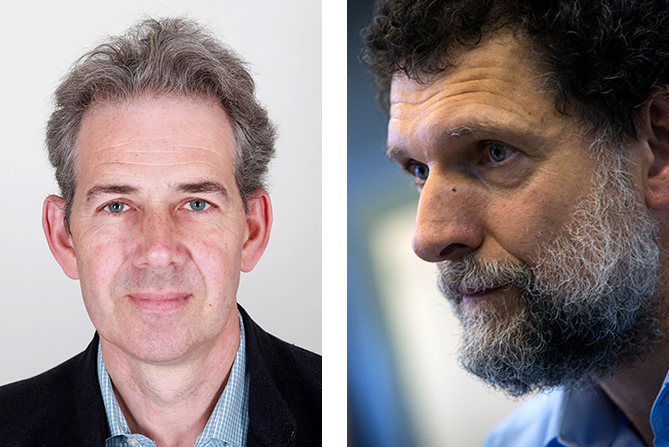
Thomas de Waal on sending Osman Kavala books to read in Silivri Prison.
PEN Transmissions is English PEN’s magazine for international and translated voices. PEN’s members are the backbone of our work, helping us to support international literature, campaign for writers at risk, and advocate for the freedom to write and read. If you are able, please consider becoming an English PEN member and joining our community of over 1,000 readers and writers. Join now.
Since he was arrested in October 2017, the life of Osman Kavala, Turkey’s most prominent political prisoner, has been reduced to a few basic elements. He lives in a small cell, adjoining a tiny outside courtyard where he can take exercise and see a rectangle of sky. He is allowed occasional visits from his wife and his lawyer.
The Turkish authorities have subjected Kavala to cruel and arbitrary imprisonment. For a long time, no charges were brought against him. Then he was acquitted of one set of charges but immediately arrested, on the same day, on even more grotesque charges of allegedly participating in the 2016 coup d’état.
Incarceration has stopped Kavala from pursuing the vast range of activities in support of democracy and dialogue with Turkey’s neighbours that made him so prominent and beloved across the world. But his intellectual life is undimmed. Kavala is not allowed a computer, so he writes letters and notes in longhand, giving interviews and commentaries on cultural and political topics.
For much of the day, he reads. He and his wife Ayşe Buğra, who recently retired as a social sciences professor at Boğaziçi University, find a little solace from the agonising uncertainty by reading books in parallel and sharing impressions when they meet. Initially, he made use of the prison library and reread Marcel Proust. Then he started to receive deliveries of books.
‘Every week he reads the books pages of Cumhuriyet newspaper,’ Buğra told me recently in Istanbul. ‘He is more informed than I am about new publications!’ Currently, they are reading the novels of Olga Tokarczuk
Books are a way to keep in touch with a wider circle of friends, colleagues, and writers abroad, such as Elif Shafak. Julian Barnes’s 2016 novel The Noise of Time, about the dilemmas faced by Dmitri Shostakovich and his struggles with the Soviet establishment, made a deep impression. ‘It’s so relevant to present times,’ said Buğra. Through Shostakovich, Barnes was also describing the tribulations of contemporary Turkish artists facing the impossible choices of whether to leave the country, and if and how to speak up against injustice. The novel again strikes a chord in 2022, as Russian artists face similar choices.
Thanks to English PEN, Barnes wrote a letter to Kavala, thanking him for his warm words about The Noise of Time and sending a ‘metaphorical handshake’. The gesture was deeply appreciated.
I – and not only I, it seems – had hit on book deliveries as a way of keeping in touch with our friend Osman. The Turkish prison bureaucracy does what it can to make the process difficult, not just by restricting the number of books sent, but also by frequently rejecting books sent from abroad that do not have Turkish tax-stamps demonstrating that they were bought in Turkey. This means one must buy the books in Turkey, or online via an Istanbul bookshop.
Having overcome these hurdles, I sent Osman a few books ordered via Pandora bookshop in Istanbul. I tried to choose titles that were stimulating but not too depressing. So I sent him Mikhail Bulgakov’s The Master and Margarita, hoping that a story of free spirits battling state bureaucracy would be inspiring. He told me he enjoyed the subversive character of Professor Woland, the Mephistophelean spirit who brings havoc to Stalinist Moscow, and who ‘enables us to see how things are’. Later, in a more frivolous mode, I sent him Eva Ibbotson’s Magic Flutes, anticipating – correctly, I am glad to say – that a patron of the arts would enjoy her description of the improvised staging of a Mozart opera in a decrepit Austrian castle. Osman responded that he enjoyed the intellectual and musical romp.
He also greatly enjoyed Letters to Camondo written by my brother Edmund de Waal, the story of an artistic entrepreneur who grew up on the shores of the Bosphorus and tried, and failed, to have the French state return the loyalty he showed them. More parallels there for Osman Kavala, the son of a wealthy family who became a major patron of the arts in Turkey.
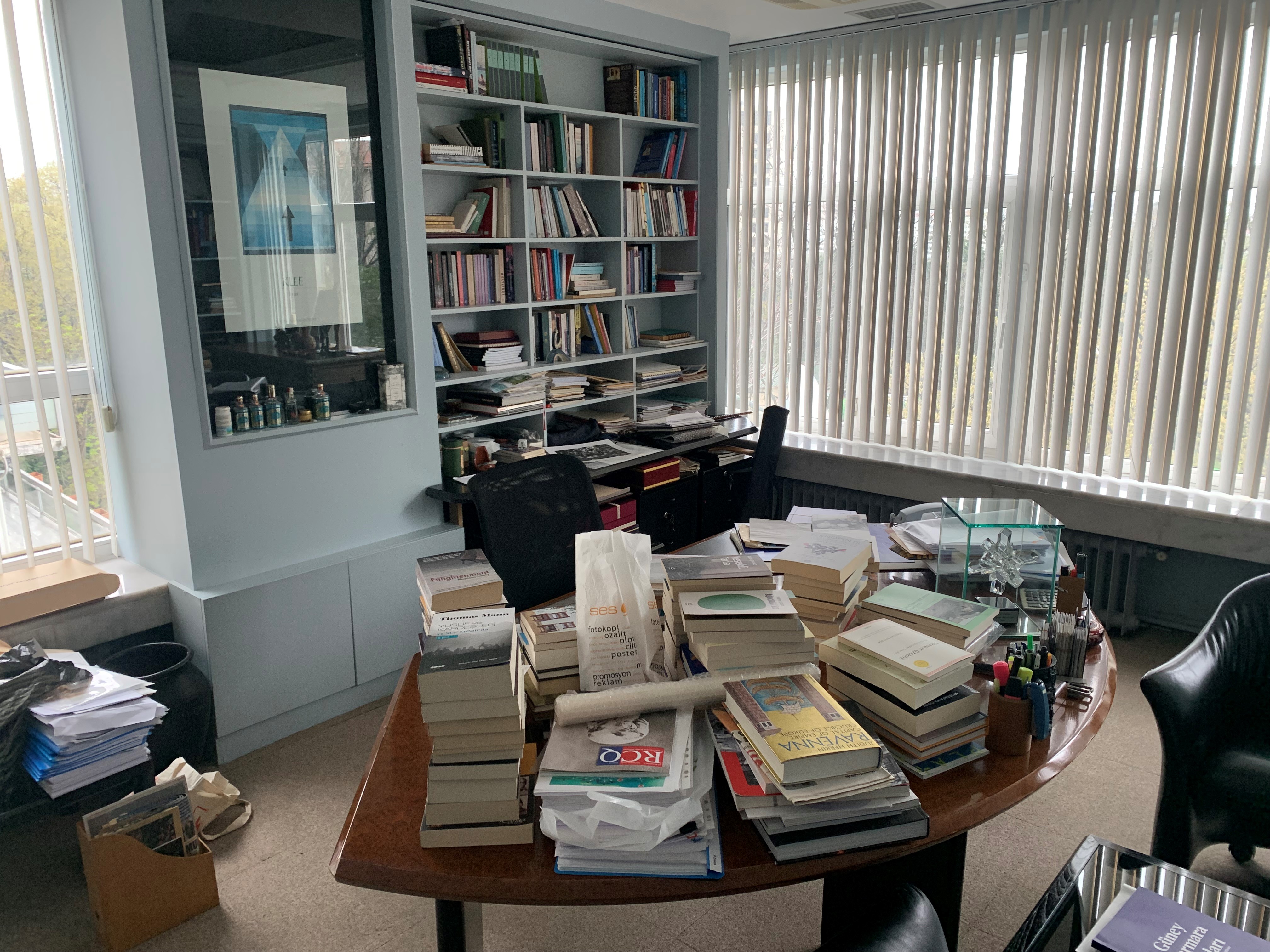
Lately, the flow of books to Osman has hit a bit of a traffic jam. I recently visited the headquarters of his cultural foundation, Anadolu Kultur, in central Istanbul. Inside, Kavala’s office lies empty, missing its tenant. His wide desk is piled high with books – I counted about 40 of them – waiting to be brought to Silivri Prison, 90km outside Istanbul, by his lawyer. More arrive all the time. Kavala’s secretary photocopies the front and back covers and includes them in the next package of letters and court documents, so he can choose books to read next.
Kavala reads between two and five books a week, fewer when he is working on his trial documents. And he is only allowed a maximum of ten books in his cell. (What danger, I wonder, does possessing 11 books in your cell, and not 10, pose to the state? Only an authoritarian regime can answer these questions.)
In the pile of unsent volumes on his desk I saw titles by Thomas Mann, Seamus Heaney, Kazuo Ishiguro, and a couple of books that I had sent him and were not yet delivered. Let us hope that he never has the time to read all these books – not in his prison cell, at least. The case against Kavala is so absurd, and the international calls for his freedom are so strong, that one day he will be released. Sooner, we hope, and not later.
Tom de Waal is a senior fellow with Carnegie Europe, specializing in Eastern Europe and the Caucasus region.
He is the author of numerous publications about the region. The second edition of his book The Caucasus: An Introduction (Oxford University Press) was published in 2018. He is also the author of Great Catastrophe: Armenians and Turks in the Shadow of Genocide (Oxford University Press, 2015) and of the authoritative book on the Nagorny Karabakh conflict, Black Garden: Armenia and Azerbaijan Through Peace and War (NYU Press, second edition 2013).
From 2010 to 2015, de Waal worked for the Carnegie Endowment for International Peace in Washington, DC. Before that he worked extensively as a journalist in both print and for BBC radio. From 1993 to 1997, he worked in Moscow for the Moscow Times, the Times of London, and the Economist, specializing in Russian politics and the situation in Chechnya. He co-authored (with Carlotta Gall) the book Chechnya: Calamity in the Caucasus (NYU Press, 1997), for which the authors were awarded the James Cameron Prize for Distinguished Reporting.
Photo credit (r): Kerem Uzel.