Tag: past

  • Faces Afraid of the Mirror

    Faces Afraid of the Mirror

    Zehra Doğan imagines the future: it is 3219 and art is a crime. Mirrors are banned. States who provide welfare to their citizens are brought before the European Court of Human Rights. And a country that imprisons its artists makes more and more money from tourists…


    The footsteps were approaching. Every step shook the ground. It sounded like they were really close. She had to finish her task before they came. 

    A foggy sky, hard to see; an unknown place, an unknown language, an unknown identity. No one understood one another. But everyone was speaking. Everyone way trying to impose their values on one another, even though they didn’t understand each other.

    Some gave up, stopped being themselves and stepped into different bodies. Others rejected what was being imposed. But really, everyone was small, weak, controlled by an unknown force. Occasionally, one person dominated another and celebrated this victory in a bloody way but in reality, they were all just toys. Now and then they forgot that they were toys and dreamt of another life but soon enough those dreams were stopped with a click on the most cruel button of the control panel. Their rage grew each time their dreams were interrupted, and they attacked those weaker than them. So they could forget about reality.

    The year is 3219. In an unknown country, the sun is high in the sky, scorching even in the winter time. Here, it is always very hot in winter, so that it is hard to even breathe. Like every other country, this one is known for its beautiful sights. With its bombed buildings, destroyed museums, imprisoned artists, mass graves and nonstop shelling, it looks particularly heavenly.

    This particular country gets more beautiful every year by killing, and by being killed. Although it attracts many refugees – thanks to its unbearable living conditions –, it still manages to remain unsafe. Even as the smell of corpses on the ground burns people’s throats, the country attracts more tourists. More tourists bring more money. And thus the person who holds the controller becomes more powerful.

    The footsteps don’t stop. Scorpions are hissing in every corner. A timid heart is beating under the rubble. It beats faster as the footsteps approach. She’s covered in sweat –  a result of fear. No one knows how long she’s been hiding there, in this dark well. A scorching sun above, sun on the ground, and scorpions, with their ugly feet, leave their marks on the snow. With every footstep she hears, she works faster: She is desperate to finish what’s in her hand before they arrive. She is a tiny woman; her hair sweeps over her breasts with every move. The fear of being caught is clear in her eyes. Blood is dripping from between her legs. This is how she paints: she rubs her hand against her vagina, drawing what’s born out of her onto paper and thus giving birth. Her life would be over if she was caught. 

    In this unknown world that she lives in, art is the biggest crime. It destroys the order of the world. It is annoying, it scares people, it kills tourism. People are afraid of going to places where there’s art; the ones who go there don’t ever come back. As a result, whenever there’s an art alarm somewhere, countries issue travel warnings for their citizens. The most dangerous country in this regard is a small country with unknown lands and unknown peoples. Although it has a high level of prosperity compared to many others, it just can’t get rid of art actions. It is frequently criticised for its wealth, it has lost many cases in the European Court of Human Rights for providing welfare to its citizens; the politicians who argue that their country is anti-democratic just continue  providing wealth to their citizens, they don’t feel any shame. But, for an unknown reason, the unknown people in this country revolt all the time and stubbornly make art whatever the price. The tiny scared women is one of them. She obtains illegal paints, and despite the home raids and her police record she keeps on painting, using turmeric, tomato paste, coffee, ash, fruits, vegetables and rubbish.

    ‘She fouls the world with every painting, someone must stop her. Look, she’s even using her menstrual blood. She puts her hand between her legs and paints with her fingers, nonstop. This woman tells us that we’re beautiful! Without shame! No, she’s beautiful, she’s doing the worst thing by making the world more beautiful, this must be stopped. Or else the world will become a more beautiful place.‘

    It was an era when art was destroyed because it was dangerous. People didn’t recognise themselves or each other: they led the murky lives of people who don’t know themselves. No one wanted to hold a mirror up to one another. They were afraid of scaring each other. They were so much in the mud that if someone objected, that person would be regarded as criminals. The ones who protested reminded them of their own dirt. Because mirrors were the most dangerous invention of all times. If someone was found to have a mirror at home, they’d be killed on the spot. No one wanted to see themselves in the mirror; they had a dangerous magic, and the ones who looked went mad and started to protest against the system. That was why all the states regarded mirrors as the most dangerous weapons.

    But one day, the tiny woman had found the only mirror in the world. She hid and started drawing what she saw with her blood. She gave birth from her blood and mirrored life. She painted her hope, so that maybe, one day, people would wake up.


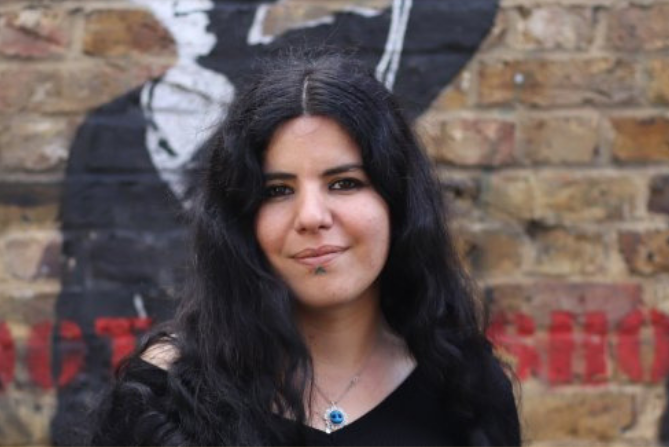
    Zehra Doğan (born 1989) is a Kurdish artist and journalist from Diyarbakir, Turkey. She is a founder and the editor of Jinha, a feminist Kurdish news agency with an all-female staff. In 2017, she was sentenced to 2 years, 9 months and 22 days in prison for ‘terrorist propaganda’ because of her news coverage, social media posts, and sharing a painting of hers on social media. Her imprisonment prompted international outcry, including a 2018 mural by street artist Banksy in New York. She was released from prison in Tarsus on 24 February 2019. She has recently taken part in exhibitions and performances in the Tate Modern, London, and the Pergamon Museum, Berlin. Follow her on Twitter.

    This text was translated by Onur Erem.
  • Living History: a Conversation with Kapka Kassabova

    Living History: a Conversation with Kapka Kassabova

    Kapka Kassabova explores the intersection between past, present and future in her work, and in particular how ancestral legacies and ideologies linger on. We spoke to her about the Balkans, belonging and how to avoid clichés.


    Let me start by asking you about the past. In writing about Bulgaria, Greece and Turkey, but also about Macedonia and Albania, you write about countries with official versions of history and state, nation and language, people and religion. Do you think these versions of history still exercise the same power that they used to? Does the romanticised past still have the same pull as it did before decentralisation, before the internet? Or do you feel that it never held much power anyway?

    Things are always different on the ground. And often surprising. That’s why I am an experiential writer and not an academic one. Encounter – with people and place – is central in my writing. My encounters with the people of the border region showed me just how ideology can be in turns powerless and powerful. The ideology of a single national, religious, ethnic identity tends to be counterbalanced, often, by the reality of people and communities having poly-valent, multi-faceted, messy and interesting pasts and presents. 
    So for instance, many of the Turks of Thrace are descended from Balkan Muslims expelled from Greece, Bulgaria and Bosnia some 100 years ago and some speak remnants of Slavic dialects. My friend and translator in Turkey, the photographer I call Nevzat in the book, is one such person – and it was thanks to his Bulgarian language, passed down by his grandmother, that I was able to access the people of Turkish Thrace at all. Despite the savage and stupid border imposed on this region during the Cold War, it is very much a ‘Thrace without borders’, as a Bulgarian Orthodox priests in Edirne put it. 
    On the other hand, the iron curtain and its legacy is a powerful reminder of how ideology can cast a lasting spell over a region. Part of that legacy is a spirit of paranoia, fear, and a choking sense of the unspeakable – this is some of what I tried to capture in Border. It is also symbolic that the iron curtain was recycled and sold as scrap by locals. The scrap of history: this is the future of all inhumane borders and walls, because they go against the flow of time and understanding. On the whole, I feel that ideology of any kind takes greater hold over the minds of those without much variety of life experience, those with sheltered lives. The more varied your life experience, the more sharply you can see through the facade of an ideology. This is why it’s so vital for all of us to cross various borders and see how things are on the other side. That way, the human principle always wins over dogma.  

    Increasingly it seems to me that separating past, present and future is a futile task, they inform each other so much. I’ve read in another interview that you’re interested in ancestral legacies, and I was wondering if you could expand on that a little bit. (For me, personally, my ancestral legacy is something that drives me to make up for past shortcomings and crimes.)

    Your take on it sounds intriguing! A futile task indeed – because the real task is to truly understand these connections and change the groove of repetition. William Faulker nailed it: ‘The past is not over yet. It’s not even past.’ 
    I’m interested in how small acts of kindness or cruelty can impact generational and collective fate. There are many such cases in Border. For instance the nice man in The Village Where You Lived Forever, locally known as Indiana Jones, whose shepherd-father back in 1984 saw a young East German fugitive trying to cross into Greece, eating some apples in what he thought was Greece but was still Bulgaria, and duly handed him over to the border police who beat him to death. The whole village lives with that memory. If you spend time there and listen to people, it’s as if that young man is still there, eating his last apples.  

    My interest in legacies from the past began during the journeying for Border, and went on to become a new book, To The Lake. I explore how ancestral legacies (emigration, exile, war, tyranny, perfectionism, idealism, nationalism) travel down generational lines to each of us. None of us is spared, we all carry the past, whether conscious of it or not. Through the landscape of the Ohrid-Prespa Lakes in the south-western Balkans, I explore how we each carry psychic, emotional, political, and cultural legacies from our families and nations. Families are microcosms of nations. I start with myself and my maternally inherited fear of loss.

    I wanted to ask you about belonging. In Border, you frequently touch on the idea that you could be at home anywhere, a notion that you question throughout the book. I wonder what you think about belonging now, years after your trips to the border. And in a more general sense, I wonder if you think it’s possible to feel at home everywhere, growing up, as we have, in states that indoctrinate us with the idea of ‘the nation’ as the ultimate indicator of where we belong.

    ‘Home is where they understand you,’ said the German writer Christian Morgenstern. And ‘Home is where they can pronounce your name’, in an Irish proverb. Where do we feel understood, and where do we bring the light of our own understanding? That’s a good indication of where we belong, at least for a time. Ultimately, we all belong in love – love is our true home. Wherever we are engaged with something that we truly love, and whoever we share genuine love with – that is our home. I grasped this through my encounters with the people of the Border – the last shepherds, lighthouse keepers, voluntary workers, gardeners, story-tellers, border people like Marina in Strandja Mountain who live in a plundered humanscape, but who continue to nurture what is left and infuse it with meaning and even magic. 
    Nationally shared markers can be powerful in terms of cultural community (where they can spell your name…). As for me, these days I feel at home wherever there is unspoilt nature. I don’t miss living in Bulgaria, but I do miss speaking Bulgarian. Language is a powerful home and a powerful psychological glue. It is Bulgarian – and by extension other Slavic – languages that has made books like Border and To The Lake possible at all. Even if English is my literary language and therefore also my home. 
    But artists should never be too comfortable anywhere, and good art by its very nature crosses all borders. 

    Tell me about your next book. I’ve read that it’s a psychogeography of two lakes in Albania and Macedonia. I’m assuming that one of these is Lake Ohrid, where your grandmother (is that right?) is from. Like the border you writer about in Border, this is a region of religious syncretism, mixed languages and cultures, but it was also less of a periphery, at least in Yugoslavian times. What has been different about this book project, compared to the previous one? What has been similar?

    Yes, To The Lake is a journey around the Ohrid-Prespa basin – one of the world’s most ancient lake basins. Like Border, the lakes today sit on a triple national border (North Macedonia, Albania, and Greece) and are very much a periphery. But they were shaped by successive civilisations, starting in antiquity with the Illyrians and the Macedons. The more personal journey into family dynamics is my way into the broader exploration of the southern Balkans with their extraordinarily stubborn legacies of trauma and survival. 
    While the border with its masculine militarism was the central metaphor in my previous book, the lake is the central image here –  a feminine, gathering place, but of course the deeper truth turns out to be more ambiguous and uneasy. Because lakes are also places of secrets and death.  

    Writing about South Eastern Europe is very often shaped by a curious mixture of exoticising and negative stereotypes. (Or Balkanism, as Maria Todorova called it.) Border has had great success, and I wonder what that has felt like. Have you felt like an unofficial and perhaps unwanted ambassador?

    Balkanism is a cousin to Orientalism, and both are caused by the fact that often, we the natives of the Balkans or the Middle East, with our extraordinarily polyphonic histories and hurts, are narrated by others – usually others from the dominant colonising cultures. We resent that, of course, but passively. The curious result is that over time, we have become others in our own eyes – a strangely self-obscuring syndrome whereby we struggle to narrate ourselves to the outside world and are then extra resentful that the only times we are ‘noticed’ is when there is a war or some other negative event. This is changing, though. Contemporary Balkan writers are being translated into more languages, and there are also more of us Balkan natives who write through a double or even multiple cultural perspective, thanks to the free movement of people after the Cold War. Thanks to the removal of various walls. 
    I’m a poet and storyteller. The artist’s job and destiny is to be subversive – very different from the role of a spokesperson. My focus is on capturing the essence of place and human experience. That is where my loyalty is: to the truth of the human historio-geographies I explore, because I love them so. If anything, I am an ambassador for the powerless, those who live history instead of writing it safely from behind a desk. So that history is not always written by the victors.   


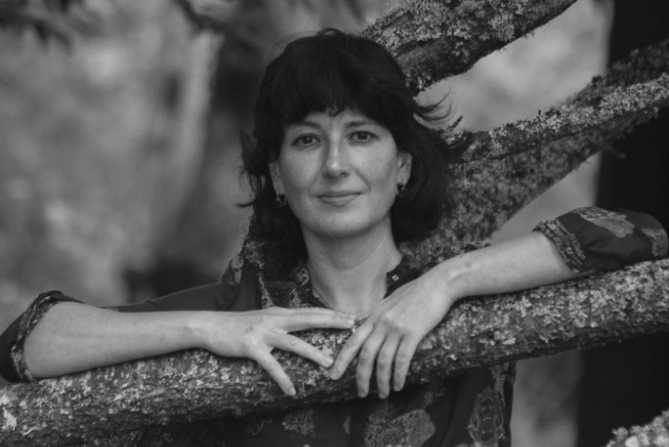
    Kapka Kassabova is a cross-genre writer with a special interest in human geographies and the hidden narratives of places, people, and peripheries. She has published several works of narrative non-fiction, as well as poetry and fiction. Border: a journey to the edge of Europe was shortlisted for, and won, multiple awards, including the British Academy Al-Rodhan Prize for Global Cultural Understanding, the Saltire Scottish Book of the Year, the Edward Stanford-Dolman Travel Book of the Year, and the inaugural Highlands Book Prize. Born in Sofia, Bulgaria, she is now based in the Scottish Highlands. Her forthcoming book is To The Lake: a Balkan journey of war and peace (Granta/ Graywolf 2020).

    Author portrait by TD.

    Interview by Theodora Danek.