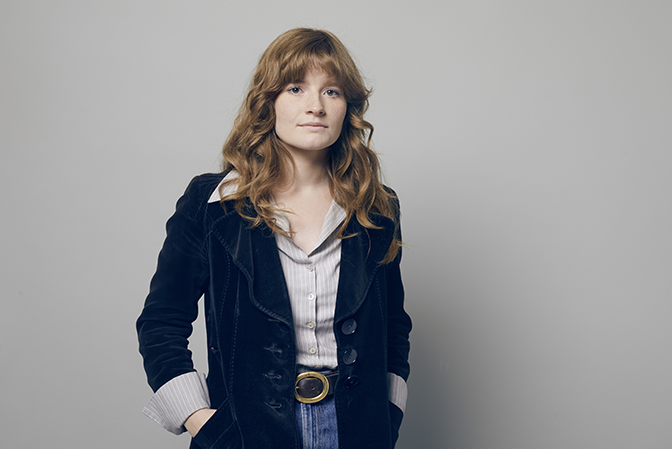
Friða Ísberg on freedom, referenda and Icelandic literature.
PEN Transmissions is English PEN’s magazine for international and translated voices. PEN’s members are the backbone of our work, helping us to support international literature, campaign for writers at risk, and advocate for the freedom to write and read. If you are able, please consider becoming an English PEN member and joining our community of over 1,000 readers and writers. Join now.
Fríða – thanks for talking to me. The Mark, your novel translated into English by Larissa Kyzer, is about the societal whole and the individuals that comprise it, about people reckoning with the possibility of a mandatory and universal test for empathy. Could I start by asking you about the multiplicity of voices in The Mark? They’re incredibly distinct, but they come together as the plot progresses. How important was that sense of chorus to you?
For me, the easy part of writing is the intoxication of a new character – following and understanding their rhythm, so to speak – so it’s always a matter of discipline for me to stop writing new characters. But I knew early that a chorus would be vital to tell this story. I wanted to navigate polarisation, how we are exposed to information, who and what convinces us, how we form our opinions and how we take a stand. And the way polarisation presents to us in these times is that the arguments held by two opposing sides are mutually exclusive, that there really isn’t much room for doubting one’s own side or conceding to a part of the other side’s argument or venturing out into the grey, into the nuances. We’ve got used to dismissing the other side completely; social media and fake news have made it quite easy for us to do so. My father (right wing) is exposed to his information, his choir, and I (left wing) to mine. And, ultimately, it can make us very obedient to our sides, and can sometimes make us lazy in our critical thinking. Around the time I started writing this book, in 2018, I was dismissing everything my dad was saying as ‘fake news’, and vice versa. But in the novel I wanted to make it hard to choose one side as correct and dismiss the other; I wanted to make it hard to be told what to think and be obedient, so I asked each of my characters to try their best to convince me.
Who walked into your head first: Vetur, Eyja, Ólafur or Tristan (or someone else)?
They came in the order in which they appear: Vetur, Eyja, Óli and Tristan. Each one asked me what would happen to them in this society.
How did you collaborate with Larissa on the English translation? I can imagine those voices threw up some translation troubles.
Me and Larissa have worked together for almost five years now, and I think we have a very beautiful partnership in translation. She is a wordplayer, like me, and we both like to goof around with the text. But I think the biggest challenge in The Mark was Tristan. His voice was written in a very specific Icelandic sociolect, half-English, half-Icelandic, that’s considered to be very poor Icelandic. The half-English part obviously slips seamlessly into an all-English translation, and so Larissa needed to find an all-English way to express the character, which I think she did very well. My Portuguese translator, Luciano Dutra, had to find another solution: he chose different dialects, because English slang in Brazil would indicate an upper-middle-class education, and even sophistication.
Can we talk about political fiction? All fiction is political. Most work we call ‘political fiction’ is work that has something expressly to say about political issues. The Mark is political fiction in the sense of engaging utterly directly with political processes, theories, questions. Does that make you a political novelist?
Well, let’s be frank, political fiction sounds very dry and serious – an ‘eat your vegetables’ kind of genre. And although I love vegetables today, I didn’t love them as a kid, unless they were on top of a pizza. So I want to write a pizza with mushrooms, onion, peppers. A loaded pizza. Characters and style will always be priorities number one and two for me. I think speculative fiction, a highly political genre, often finds the balance of a vegetable pizza: in a playful way, shifting the angle a little bit to look at society from a slightly different viewpoint. I think it’s a brilliant way to engage people in political thinking.
How has the book been received – and perhaps used – in Iceland?
It was initially hijacked by the vaccination debate when it came out in Iceland. I had finished the book in January 2021, just as the first vaccinations began, and the debate and craziness didn’t start until later that spring. But when the book came out, in October 2021, it was all that interviewers asked me about. There are certainly similarities: in The Mark, you can voluntarily take The Empathy Test and mark yourself in an official registry, open to the public; more and more private and public spaces are closing their doors to unmarked people, which constitutes one third of the population. And because the book considers both sides of the debate – whether The Empathy Test should be mandatory or not – there was suddenly a dialogue for the anti-vaxxers to engage in. There I was, six months pregnant, with a vaccination band aid on my arm, scrolling through comments by anti-vaxxers and pro-vaxxers, using the book as a platform.
What I will say is that the vaccination debate is a good example of how, as a herd, we collectively decide how best to ensure our survival, and then ridicule those who didn’t accept the terms. It’s an example of how hard it is to second-guess, or to go against the right opinion. We were in a rush and so we made medicine in haste, and every other week something new came out – that women under 40 shouldn’t take this brand, the stories of complications after vaccination (I know a guy who lost all his body hair, a woman who started having heart problems; I have friends who didn’t get their periods for months). And can’t you feel it, now, when I step a little bit into the grey area, the danger of it? That – this – is what I initially wanted to explore in The Mark. I vaccinate my child, and if somebody told me to get a fourth shot of Pfizer tomorrow I would. My point is: we must be able openly to discuss the grey.
Are referenda good things?
Yes. They are a vital part of democracy, and a vital part of making citizens feel like they have a say. I am more concerned about fake news, about the ways in which we’re vulnerable to information. There have always been different newspapers. A socialist newspaper and a conservative newspaper and so on. But the speed of it all has changed everything – the speed of information, the access to information and therefore the access to fake news, the access to online spaces that build societies on fake news. You can become an extremist in anything in a course of a day.
What are your hopes for Icelandic literature (at home, and internationally)?
At home: I hope the big publishers start publishing something other than just middle-class trauma porn in poetry.
Internationally: I hope somebody buys the rights to two novels coming out in October 2024, Amity by Brynja Hjálmsdóttir, and Jumbo Jets by Tómas Ævar Ólafsson.
Could you speak a little about technology and freedom? The Mark is speculative fiction, in many ways – it’s in a future and it imagines future technologies that raise questions about the promotion and limitation of freedoms. Is technology a threat to freedoms (personal and collective) – has it always been?
Yes, how do we define freedom?? Are we free within a group? Let’s paraphrase: are we ever free within a group? The group is a safety measure: we flock together to survive and to protect one another. But we compromise our total freedom, the freedom from being watched and surveyed and disciplined by one another. There are so many rules! How you converse, how you use your eyebrows while speaking, what to say. And so, as a result, so many freedoms. But, alright, usually we define freedom like John Stuart Mill: we are free as long as we don’t hurt others within the group.
When writing The Mark, I became a little obsessed with the thresholds between private and public spaces. Most of us have some kind of territory to call our own – a place where we are free from the group, where our nervous systems can relax – but as soon as you step out of your bedroom door, or out of your apartment, you have entered a public space. And what happens to your nervous system when, with technology, the group can supervise individuals much more efficiently? And step into your holiest of private spaces, your ability to empathise? As you can read, I have no answers, only questions.
Finally, as the author of a book so deeply interested in the idea of empathy, can you talk about the role of literature in fostering it? (Or, put differently, therapy or books?)
Well, I do believe in the general idea that reading other people’s narratives, whether these people are characters or are real, trains our ability to imagine other people’s existences. But I am also deeply interested in the dark side of empathy – whether empathy, which has been the antidote for evil for some decades, can also blind one’s judgement. There is a difference between understanding an evil act and excusing it.
My answer will always be both (I am a child of divorce): therapy and books.
Fríða Ísberg is an Icelandic author based in Reykjavík. Her books are the poetry collections Stretch Marks and Leather Jacket Weather, the short story collection Itch and the novel The Mark, which won the Fjara Literature Prize, The Icelandic Booksellers Award, the P.O. Enquist Award. Ísberg is the 2021 recipient for The Optimist Award, awarded by the President of Iceland to one national artist. Her work has been translated into 17 languages.
Photo credit: Gassi.
Interview by Will Forrester, Editor.
