Selahattin Demirtaş on ‘home’, state-sanctioned writing, and what makes literature literature. Translated by Kate Ferguson.
PEN Transmissions is English PEN’s magazine for international and translated voices. PEN’s members are the backbone of our work, helping us to support international literature, campaign for writers at risk, and advocate for the freedom to write and read. If you are able, please consider becoming an English PEN member and joining our community of over 1,000 readers and writers. Join now.
I think no concept on earth carries as much weight as that of home. It is the most crystallised expression of the feeling of personal safety. In the words of Emerson, ‘The house is a castle which the King cannot enter’. Home captures everything from pain to longing to shelter; it represents ‘belonging’ in all its facets. Both a tiny house and the whole cosmos – the most expansive concept of which we know – can fit into this single word. Yet bearing the weight of both comes as no imposition.
It is literature that makes these two different dimensions inherent in a single concept. We cannot deny the role of literature in social and political change, for it is literature that delivers life from the status of humdrum prose and imbues it with meaning. And at the pinnacle of this literature, we find the work of the great homeless, and their work alone.
The great homeless do not depend on artificial inspirations, because inspiration, along with interpellation and discourse, are nothing but guises of authority; to seek hope in inspiration is nothing short of self-deception. Literature is anything but self-deception. By deceiving yourself, all you do is offer a brief moment of solace.
It is with the sole aim of rendering the literary artist submissive that authority feeds inspiration, transforming literature into a producer that works for it and it alone, nihilating the artist and their labour in the process. Authority takes an interest in writing only insofar as it is to its own benefit. Otherwise, it couldn’t care less. Positioning itself as a connoisseur, authority creates debates, inflates the value of trivial works, and delivers its own verdicts to create a pliant readership for those works that it has deemed worthy. Sometimes, it bestows awards – medals of honour, the title of State Artist, and so on. But the great homeless do not allow the notion of quality to be monopolised by one group; they reject awards, and take their place alongside the people, aligning themselves with humanity rather than the state. They are not just a vacuous mob, nor an amplifier of senseless noise. State artists – and the mechanisms that sustain them – offer nothing but a cold touch; they kill the sincerity of their work and their books. We know this all too well.
Ever since Kant, states have managed to survive thanks to two things: internal enemies and external enemies. The state uses its enemies to keep its citizens on their toes, but at once lines it borders with explosive mines, leaving us citizens with nothing but limbs that, should we take just one step too far, are irreparably rent asunder.
State artists speak not of I, but of we; we is the place that grinds down the I, and they refer to as ‘snobs’ any writers who speak of themselves as I. They despise Orhan Veli, dislike Tevfik Fikret, ridicule Ahmet Haşim, and have never even heard of Osman Sebri. The state criminalises at every opportunity those who are not one of its own; prisons are filled with ‘thoughts’, and influence is held by those who remain – by those who come from within the state’s we, those who live among the foxes and the wolves, howling along with them.
And thus a literary horde emerges. Their poetry is read out on state television and radio, films are made of their ‘life stories’, their books sell out before they even reach the shelves, and the Ministry of Culture purchases copies to fill the country’s libraries. They are not concerned with their readers; for them, readers are customers, and it is the job of the writer to market products to them. And so literature is mortgaged off, and the reader, in the name of literature, is made a partner in this sorry state of affairs. These are the ones who impeccably avoid washing off the dirt of the state, and therefore remain dirty; as such, their literature is ‘clean’.
Nothing, in the name of literature, will come of this. What ever can come of something that does not change or develop? There is life, but no one living it. They know nothing of Macbeth’s stones that move, or trees that speak.
There are three aspects that make a work of literature: thought, art and metaphysics. It only becomes a true work of literature when it carries the potential for social transformation. The process of writing is like working a slab of stone: it is shaped until it resembles something. It is now finished. It is not like eating and digesting something; it is a way of defending affection, love, and life. It is the courage to give back what you took from nature. This is love. A work without love is no work of literature. The great homeless aim at nothing but love, and it is no secret that love holds the greatest potential for transformation. The great bard Yunus Emre compared love to the sun: ‘The heart that feels no love is none other than stone / What can grow on stone hearts? / Though the tongue softly starts, / Words of venom fume, rage, / And turn into war soon’. War brings nothing but destruction. And no transformation can come from destruction. Yunus Emre is among those who counted the whole of Anatolia as his home, yet never had a single house in which to take shelter.
He is just one example of many. Kafka was born in a cramped apartment on the edge of Prague’s Jewish ghetto. His two brothers died when he was still a child, and his three sisters were killed by the Nazis. When those with whom you share the air of your home are gone, what remains is nothing but a tiny cell. When Kafka died, it was not at home, but in a sanatorium in Vienna. This same Kafka, when he had finished The Metamorphosis, put his manuscript into an envelope and sent it to Robert Musil, who read it overnight and wrote a letter in the morning: ‘Edit it down and we’ll publish it’.
I have to end the story here. But it doesn’t. Each reader reaches their own conclusion – because, thanks to authors who are concerned about them, readers cease to be customers. Only the writing remains, and a new link is added to the chain of transformation, of metamorphosis. The reader holds no small importance. Knut Hamsun, one of the world’s leading fascist authors, fed on fascism his entire life. But upon learning that he was a fascist, one reader gathered up his copies of Hamsun’s books and dumped them at his door. Hamsun cried that day.
What makes a country a home is its writers. So let me here say a few words about Thomas Mann in Germany, or about Nazım Hikmet and Cigerxwîn here in our country. Overnight, the Nazis declared Mann a traitor to the country and stripped him of his titles. They burned his books, and then sent him the ashes. Nazım Hikmet spent the best years of his life in prison. After his release, when he was reading a poem at a gathering of friends, the house in which he was staying was stoned, and his years of exile began. Those whose home is the entire world have no home. It is a realisation that created one of the world’s greatest poets. Cigerxwîn’s language was banned; it was forbidden for him to write poetry or to worship in his own language. It was with the destruction of his home that Cigerxwin’s life, and his transformation, picked up speed.
Those who cast stones at Nazım Hikmet’s home, those who burned Mann’s books, those who banned Cigerxwîn’s language all offer similar justifications; they all laude the great and glorious nation. But nationalism is to shut yourself in your own home in the narrowest definition of the word. That home offers no air to breathe. It turns into Kafka’s cell. A nation that is closed in on itself knows of and hears only itself. It is trapped in a vice with thick, unscalable walls like those of a prison. Great literature is the work of the great homeless; they are the ones that transform our tiny houses into the cosmos.
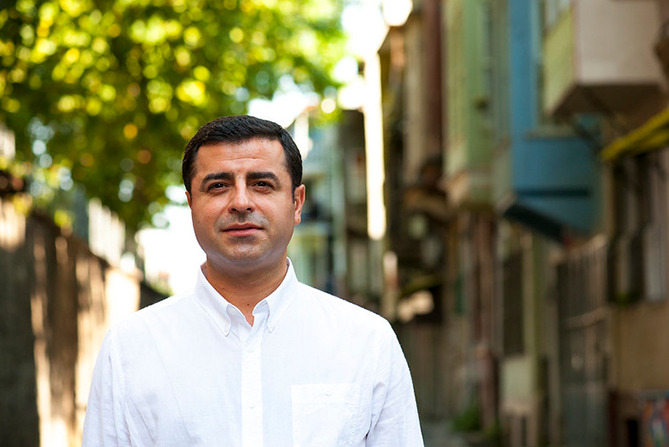
Selahattin Demirtaş is a Zaza-Kurdish politician and former co-leader of the Peoples’ Democratic Party (HDP) in Turkey. He began his political career as a human rights lawyer, and helped transform the HDP into a more inclusive party with an emphasis on progressive values, feminism, and LGBTQ rights. He passionately believes in the liberal, democratic future of Turkey. Imprisoned since November 2016, Demirtaş ran for president in 2014, and again in 2018 – where he conducted his campaign from his prison cell. Dawn, his first work of fiction, was written from a maximum-security prison in Edirne, where he is still being held.
Kate Ferguson earned her MA in interpreting and translation studies at the University of Leeds. She has been based in Istanbul since 2007, working as a freelance translator and interpreter trainer.
Photo credit: Peoples’ Democratic Party (HDP) Press Office.