Tag: Sri Lanka

  • The Third One Might Not Take as Long: An Interview with Shehan Karunatilaka

    The Third One Might Not Take as Long: An Interview with Shehan Karunatilaka

    Shehan Karunatilaka on language, living history, labour and luck.

    PEN Transmissions is English PEN’s magazine for international and translated voices. PEN’s members are the backbone of our work, helping us to support international literature, campaign for writers at risk, and advocate for the freedom to write and read. If you are able, please consider becoming an English PEN member and joining our community of over 1,000 readers and writers. Join now.

    Shehan – I’ll start at the very beginning and the very end: when, in the writing of The Seven Moons of Maali Almeida, did it become apparent to you that the book would start after the fact of death?

    The plan was to write a ghost story (just like my first book was supposed to be a cricket story). So I began with a traditional ghost story with jump scares and murders, and the only thing that was interesting in that draft was the ghost on the bus, a dead reporter called Maali Almeida. When I knew the story would be told by a dead man, I had to imagine some sort of afterlife. That took a few more drafts. But the idea of the dead speaking, and imagining the voices of Sri Lanka’s war victims, that was very much present throughout.

    There are a few rules about what the book’s ghosts can do: only being able to go where their corpse has been or where their name is spoken, travelling on the winds. How much were these rules – and some of the wider world-making – purely strategies or devices in order to allow the book to function and the plot to move, and how much were they more than that?

    I had a bunch of rules that I borrowed from ghost tropes, religions, philosophies and near-death experiences. In the end, they got pared right down, and I only used those that served the plot or character – the Seven Moon deadline, the use of winds, the significance of ears and the power of your name being spoken. But the idea that powerful spirits can whisper thoughts into the ears of the living and influence their actions also became a possible explanation for why some Sri Lankans continue to do strange and absurd things.

    The second person is so incredibly hard to do well, but I love your ‘you’. When in the writing and drafting of it did that perspective appear, and why?

    I had to imagine a disembodied voice telling a story. I figured that if anything survives the death of your body, it must be the voice in your head. I’m not sure about everyone else’s heads, but the voice in mine is in the second person. It’s speaking to me now. And that’s the way Maali spoke to himself, so I went with that, and the story seemed to flow. It later made sense to me that the second-person narrator and the person Maali Almeida are not exactly the same – something that the audio version of the book cleverly picks up on.

    I loved Chinaman, your debut novel. Why did I have to wait so long for your next one? (It was well worth the wait, by the way.)

    Thank you. The usual excuses, really. I got married, had kids, moved country, became a freelancer. I didn’t expect to be writing a second novel, so I struggled to find time for it. I’m better organised now, and my kids are better behaved, so the third one might not take as long.

    Maali’s character is based partly on Richard de Zoysa, who, like Maali, was a gay man in Colombo in 1989. What was your experience of writing a character whose sexuality is such an important part of the book, but whose sexuality is, as you’ve said elsewhere, not your own?

    This was a big challenge, and I took it seriously. I read Vidal, Genet, Crisp and Selvadurai, watched Boys in the Band multiple times (the original Friedkin version) and talked to gay men who lived in Sri Lanka during the 80s. Arun Welandawe-Prematilleke’s ground-breaking play about Sri Lankan Grindr culture, The One Who Loves You So, really opened my eyes to how gay characters can be portrayed without evoking lazy tropes. 

    What are you most hopeful for and what are you most fearful of after having won the Booker?

    The fear is that I won’t write much of anything over the next twelve months. This was confirmed by a very exhausted Damon Galgut just after the Booker. ‘You won’t write a word, my friend,’ he said kindly, but seriously. ‘It’s one big lit fest for the next year,’ He’s a terrific writer and The Promise is a magnificent book, but I do hope to prove him wrong. The win will bring more readers and less financial uncertainty, but I hope I don’t get too distracted and forget to put in the writing hours for the next book.

    I want to ask what I know will be a complex and fraught question, but what I think is an important one. You’ve spoken elsewhere about ‘not being brave enough’ to set a book in contemporary Sri Lanka or its recent past, and instead going back into the country’s history for this book. You’ve written a novel that confronts and bears witness to the atrocities of that history (‘I was there to witness. That is all’ is a very good line at an important moment in the middle of Seven Moons)while also satirising it and finding comedy in it. But of course that history – 1989, and the years running up to it – is living history for many people. Did that, and their experiences and traumas, weigh on you when you were writing The Seven Moons of Maali Almeida? Do you think the book’s recognition risks being co-opted as a way for history to move on from those atrocities.

    I hope the opposite. I hope that it’ll encourage more Sri Lankans to write about and unpack the past, and that a new generation of readers who’ve grown up with the internet will go back and read about histories that they’re not taught in schools. History and Sri Lanka may seem to have moved on now, with fresh catastrophes to create narratives around. But hopefully readers and writers can engage with the past and take some lessons from it.

    You spoke in Tamil, Sinhala and English when accepting the Booker Prize. How important was that, for you?

    I’m glad I was able to thank everyone and speak in all three languages (even though I did a poor job of keeping to my one-minute limit). I’m fluent in Sinhala but not as articulate as I’d like to be, and am only just learning Tamil. But I wanted this to be a victory not just for English-speaking, middle-class Colombo Sri Lankans, but for all Sri Lankans, regardless of which language they read or write in.

    Finally, is writing (perhaps life) all just a gamble, a game of chance and probabilities?

    That’s certainly what Maali thinks. We’d all do well to acknowledge the huge role luck plays in our life, though people may refer to it by different names. Of course you welcome an outrageous fortune like the Booker, but you need to be aware that no one can keep rolling sixes, and that it’d be foolish to expect to.


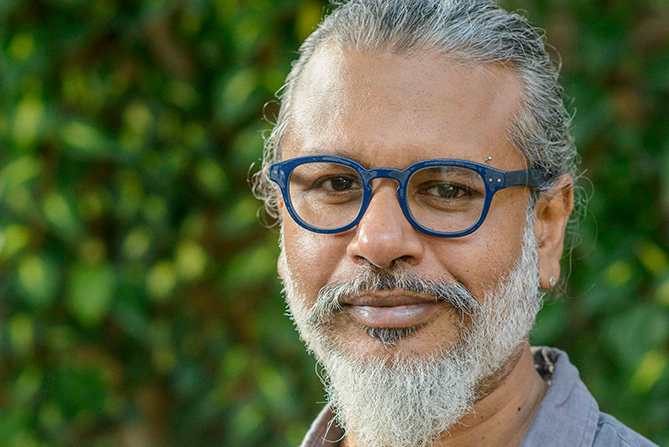
    Shehan Karunatilaka is the winner of the 2022 Booker Prize for his second novel The Seven Moons of Maali Almeida. His debut novel, Chinaman (2011) won the Commonwealth Book Prize and Gratiaen Prize. Born in Sri Lanka, he studied in New Zealand and has lived in London, Amsterdam and Singapore. He currently lives in Colombo with his family, his guitars and his notes for new stories.

    Interview by Will Forrester, Editor

    Photo credit: Dominic Sansoni.
  • By Nanthikadal Lagoon, Our Dreams Lie Rusting in the Mud

    By Nanthikadal Lagoon, Our Dreams Lie Rusting in the Mud

    Shash Trevett on the poetry of Nillanthan.

    PEN Transmissions is English PEN’s magazine for international and translated voices. PEN’s members are the backbone of our work, helping us to support international literature, campaign for writers at risk, and advocate for the freedom to write and read. If you are able, please consider becoming an English PEN member and joining our community of over 1,000 readers and writers. Join now.

    All translations of the poems quoted here were done jointly by Shash Trevett and Geetha Sukumaran.

    *

    18 May 2009 was a day of apocalypse. Fire rained from the air, from the water, across the land. It did not discriminate between civilian and combatant, men and women, the fit and the infirm. It was a great leveller; an instrument of retribution, merciless towards the mass of bodies trapped on a narrow kilometre-square stretch of sand between Nanthikadal Lagoon and the Indian Ocean at Mullivaikkal, eastern Sri Lanka. Of course, the eyes which directed the fire across this no man’s land, fuelled by a bloodlust that had laid unsatisfied for 30 years, belonged to the Sri Lankan Army. The hands stoking the sacrificial altars, ruthlessly pushing unwilling lives onto the pyre, belonged to the LTTE, the Liberation Tigers of Tamil Eelam.

    Stuck between the LTTE and the Sri Lankan Army, the people who found themselves by Nanthikadal Lagoon had been on the march since January 2009. Around 300,000 civilians from the Vanni area in the Northern Province fled from the Sri Lankan Army in January, when a ferocious assault on Killinochchi, the capital of the Tigers, began. From January to May, the people endured a harsh exodus pushing eastwards, escaping from the fighting around them, with each stop taking them further away from food, medicine and hope, and inexorably towards the banks of Nanthikadal Lagoon. They were heading for the No Fire Zones set up by the Government of Sri Lanka – places of refuge to which they were urged to escape by tannoyed voices speaking in Tamil. As they broke their march each night, they dug shallow bunkers that offered meagre protection from the artillery fire that seemed to be aimed squarely at them. By the end of 18 May (according to the UN), around 40,000 civilians would be massacred. There would be singing and dancing in some streets in Colombo.

    The poet Nillanthan was one of those who endured the horrors of this final phase of the war in Sri Lanka. A poet who had published four collections, and an artist who had exhibited across the subcontinent, Nillanthan also worked as a political commentator and had been displaced to the Vanni (territory held by the LTTE) some years previously. In a series of seventeen poems that I am currently translating jointly with Geetha Sukuman (a translator based in Canada), Nillanthan details the daily hardships faced by the caravan of people fleeing the fighting from January to May 2009. Unlike his artwork, which is explicit in its depiction of the violence of war, Nillanthan’s poetry is more lyrical, gently diluting horror through the lenses of food and cultural practice. It is the poetry of the ordinary, yet within this he draws links that speak of the poignancy of loss and suffering. In his poem ‘Pina Koorai’, he writes of how people used elaborately decorated wedding saris (the koorai) to make tents, sleeping mats, shrouds and, most importantly, sandbags.

                                        Smoke covered the land when Ban Ki-moon

                                        saw these sari-woven death slums

                                        from the air.

                                        Yet the threads of gold glittered

                                        in the sun.

    In ‘Market at the End of Time’, he presents two price lists for goods available – one from Valaignar Madam in March, just as the people had begun their long exodus, and the other from Mullivaikkal, in May, where the final reckoning was to occur. There is no commentary in this poem, no judgements made. It is simply a list of essential items that people could or could not buy. The task of fleshing out the meaning behind the items listed as ‘unavailable’ is left to the reader. Coconuts and chillies, for instance – essential ingredients for adding flavour to the thin rice water that was the only food obtainable to the people. 

    In ‘February 2009’, Nillanthan writes of how a school was turned into a makeshift hospital, where, ‘on a blackboard, a doctor / keeps score of the injured’. Doctors operated without anaesthetic, with saline drips hung from branches of trees, and ‘flies swarm[ed] on corpses, on shit, on wounds, on dreams’. This catalogue of lack – of food, shelter, water, sanitation, medical facilities – is captured perfectly in the poem ‘End of an Age 2’:

                                        They ran out of biscuits at Thevipuram

                                        and coconuts at Ananthapuram. 

                                        From Valayanmadam onwards

                                        there were no more green chillies or onions,

                                        no more tamarind.

                                        The coffins ran out at Irattaivaikal. 

                                        The morning they capitulated

                                        they drank water squeezed from mud

                                        and with three days grime on their faces

                                        witnessed an age come to an end.

    Nillanthan writes again of the lack of coffins in ‘Used Coffins’, recounting how four or five coffins were recycled repeatedly and used merely for funeral services. The bodies were buried wrapped either in black plastic or koorai saris. Malnutrition and lack of sanitation killed the very old and the very young; constant bombardment by the Sri Lankan Army killed the others. As May approached, an increasingly desperate rebel force conscripted men and children. Those who resisted were shot. The UN has accused the Tigers of using the civilian population as human shields. Those who tried to sneak away at night were caught and shot. Those who managed to make it over to the Army lines were caught and shot by the Army. In ‘Mother of Two Martyrs’ ,Nillanthan writes of how a mother sought to keep her children safe from the carnage, hiding (in vain) her eldest from the Tigers, and being unable to prevent the forced conscription of her middle child after she lost her first.

                                        On the day she escaped to that lagoon

                                        with her youngest child

                                        was this mother shot in the face

                                        or in the back?

    asks Nillanthan. In the confusion, it is unclear whether she was shot in the back by the Tigers for fleeing, or shot in the face as she crossed into the No Fire Zone set up by the Sri Lankan Army. Caught between the cold hatred of the Army and the rabid desperation of the LTTE, the people who marched towards Mullivaikkal walked a road from which there could be no escape. There was no one to save them from the apocalypse.

    Nandikadal Lagoon will feature prominently in the future cultural imaginings of the Tamil people of Sri Lanka. It will be reworked, reimagined, rewritten repeatedly. It will be the Tamil Srebrenica, another Mai Lai. These poignant poems of witness by Nillanthan are the first to have appeared from the carnage. They are a map guiding the reader through those bloodied months of annihilation; a record of those dark days. The reader walks alongside those whose eyes can never unsee mangled bodies, whose noses can never forget the stench of rotting corpses, whose minds find it impossible to heal after facing an abyss of evil and cruelty. Returning to Nanthikadal Lagoon in 2012, the poet writes of his own inability to break free:

                                                    After two seasons of rain

                                                    our dreams lie rusting

                                                    in that salt-laden mud.

                                                    The sun sinks behind trees

                                                    and submerges in the waters

                                                    of Nanthikadal. The water fowl

                                                    wait, holding fast the last words

                                                    of those who have vanished.

                                                                            (from ‘Nanthikadal, August 2012’, tr. Shash Trevett).


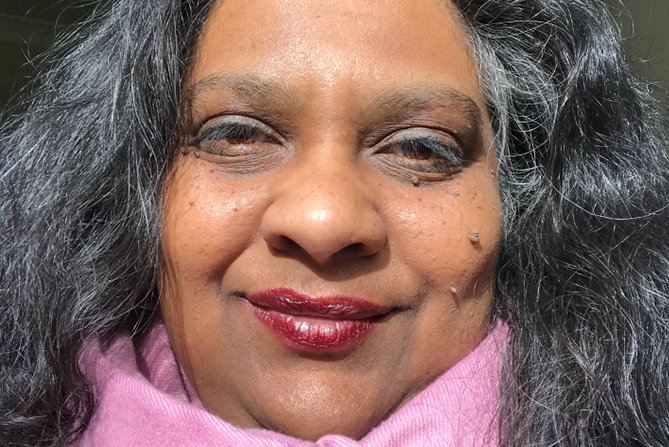
    Shash Trevett is a Tamil from Sri Lanka who came to the UK to escape the civil war. She is a poet and a translator of Tamil poetry into English. She has collaborated with artists and composers and is a winner of a Northern Writers’ Award. Her pamphlet From a Borrowed Land was published in May 2021 by Smith|Doorstop.  She is currently co-editing (with Vidyan Ravinthiran and Seni Seneviratne) an anthology of Tamil, English and Sinhala poetry from Sri Lanka and its diaspora communities, to be published by Bloodaxe in 2023. Shash was the 2019 Apprentice Poet in Residence at Ilkley Literature Festival and is a 2021 Visible Communities Translator in Residence at the National Centre for Writing. She is a 2021 Ledbury Critic and a Board Member of Modern Poetry in Translation.