Tag: translation

  • Mostar’s Sniper Tower

    Mostar’s Sniper Tower

    Tayiba Sulaiman on memorialisation.

    PEN Transmissions is English PEN’s magazine for international and translated voices. PEN’s members are the backbone of our work, helping us to support international literature, campaign for writers at risk, and advocate for the freedom to write and read. If you are able, please consider becoming an English PEN member and joining our community of over 1,000 readers and writers. Join now.

    This piece is part of a year-long series, supported by the Norman Trust, showcasing Gen Z writers and writing. Read our editorial on the series here.

    ~

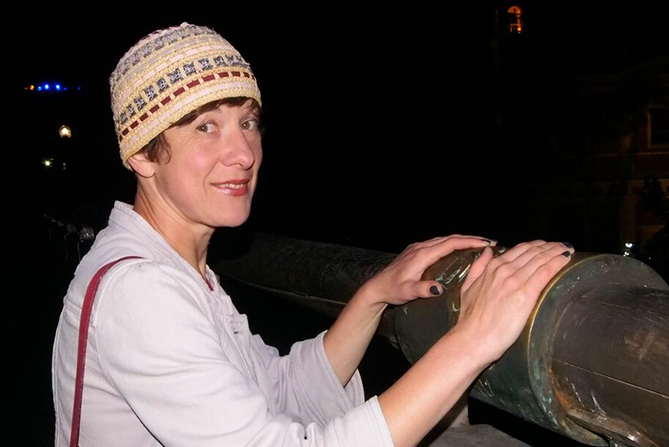
    I’m wearing the wrong trousers for trespassing – summery and wide-legged, they keep snagging on bricks. It is August 2023, and I’m climbing over a half-collapsed wall of the former Ljubljanska Banka in Mostar, Bosnia. I’m yet to be convinced that going in is a good idea. More than this, I am worrying about whether it’s right. At the top, I turn around to lower myself down to the ground floor where my family are standing. Before I jump down, I catch sight of a woman on the balcony of the apartment behind the building. She doesn’t smile. I feel a chill go through me. The building is not supposed to be accessible to the public; the local council have boarded and fenced up all the entrances, except for this accidental opening around the back.

    In theory, I celebrate civil disobedience, but in practice I’m already feeling there’s something fundamentally wrong about our being here at all – not just because of the rules of the present, but because of the burden of the past. This was once a space of militarised violence. Because of its height, the building was occupied by Croat forces and used as a sniper tower during the two sieges of Mostar, the first of which began in April 1992 and the second around a year later. The building’s grand glass façade was shattered, and has now been cleared away as if it never existed. Only concrete remains. Abandoned after the war, it has become a sort of unofficial gallery for street art, graffiti and murals. And it was this we wanted to see.

    I’d worked with Remembering Srebrenica the year before I started university. It was likely because of a heavy awareness of human suffering during the Bosnian War that, when I had the chance to visit, I’d expected to find its legacy memorialised everywhere I went. Of course, the idea of memorialising a war is much hazier than I’d assumed it to be, especially where an agreed version of events is still being debated. At the Srebrenica memorial site, I read a 2021 report which describes the ‘opposition to the official recognition or condemnation of the genocide by states, local governments, and institutions’ in the region. The war is over, but the story isn’t.

    The traces of conflict are impossible to miss – there are bullet holes in so many buildings in Sarajevo and Mostar, and many testaments to the dead. There’s the fountain in Sarajevo’s Veliki park paying tribute to children killed in the siege, the statue of Ramo Osmanović calling for his son Nermin, the endless white stone gravestones of those who were killed during the war. But I suppose what surprises me is how inconsistent the attempt to make sense of the war’s brutality seems. We’d visited Mostar’s Museum of War and Genocide the day before, and were bewildered to discover how blurrily the conflict’s historical context was presented. It felt like an avoidance of finger-pointing, of accusation. We had watched footage from November 1993 of the destruction of the old Stari Most, Mostar’s Ottoman bridge, as Croat Defence Council soldiers cheered, but later, standing with crowds at the reconstructed bridge, we struggled to track down an acknowledgement of what had happened there. (Online, I find a plaque in Croatian naming and condemning its destruction, but in English, there’s only a stone that reads ‘DON’T FORGET ‘93’, without contextual information.) During our trip, we visit several museums documenting the Bosnian genocide, none of which are state-funded. They are supported by the Dutch government, in atonement for the massacre that Dutch UN forces allowed to happen at Srebrenica. The British government also contributes financially towards the upkeep of these museums – even as it looks directly past the genocides it is endorsing elsewhere in the world. There is a process of memorialising, but it feels like it’s always slightly out of your line of sight.

    It is clear to me that this tower can’t be treated like a tourist spot. I’d read several accounts of it where the fact that it was once used to murder people from a safe distance was almost ignored. I didn’t want to barge in somewhere demanding to see the art, disregarding the wishes of the people – perhaps even of the artists ­– and I didn’t want to stir up the ghosts of the crimes that had been committed there. It seemed to me that there was something sacrilegious about it.

    I stand there on the ground floor, trying to decide whether it would be better to turn back. Turning, I catch sight of my dad walking past a wall, on which someone has spray-painted the words:

    God is Here Don’t Worry 🙂 Go All way up…!

    I am thrown by the idea that someone has predicted exactly my sense of doubt, moved by the fact that they have somehow eased it. I hadn’t expected the building itself to coax me forwards. I hadn’t expected to find something holy here.

    ~

    I trail after the others, who are already exploring the bottom floor. Standing water expands murals of warped, ghostly faces and makes mirror-images of the words. The first thing that stands out is how multilingual the graffiti is. Some German phrases are printed in block capitals – ‘DEIN TUN DU BIST’; WHAT YOU DO IS WHAT YOU ARE. Even the inscription FCK AFD. Later, I find whole excerpted paragraphs from Homer in English, alongside insults, questions and declarations. If the artists who have taken over this building have an argument to make, it’s not one that has been communally decided. These multilingual voices speak past each other, between each other, around each other.

    Where one artist’s work has spread out to cover parts of an older contribution, these voices overlap. It’s a completely different model to the established avenues through which we usually find work in translation. Here, space is as in demand as in a packed magazine. Everyone is after the best spots. But, in this case, there’s no point at which the work is finished. It’s last come first served. For me, this building is a place where established ways of doing things – of making art, of translating, of thinking about the past – are jumbled, exposing their weaknesses, and where the whole question of the value of a consistent, coherent take is thrown into question. In a way, the building is like an anti-gallery. There’s no governing board to steer the direction of its contribution to Bosnian history or culture, and there are a fair share of names scratched into the stone. There’s no single curator, no strategy of inclusion or exclusion. Anything can – and very likely will – be overwritten by anyone.

    Slowly, we begin to head upwards. I hadn’t expected the overwhelming openness. Forget bannisters, railings, or anything else to hold onto. These stairs don’t even have walls. It’s a risk assessor’s nightmare, but there’s something liberating about the false sense of dizziness induced by the sweeping skyline. It’s safe enough, so long as you’re sensible and avoid the edges. I feel like a child riding a bike without stabilisers. But I can’t get too comfortable, because even if there’s no danger now, the awareness of past threat hangs over me. So much of this art is haunting; the mural of shifting faces which spans a corner, warping outwards, and the sly, subtle warning to avoid the exposed lift shafts where someone has spraypainted two arrows, one pointing upwards and one downwards, respectively labelled ‘HEAVEN’ and ‘HELL’. The fall would be fatal. It’s a privilege, of course, to wander through this place in a time of relative safety. I find myself longing to know when exactly each piece of graffiti was done, to help put a context to this strange balance of beauty and of sinister reminders.

    To my surprise – despite my feeling of solemnity – so much of the graffiti is out of pocket, even funny. On one wall on a higher floor, in front of a stunning view of a hill which holds the city in its palms, someone has spraypainted ‘RATE THIS PLACE ON TRIP ADVISOR’ and completed it with a line of stars. It makes me laugh at its daringness, its cheekiness, in English, making a demand of us, understanding us as interlopers. While the first bit of graffiti that had encouraged me onwards might have wanted people to visit, the sentiment isn’t necessarily shared by all: these artists won’t let us get too comfortable, and they know who we are. I love this sharpness and humour, which goes on in the face of its own destruction, its anarchic defiance. Here, the past isn’t something to be swept away or standardised or replaced with a nice, coherent, comforting argument about the human capacity to kill or the grand horror of war. In the tower, ruin is met with something utterly and undeniably alive.

    From the highest floor, we look down and see my mother and my youngest brother below us in the park, playing on the bridges over the water. Snipers once took aim from the top of this building, and here I am, waving at the tiny forms of the people I love most in the world. Maybe it’s the greenness of the water, or the beautiful mosques and churches tucked behind every street corner, but Mostar feels like a peaceful place today. From this vantage point, I wonder how much of that peace is the sort that survives on silence, or at least relative quietude. The worst traces of the war have been cleared out of sight, but the bruises remain, and if you stray too far from the centre, you find places like this, where the legacy of the war still throws a long shadow. I find many things in this strange tower on the city’s edge, but peace and quiet isn’t one of them. It feels busy, loud with all the voices it contains. It echoes with the laughter and disagreement of artists, teenagers, soldiers and ghosts.

    ~

    The sniper tower stands tall as a reminder that whether we assemble memorials to a nation’s history or demolish all traces of war and conflict, we are constantly curating a relationship with the past. A messier, more multivalent way of engaging with shared history will continue somewhere out of sight. If we want to see this in action, we must seek it out and make sense of it for ourselves. I suspect that this is really where my initial discomfort was rooted. Entering a space like this can feel like taking the burden of understanding, of a fair and nuanced approach to atrocities, entirely onto your own shoulders. There’s no approved version of events explained neatly on the walls; you might not be armed with a reading list; there’s no state-sanctioned approach that will tell you what to think. I’m not sure that this passive but comfortable engagement with the past on predetermined grounds is the most responsible way to look at history as it stares up at you from beneath the rubble.

    I maintain that there’s great value in staying sensitive, to remaining somewhat in awe of a place and its ghosts. But I also think we need to interrogate the feeling that things would be better if someone else could just think their way through the problem of reading the past for us. Sometimes you need to jump the fence and see for yourself. I had worried about disturbing a grave silence here that doesn’t exist the way I had imagined it. Instead, the tower is an open-ended place of countless voices speaking past and to one another, and I’m glad I took the chance to hear them. From the top of that building, a place where the past is so visceral and unsettled, the present looks different to me: equally unmade, equally full of overlaps and disagreement, and yet constantly in danger of being shaped into stories that tell us, comfortingly, that they are complete.

    ~

    We leave the building; it’s getting late. We stop to play in the park, where we pick ripe figs, climb over the fountains, and take photos of my little brother in front of the incongruous but delightful statue of Bruce Lee. A bridal party drives past as we walk over a roundabout and towards the city centre, honking their horns loudly. The ease of slipping back into every day life here makes me even more aware of the quiet with which a place’s history can recede from memory, conveniently pushed to the parameters again.

    Where will this impulse to forget, whether it comes from the people or the state, leave places like the sniper tower? Perhaps it’ll be boarded up again for another decade; perhaps it’ll be demolished; perhaps one day, the history will be put to one side, and it’ll be renovated into upmarket flats, like Berlin Prenzlauer Berg’s Wasserturm, which contained an early concentration camp in 1933. The tower stays in my mind as I first saw it, with my little brother playing in the concrete skeleton of what was once a glass revolving door. All that’s left is a cylindrical structure jutting out onto the street corner: four panels of concrete and four gaps. On three of the panels, a pale blue starry night is painted, with the same phrase written underneath in English, German and a third language. Google Translate tells us it is Bosnian, but an alternative, perhaps more accurate name is BCMS: Bosnian-Croatian-Montenegrin-Serbian. All of these are one language, divided up to fit today’s national borders. I picture my little brother weaving between them, unaware of what this place has meant and may go on to mean. And I imagine myself, doubtful and curious, standing under its odd canopy, reading the same words in each language: WE ARE ALL LIVING UNDER THE SAME SKY.


    Tayiba Sulaiman is a writer and translator from Manchester. She graduated with a degree in English and Modern Languages in 2023, and completed an Emerging Translators Mentorship with Jamie Lee Searle in 2024. Her recent translations from German include poetry by Swiss-Croatian writer Dragica Rajčić Holzner and a verse script for the 2024 Droste Festival at the Centre for Literature, Burg Hülshoff. She also writes poetry and prose; her work has appeared in Prospect Magazine, Briefly Write and on The Poetry Business’ blog. She is a member of The Writing Squad.

    Headshot credit: Rumaisa Jilani

    Photo credits: Tayiba Sulaiman

  • Letting Us Adults In on a Secret: An Interview with Liliana Corobca and Monica Cure

    Letting Us Adults In on a Secret: An Interview with Liliana Corobca and Monica Cure

    Liliana Corobca and Monica Cure on children, Moldova, and secrets.

    PEN Transmissions is English PEN’s magazine for international and translated voices. PEN’s members are the backbone of our work, helping us to support international literature, campaign for writers at risk, and advocate for the freedom to write and read. If you are able, please consider becoming an English PEN member and joining our community of over 1,000 readers and writers. Join now.

    WILL FORRESTER: Monica, Liliana – thanks so much for speaking to me. Your latest collaboration, Kinderland, is a book about children in the absence of adults – about the social and economic conditions that cause this circumstance, and what this circumstance in turn causes. Could you start talk to me about writing and translating a child’s voice, in particular one which (because of the novel’s circumstances) is beyond its age.

    LILIANA COROBCA: Before this novel, I wrote another – A Year in Paradise – in which Sonia, the main character, has not yet turned 17. She has failed university admission and ends up in the clutches of a trafficker who takes her to a brothel in a war zone on the edge of the world. It explored an aspect of migration in the post-Soviet space, perhaps the most cruel and unfair aspect: human trafficking. In Kinderland, the girl is younger, and it was easy for me to adopt her voice. In fact, the novel was initially an epistolary one, in which the mother’s voice was as strong as the children’s. The kids told their mother what was happening at home and the mother told them what she was doing in Italy. But, as I wrote, the mother drifted away, until I couldn’t feel her anymore. I didn’t feel the need to step into her skin. She became an episodic character; when she appears, it’s through the eyes and voices of the children.

    I was hesitant when I started writing the book (it was published in Romanian 10 years ago), because I felt I couldn’t write about children if I didn’t have them around, couldn’t see them by my side, observe their reactions, understand them by always watching them. Then I said to myself: let’s take a risk. For the elder children, Cristina and Dan, I used my relationship with my brother – who is seven years younger than me, the same age gap as in the book; the third child, who moved me when he appeared between the lines, was my imaginary one, my fictional little boy.

    MONICA CURE: When I began reading Kinderland, Cristina’s voice immediately seemed familiar to me. A similar situation exists in Romania as in Moldova – especially among children in rural areas. Even when parents don’t leave the country to find work, they often have long commutes to the city, and so children spend much of their time in the company of grandparents or other children. I’ve spoken with children who have even picked up certain mannerisms or ways of speaking from elderly people. Having so much freedom – if that’s what we want to call it – makes these children seem to be ‘in the know’ about what is happening around them. But it’s also because they have to be.

    WF: One of Kinderland’s great virtues is its modulation between severity and play (and in finding the playful in the severe, the severe in the playful). Liliana – could you talk a little about that modulation? And Monica – could you talk about severity and play in your act of translation?

    MC: I think that’s a great observation. For me, the scene that best embodies this is when the youngest brother, Marcel, uses his father’s coat to pretend he’s there – even if not in a positive way. The siblings have played dress up in their parents’ clothes before, but this time it’s more poignant. We as readers experience that modulation intensely, but the narrator seems to experience most of it in the same way. That heightens the contrast. In my translation, I wanted to convey that overall consistency of the narrator’s tone.

    LC: To be alone and abandoned in a village is a tragedy. But I tried to accept the children’s perspective: on the one hand, I think that any victim tries to tame reality, to adapt by looking for solutions; on the other, children are always playing – they grow up playing. The tone of the book is a very pure, very innocent one. I remember that I had just finished some projects on censorship – hard and dry – the year I was writing it, and I was seeking to balance my concerns; as dark and hopeless as the anthology of documents on communist censorship was, the story of the abandoned children was bright and tender. I felt that I had to invent some sunny events, so that I could continue the sad story and so that the reader could move forward, too. I wasn’t a detached, cold author: I got involved and looked for a balance and a solution. We can’t survive without a bit of humour, especially in contexts like the novel’s, a borderline situation to which thousands of people – children – are subject today.

    WF: Monica – when your translation of Liliana’s The Censor’s Notebook won the Oxford-Weidenfeld Prize, much was made of it being your debut. Your second book-length translation is of Liliana’s words, too. I’d like to ask about your translatorial voice, and how you think, at the moment, it relates to Liliana’s authorial voice.

    MC: I feel incredibly fortunate to have got to work on Kinderland after The Censor’s Notebook. Part of what I love about Liliana’s writing is the range, the varied (and important) topics she feels compelled to illuminate in her works. Though the voices of Liliana’s narrators are very different – a 12-year-old girl and a middle-aged communist censor – the sense of humour has something similar in it. I like that Kinderland was a new challenge, but  that it also allowed me to build a kind of continuity of voice for Liliana’s works in English.

    WF: Liliana – many of the Kinderland’s scenes start with words like ‘sometimes’, or ‘one time’, or ‘one summer’. These phrases reveal something about the horizons of time in the book – as though it is progressing, yes, but progressing to nowhere in particular; as though a given scene is repeated and repeatable. The physical plot on which the book takes place is circumscribed, too. This is of course about the bounded space and time of childhood, but it felt to me as though it was also about more than that. Could you talk about these ideas a little? And, perhaps relatedly, about what you think drives this story forward.

    LC: The idea for the novel came from the story of a traumatised boy I met when visiting my home village in Moldova. His parents both worked abroad, returning for only a month in the summer. He had come to our home with his father, who left the child in the guest house. The child was so afraid that his beloved father would forget him at his strange house that he just looked straight at him, staring, hoping that his father would see him and not forget that he exists. The boy didn’t talk, didn’t play. This is where I started – although that little boy isn’t a character in the novel. My parents were teachers and they told me all kinds of stories about such children. The situation – children left at home, alone, without parents – is a real one. I realised it is was a generalised phenomenon and I wondered what our world would be like tomorrow, wondered if the family institution had changed. In my village, every family has a member who has left for money, at least one migrant. I realised that the most important event in the lives of these children is the arrival of their parents.

    ‘Waiting’ is the word around which the entire action of the novel revolves. It is the impulse that drives the scenes in the book forwards. The youngest child puts a chair at the gate and waits. They must do so for more than half a year. Children live with the memory of the moments in which they were normal children with parents. I was interested in how they children survive, and how they become dignified people.

    WF: ‘A village all our own must exist somewhere, one with its own laws, with a way of life that’s inaccessible and hidden to others. Where life carries on beautifully, generously, compassionately, without meanness, longing, and waiting. A village of good children.’ These lines open a passage quite late in the book; when I reached them, they gave shape to a question I’d been dancing around. Secrets are so important to this book – to life, and to a child’s life, and to a community of children in a particular socio-political context. Could you both talk to me about the power – good and bad – of secrets? You’re very welcome to tell me a secret from your childhood, too, if you’d like…

    LC: Maybe it’s not really a secret, because it’s in the book. I describe a scene that seems to belong to the domain of the fantastic – the meeting with the wild boar in the forest – but which is real: in 2010, when I had a scholarship in Stuttgart, I crossed paths with a wild boar in the forest of Akademie Schloss Solitude one evening. I don’t like secrets, really. But mysteries, yes. I believe that children need mysterious, magical experiences; spiritual power, imagination, little ‘secrets’ help these children. And this, although it might not seem like it, is very much related to my very atheistic childhood. We weren’t allowed to go to church, talk about God, read the Bible (a function of a childhood spent in the communist regime), and so we felt the need to invent something unseen, something great. Let’s live in pagan stories, invent our own religion. The power of secrets is a theme as huge as a novel; for the children of Kindereland, it is the power of hope, of patience, of survival.

    MC: Absolutely. Secrets are powerful, especially when shared by a group. In the passage you quote, keeping things secret allows for the protection of a way of life worth protecting. Here, it would be the innocence of childhood. A secret that is hard to keep for long. But there are unintentional secrets as well. Something can become a kind of secret, especially for children, when there’s no one to listen to you. An entire inner world can become a secret, including what is causing you pain.

    I have a very distinct memory from first grade, when it became a fad to look for four-leaf clovers outside during recess. I remember continuing to look for them into the summer when we moved to a new house. My secret search was related to all that I couldn’t yet put into words about cultural and physical displacement, about a sense of aloneness. So much of Kinderland’s power is in speaking this secret, letting us as adults, and now as English-language readers, in on the secret.

    WF: Finally, do you think this is a book of memory or a book of imagination?

    MC: If I had to choose between the two, I would choose imagination. because that is the consummate domain of children, and we see this story through Cristina’s eyes. Imagination is also what makes reality bearable and gives us hope that things will get better. That’s what I want for the children of Kinderland.

    LC: I think that if I hadn’t been born in a small village, if I hadn’t gone through many of the small experiences I describe, I wouldn’t have been able to write such a book. How to milk a goat, how to put a plantain leaf on a wound, how to cook, how to take care of animals. The main characters are invented – they have no prototypes in reality – so it is a book of imagination. The main situations – the problem of migration, the state of the village, its life and spirit – are based on real data, so it is a book of memory. I cannot separate these two aspects.

    When I was little, I could see from the stairs of our house three walnuts on the horizon, which, from a distance, looked blue. At one point, I went with my father to the horizon and saw those three walnuts. There, I felt the emotion described in the novel, attributed to the main character Cristina. And now, when I go home, I look at the horizon to see the three walnuts. They are still there, but Kinderland is not an autobiographical novel.


    Liliana Corobca was born in the Republic of Moldova. She made her debut with the novel Negrissimo (2003), winner of the ‘Prometheus’ Prize for a debut awarded by the România literară magazine; the Prize for Prose Debut of the Republic of Moldova Writers’ Union and The Character in Inter war Romanian Novels (2003, translated into Italian and German). Her novels The Censor’s Notebook and most recently Kinderland were both translated into English by Monica Cure and are published by Seven Stories Press.

    Monica Cure is a Romanian-American writer, translator, and dialogue specialist. Her poetry and translations have been published in journals internationally, and she’s the author of the book Picturing the Postcard: A New Media Crisis at the Turn of the Century (University of Minnesota Press). Her translation of Liliana Corobca’s The Censor’s Notebook won the 2023 Oxford-Weidenfeld Translation Prize.

    Interview by Will Forrester, Editor.

  • To Translate with an Accent

    To Translate with an Accent

    Deepa Bhasthi’s call for translations with accents.

    PEN Transmissions is English PEN’s magazine for international and translated voices. PEN’s members are the backbone of our work, helping us to support international literature, campaign for writers at risk, and advocate for the freedom to write and read. If you are able, please consider becoming an English PEN member and joining our community of over 1,000 readers and writers. Join now.

    The first time I found myself in London, many years ago now, I remember being told, no, not that atrocious ‘your English is very good’, but that I had a very Indian accent. The first time I heard it, it came as a shock.

    Back in school, we were instructed to speak only in English, or risk severe reprimand, a note in our diaries to summon our parents or, worse, the disdain of our classmates. There were those among us who spoke the language even at home – the culture in the hill station I grew up in remains, like most other once-retreats for the colonisers, heavily influenced by the British class system. My parents insisted on speaking Kannada at home, but they did not particularly care when I discarded the language in our library for my growing collection in English.

    Raised by our schools to embrace an alien tongue – and, by extension, an outlook that encouraged us to see our own languages and cultures as ‘one wasteland of non-achievement’, as Ngũgĩ Wa Thiong’o terms it – we sought to align with identities far removed from the multi-linguistic cultural landscapes we lived in. We were taught to erase every bit of our native cultures from our mouths and minds, and encouraged to cultivate a neutral accent. Our skin tones might give us away, but our English would be crisp, clean and un-placeable. Thanks to this Macaulayism, my Kannada, my Hindi, the other languages I speak now reek of the slight twang of an English medium education, still an aspiration for millions in my country.

    Naturally, then, it bothered me slightly to be told I had an Indian accent, even though they couldn’t say which part of vast India it was from. ‘Well, I am Indian’, I remember muttering under my breath.

    Back in India, my accent was again what it had always been – neutral, urban, upper caste, privileged. It would take me a few more years, and (accidentally) starting a career in translation, to realise just what a privilege it was to have any accent at all. I had started to translate from Kannada to English – mostly, as time went by, to feel closer to the former, something I had missed belonging to for decades. A kind of rooting, if you will.

    Much has been said about translation’s challenges, joys, and nuanced politics of choice – of the decision-making it necessitates. Perhaps not many people think simultaneously in two (or more) languages, two cultures, two texts as intimately as a translator. In the course of engaging with the rewarding art of translating a text – and translating a reader, as the writer, poet and translator A K Ramanujan saw it – I found myself struck by thoughts on language and specifically on literature in India, far more than I wanted to be, some days. These evolving, shape-shifting metaphors and ideas started with an untethered phrase: ‘to translate with an accent’.

    An accent is a wonderful mechanism for letting someone know that you have footholds in cultures beyond the language in which you are communicating. In India, an average person with some level of education and/or perhaps a job away from their home state is likely to be at least bilingual. Given how so many of us consume entertainment, from the popular Hindi film industry to independent music in many languages to social media, and given labour migration from one state to the other in a country as diverse as India, multi-lingual competence is not at all rare. On the other hand, it is also true that, chiefly in cities, there is a section of urbanised youth who count English as their first, and sometimes only, language. Alongside an increasingly strong push to promote Hindi for the whole country, backed by a right-wing central government that falsely claims it as a national language, sociolinguistics in India is a complex issue that needs to be approached cautiously, bearing in mind both the always-urgent need to decolonise culture, and evolving socio-economic realities.

    Given these complexities, I have begun to think of us translators working in the Indian subcontinental context as occupying a unique position from where we choose to translate. I say this because, even if not party to tri-, or multi-lingual knowledge, most of us are likely aware of how pervasive and deep-rooted caste and class systems are across our respective countries, and the unique chokehold these have over every single aspect of life, including language. A thick accent, a grammatical mistake, a mispronunciation still invite judgement among the upper classes, here, because how well – or not – one speaks English is among the many indicators of what caste the person belongs to, therefore determining how they must be engaged with, if at all.

    Language, especially English, is learnt with baggage in India, for obvious reasons. There is our colonised past and then, our globalised, hyper-connected digital lives that unfairly favour those adept at the language. Extending this to literature, it is true that Indian Writing in English (IWE) garners much more attention than what is called bhasha (the word means, literally, ‘language’, and denotes India’s many regional languages) literature, where attention, fame, legacy and income also depend greatly on the language, on the writer’s gender, caste and other factors.. For translations, it often so happens that a bhasha-to-English project finds more fame than the inverse. Worse off still is a bhasha-to-bhasha translation – even rarer to hear about, though perhaps the most interesting of translation practices. We will be the first to tell you that it is easier to negotiate exchange of cultures into and from the bhasha than to coax English to bend to our will.

    Bhasha literature is an intensely patriarchal space. I wonder if it is easier for a woman writer to make a more visible career writing in English – limited though the audience many be – than in an Indian language. Here, I think of the likes of Banu Mushtaq, an extraordinary writer in Kannada who has, for decades, been reflecting in her short stories on the lives of Muslim women in particular, and whose work I am so privileged to be currently translating. While she is a respected figure in literature, the names most widely recognised in Kannada writing are those of men. I would redistribute some of this fame, if I could redo the list.

    Writers in India have talked about these issues for decades. I choose to quote from two from my home state of Karnataka, both widely translated and read across the world. The late U R Ananthamurthy, of Samskara fame, was at times dismissive of those choosing to write in English, saying that it was a moral choice to write in one’s own mother tongue. An English professor himself, he chose to write in Kannada, calling it a political decision. It must be noted that a lot of bhasha writers have, over the decades in post-Independent India, chosen to see IWE as almost a betrayal, judging its writers for looking West in language and for validation. Shashi Deshpande, one of the best-known writers in IWE, has reflected on these issues extensively in her superbly titled memoir Listen to Me, pointing out that the writer has the absolute right to work in any language of their choice, irrespective of political correctness and the baggage tied to the language.

    When I reflect on that for a minute, I find myself sifting through another argument in my head. How much time must pass before one starts to belong anywhere? A century? More? Less? English came via colonial rule, the generational trauma of which we will be unpacking and reckoning with for decades more to come. But when one reads the likes of Raja Rao and Mulk Raj Anand, even Kamala Markandaya, to some extent, certainly Agha Shahid Ali, one notices the way English has been moulded from the Indian soil. The phrases, the stories, the flavour in what can only be called Indian English is like the smell of hot pickle lingering on one’s fingers after a rice and curd meal. Faint, but there. Has English been in the region long enough to call it, however hesitantly, with all its problems, a subcontinental  language? I would dare to say yes.

    To put it in perspective, Hindi, the way it is spoken today, as a different register of Hindustani, from which Urdu also draws, is just over a century old. Language is a cindering battleground in India; violence has broken out time and again over the imposition of languages, and there have been many deaths. Culture – messy, non-linear, and so complicated – is really about the politics around it.

    If, then, English is still an alien language, or a hegemonic beast that swallows what is truly of this land – which it absolutely also does; we need to decolonise this, and every aspect of our lives – where does a translation from a bhasha to English locate itself in this discourse? What does speaking, writing, translating into English mean in these post-colonial, post-liberation, globalised, post-truth, post-, ultra-nationalist times mean?

    I submit to you this: could we as translators cultivate a practice of translating with an accent? And editors and readers process it and read it, respectively, while noticing said accent? I understand this is a tricky premise to begin with, for the lines between foreignisation and domestication are constantly shifting, the blurriness between the choices blurred further by the translator’s own language, experiences, and so on. But what if we could find a way to retain a phrase here, a word there, to remind the reader that the text comes from another language; that, in reading an unfamiliar word, they have just learnt something new, have learnt a word which they might never use themselves but whose meaning, should they see it again, they might remember? In doing so, in my case, Kannada gains another reader. It goes without saying that there is a fine balance to be sought, between keeping some source language and ensuring a reader in English (in this case) is not met with an impenetrable target text. Here is where I shall argue that we, as various parties in this transfer between cultures, should, instead of trying to contort the source language to fit the English idiom, look for ways to stretch English so that it too can speak somewhat with the accent of the original language. Because, devoid of the musicality with which retained accents enrich the translation, we would remain separate languages and cultures, condemned to bear the burden of the proper in our unaccommodating, un-elastic cultural lives.

    Working in the English language as an Indian with many languages is a process in negotiating with its politics every other day. Decolonising the mind, and then our outer worlds, and therefore our culture is but a lifelong attempt. In the meanwhile, though, I wonder if perhaps we could see the English language, in this context, for its elasticity. Language is meant to stretch this way and that; when an elastic band snaps back in place, it often no longer retains its perfect round shape. When we speak with an accent, write with one, translate with many, the palimpsest of language loses not much, but stretches across the artificiality of bridges and borders. Like that only, as we would say here in India.


    Deepa Bhasthi is a writer and translator living and working in Kodagu, South India. Her translation of Jnanpitha Awardee Dr Kota Shivarama Karanth’s novel The Same Village, The Same Tree was published in August 2022. Fate’s Game and Other Stories, a translation of short stories by Kodagina Gouramma, among the earliest women writers in Kannada in the early twentieth century, was published by Yoda Press in January 2023. She was one of the six winners of the inaugural PEN Presents for a sample translation of the short stories of Banu Mushtaq, who explores the lives of women in contemporary southern India, and in particular the experiences of Muslim women. The book-length translation is forthcoming.

    Deepa writes on visual art, literature and politics of culture for publications including ArtReview, MOMUS, Literary Hub, Himal Southasian and MOLD. Her research interests are in the areas of sociolinguistics, land versus landscape and food politics. She occasionally works in visual art projects.

  • The Freedom and Right to Share Our Stories: Nguyễn Phan Quế Mai on Decolonising Literature

    The Freedom and Right to Share Our Stories: Nguyễn Phan Quế Mai on Decolonising Literature

    Nguyễn Phan Quế Mai on decolonising literature about Việt Nam by writing in the language of the coloniser.

    PEN Transmissions is English PEN’s magazine for international and translated voices. PEN’s members are the backbone of our work, helping us to support international literature, campaign for writers at risk, and advocate for the freedom to write and read. If you are able, please consider becoming an English PEN member and joining our community of over 1,000 readers and writers. Join now.

    A few years ago, I visited the New York Public Library and went through its list of tens of thousands of books in English about Việt Nam. I was astonished by how many of the books only focused on Việt Nam as a war, how many were written by Westerners who used Vietnamese people as the background to the Western stories, and how few of the titles were written by Vietnamese writers.

    In many of these books, and many Hollywood movies about Việt Nam, Vietnamese women are often reduced to Western stereotypes of Oriental women – exotic sexual objects, helpless victims, absent of trauma, without agency. Viet Thanh Nguyen, the Pulitzer-prize winning author of The Sympathizer, said recently in his commencement speech at Franklin and Marshall College:                      

    I watched almost all of Hollywood’s Việt Nam War movies, an exercise I recommend to no one, especially if you are Vietnamese. Việt Nam was our country, and this was our war, and yet our only place in American movies was to be killed, raped, threatened, or rescued. […] Like many other so-called minorities, we were distorted by stereotypes or erased by ignorance.

    This problematic representation of Vietnamese people is a product of colonisation that continues as a destructive mindset long after our liberation from foreign rule. It explains some of my motivations for writing my debut novel, The Mountains Sing, in English. As someone who only had the chance to learn English from the eighth grade, and who didn’t read literature in English until much later in life, writing it felt like climbing a high mountain barefoot. But I was compelled to write in English – the language of invasive military powers and cultures – to directly resist colonialist narratives and attitudes about Việt Nam. I wanted to insert a Vietnamese voice into the canon of literature in English, reclaim the Vietnamese narrative, place Vietnamese people in the centre of the narrative about Việt Nam, assert that Việt Nam is a culture and not a war, and represent Vietnamese women as complex human beings who take active roles in society while being the pillars of their families.

    Because language is power, I have been using the Vietnamese language as a subversive weapon, snuck into the English text. I don’t always translate Vietnamese words, giving instead the context needed for the reader to guess the meaning, inviting them to embrace Vietnamese culture, to learn new Vietnamese words, to appreciate the richness, colour, textures and rhythm of our language, and to arrive in Việt Nam not only with their mind, but also with their heart. In The Mountains Sing, the Vietnamese language stands proudly with its diacritical marks, unlike most books in English about Việt Nam, in which my mother tongue is stripped down. In my essay ‘Climbing Many Mountains’, which accompanies the novel, I wrote:

    By turning to the first page of The Mountains Sing, you will open the door into an authentic Việt Nam where proverbs are sprinkled throughout daily conversations, where lullabies and poems are sung. You will experience the colours, richness, and complexity of our culture, beginning with our Vietnamese names and language, which appear in full diacritical marks. Those marks might look strange at first, but they are as important as the roof of a home. The word ‘ma’, for example, can be written as ma, má, mà, mả, mạ, mã; each meaning very different things: ghost, mother, but, grave, young rice plant, horse. The word ‘bo’ can become bó, bỏ, bọ, bơ, bở, bờ, bô, bố, bồ, bổ (bunch, abandon, insect, butter, mushy, shore, chamber pot, father, mistress, nutritious).

    In choosing to retain the diacritical marks of my Vietnamese name, as well as the names of the 23 major and minor Vietnamese characters, I was refusing the norms of the English publishing industry and, in doing so, might have sacrificed the commercial success and popularity of my novel. But it would be a great disrespect to my language were I to have removed the diacritics, considering how integral they are for the meanings of each of my characters’ names – Diệu Lan, for example, means ‘precious orchid’, Hương means ‘fragrance’, and Tú means ‘refined beauty’.

    Colonisation takes many forms. Eliminating or distorting aspects of a nation’s culture or customs for the convenience of a dominating culture is one of them. Thus, I believe it was colonisation that stripped away Vietnamese’s diacritical marks, to serve the eyes and ears of Western readers. Now, it is time for the publishing industry to decolonise literature about Việt Nam and return the diacritics to our language. For that, I salute Algonquin Books, and more than 15 other publishers who have bought the translation rights of The Mountains Sing for joining me in my mission.

    The most powerful enabler of colonisation is dehumanisation, and I have fought to humanise Vietnamese people, along with those from other cultures. In The Mountains Sing, my poetry collection The Secret of Hoa Sen, and my forthcoming novel Dust Child, my Amerasian, Vietnamese and American characters value and celebrate life and cherish their families, just like the people of other nations. Việt Nam is often misunderstood because we are often seen through the lenses of the wars we had to fight in: we were colonised for nearly a thousand years by different Chinese empires, and fought several wars of resistance against the Mongols, before being invaded and occupied by the French, the Japanese, and the Americans. Our colonisers divided our country and our people and tried to reduce us to pitiful victims who didn’t deserve to live. In Hearts and Minds, a 1974 American documentary film directed by Peter Davis, General Westmoreland – former commander of US forces in Việt Nam – showed his colonist and racist attitudes by stating: ‘The Oriental doesn’t put the same high price on life as does a Westerner. Life is plentiful. Life is cheap in the Orient.’

    If Westmoreland had met Grandma Diệu Lan and Hương from The Mountains Sing, what would he say of their love for life and the many sacrifices they made for their family? Would he be able to look them in the eyes and tell them that life was cheap for the Vietnamese?

    ‘Americans, and Europeans, have imagined the Vietnam War as a racial and sexual fantasy that negates the war’s political significance and Vietnamese subjectivity and agency,’ said Viet Thanh Nguyen, regarding the popular Broadway musical Miss Saigon, in which the main Vietnamese character Kim is portrayed as sexual and desperate. Kim suffers silently, has no agency, and longs for an American G.I. to save her. When she finds out she cannot live in America, she commits suicide: ‘For her,’ Diep Tran said, ‘being dead is better than being Vietnamese.’

    In Dust Child, readers will meet Trang and Quỳnh, two sisters who contradict the image of Kim in Miss Saigon. Trang and Quỳnh did not rely on their American boyfriends to save them; they take charge of their own destinies. Though Trang is a bar girl and a sex worker, she writes her own poetry, loves to read, and can recite from memory sections from Nguyễn Du’s The Tale of Kiều, an epic poem containing 3,254 verses. Dust Child depicts how trauma resulting from war, violence, discrimination, abuse, and abandonment affects Vietnamese, American and Amerasian children who were born into relationships between American soldiers and Vietnamese women. More importantly, it shows the courage of individuals trying to break away from the cycles of intergenerational trauma and offer healing to themselves and to those around them.

    The road to decolonising literature in English about Việt Nam is long and arduous but I am not alone. I stand beside Vietnamese and diasporic Vietnamese writers who are doing extraordinary work in correcting misperceptions about Việt Nam and our people; I stand beside our readers, booksellers, and literary champions who are uplifting my work and sharing it with enthusiasm. It gives me hope for a future in which all cultures and ethnic groups are respected for who we are and have the freedom and the right to share our stories, without the need to modify any aspect of our storytelling to serve another group of people.


    Born and raised in Việt Nam, Nguyễn Phan Quế Mai is the author of the international bestseller The Mountains Sing, runner-up for the 2021 Dayton Literary Peace Prize, winner of the 2020 BookBrowse Best Debut Award, the 2021 International Book Awards, the 2021 PEN Oakland/Josephine Miles Literary Award, and the 2020 Lannan Literary Award Fellowship for Fiction. She has published twelve books of poetry, fiction and non-fiction in Vietnamese and English and has received some of the top literary prizes in Việt Nam including the Poetry of the Year 2010 from the Hà Nội Writers Association. Her writing has been translated into twenty languages and has appeared in major publications including the New York Times. She has a PhD in Creative Writing from Lancaster University. She was named by Forbes Vietnam as one of 20 inspiring women of 2021. Her second novel in English, Dust Child, is forthcoming in March 2023. For more information, visit: www.nguyenphanquemai.com

    Photo credit: Tapu Javeri

  • On Translation

    On Translation

    Astrid Alben on language, childhood, photographs and translation.

    PEN Transmissions is English PEN’s magazine for international and translated voices. PEN’s members are the backbone of our work, helping us to support international literature, campaign for writers at risk, and advocate for the freedom to write and read. If you are able, please consider becoming an English PEN member and joining our community of over 1,000 readers and writers. Join now.

    I have yet to come across a trace image or residual synaptic impression of myself in motion; I have no memories of me climbing over a wall, boarding a flight, trying to maintain my balance on a surfboard or trance-dancing with the crowd in Mazzo in 90s Amsterdam. My gaze on my past is immobile, paralysed – photographic. Luigi Ghirri described photography as inescapably fragmentary by its nature. In his short essay, ‘f/11, 1/125, Natural Light’, he describes how – even without a pre-established narrative, or even one conceived randomly – a sequence of photographs will invite interrelations between images, in what could be taken to be memories, data or information immersed and stored visually in the brain.

    I am ten and standing on our freshly laid lawn looking out across the fields behind the new house. I want to be an ornithologist. I don’t know that word, yet. I have given it my own word: I say, I want to be a birdologist. I don’t know that word yet either, because when I am ten and standing on the grass looking out across the fields behind the new house, I do not yet speak English. We have moved to England from Lagos in Nigeria and I am learning the new language. I speak enough to start school, but none of these sentences I am currently tapping out on my keyboard are yet a possibility. My vantage point is from behind and above at a leaning-in angle, as if I am a giant cat poised quietly on its hind legs and I am staring at the improbable, strange girl looking out across the fields behind the new house, as if I have come across her image on a discoloured postcard stowed into a small ashen-grey wooden crate serving as a sales box propped up by the exit of a second hand bookshop. A vaguely familiar image, not mine or me, entirely.

    Indeed, this might be the reason that some of Ghirri’s most captivating and puzzling photographs are of people photographed from behind: a family of four studying a map of the ski slopes of a Swiss winter resort; a couple rambling away from the camera in the foothills of the Alps; a mother, her two children and a grandmother leaning against the railing, staring out at a Mediterranean Sea that you can’t quite make out in the photograph but know is shimmering underneath. Ghirri says of this:

    ‘I have always been more interested in delineating a world that focuses on attentiveness and a sense of belonging […]. I was interested in all those situations in which the illusory, transient and apparently less codified aspects of human life come to the fore, such as moments of leisure and recreation – not least because they bear similarity with the act of taking photographs.’

    My memories of me are on no occasion face-on. I am seen – I see myself – only from behind: the shoulder blades stiffened, the back of a nondescript T-shirt, nape of the neck. I want to see her face, I want my spectator-self to see her in this postcard-memory, and I am giving myself the promise of seeing her with this specific rendering, yet there is also this refusal. She, the she of my memory, is not going to let me see her face. I am subject and photographer of my own memory archive. The brain (if that can be the darkroom in this analogy) develops a faded yet hyperreal abstraction that can’t be understood in isolation. There is hyperreality and undiluted abstraction at the same moment, like a filter function that gets added to the alchemical mix of perceived and perception. Ghirri describes this hyperreal-abstraction dyad as the disappearing act of the photographer so that he is never the author, chronicler or director but indistinguishable from those he photographs. As with language, it is through superimposition and interrelating with something else that depth and meaning are given: cohesion is context.

    I, that is the ten-year-old standing on the grass of the new house looking at the fields, am learning to master this new language. After the initial hesitation, that moment of vertiginous paralysis  – as when you stand by the edge of a swimming pool with the depth and temperature of the water unresolved, wobble, regain your balance, breathe in deeply, and, steeling yourself, lower yourself cautiously like a glass filled to the brim to the table, only in this case entering not the crystal clear, characterless water of the swimming pool, but lowering oneself into the diaphanous, dark void of a new language – like so, I immersed myself in the fluidity of as-yet-atonal sounds, contortionist expressions, misfiring idioms and fidgety prepositions; a new linguistic network that, as I begin to take ownership, incrementally, will help form complex constructions. It is inevitable that you become discretely plausible yet different versions of yourself in the new language: we will be as two superimposed negatives of the same sky photographed seconds apart.

    I want to be an ornithologist. I treasure, dearly and possessively, a book on the migration of birds, Trekvogels, by Jaap Taapken and D.A.C. van den Hoorn. I have fallen into the habit of sleeping with an English–Dutch dictionary on the floor beside my bed because in the new house I will dream in words as yet unfamiliar and I will wake myself to look them up. So I lie in bed before falling asleep, mulling over how ‘trekvogels’ best translates as ‘pull’ or ‘trek’ birds in English because this is what migrating birds are in Dutch, birds that are pulled or drawn like small magnets from one place to another through the sky across continents and oceans. Even blackbirds, depending on how far north in Europe they are from, will migrate to countries like Portugal and Morocco. Storks migrate. Geese migrate, as do nightingales, pintails, black-tailed godwits, spoonbills, great shearwaters, oystercatchers, even the territorially patrolling robin, cranes, swallows, goldfinches, avocets, redshanks – in fact, let me save you the trouble by saying that most birds migrate, as of course starlings are drawn through the sky, in their swarming murmurations. I too am the accumulative product of migration: from the Netherlands to Nigeria and now here, England, with its freshly laid lawn extending into the fields.

    My focus is on the memory that presents itself as a photograph of a girl standing with her back to me. She doesn’t know I am there. I want to come face-to-face with her but the laws of physics confound this. My vantage point is as of a ginormous cat upright on its hind legs behind her. I am also staring at that which I can’t describe were I to relate it in the language I do not speak yet as well as I will need to, if I am to thrive. As a gift, a welcome gift to usher me into the new family home but more likely simply a bribe of appeasement, my mother and stepfather have presented me with a copy of a 1966 revised edition of the Collins Pocket Guide to British Birds: The Complete Identification Book, Over 1000 Illustrations with 600 in Colour, by R. S. R. Fitter & R. A. Richardson. Funny, how one remembers emotions more distinctly and undiluted than one’s own face. But I do remember most vividly my initial joy at receiving what was evidently a bird book and how my joyful expression melted like a waxwork thrown onto the fireplace the moment I realised the names of these birds were unknown to me. I thought at first it must have been some sort of mistake. These birds depicted in the plates all had the wrong names. How can birds be in two languages? Another word for ‘eyelash’, yes. ‘Biscuit tin’, ‘doorframe’, ‘backstroke’, ‘stamp’, ‘egg yolk’, all of them, yes. Birds? No. Birds were my domain. I had devotedly memorised them and their taxonomy, from the narcissistically detached, cold-hearted heron to the toucan with its monstrously flaming beak of orange, magenta and violet with streaks of green and yellow and pitch black. The pictures in this Pocket Guide to British Birds – some in colour, others, like the cormorant and guillemot, glaring back at me in alienating gradations of grey – I was lost to them. What had become of the meeuw, de patrijs, de uil, de lepelaar, de kievit, reigers?  These British birds were unrecognisable, not mine, not mine!

    Do only the things we can name exist? There is anecdotal evidence to support this theory, beside my childhood trauma. In 2006, the Dutch physicist Robbert Dijkgraaf, reputedly one of eight people to understand string theory, wrote a column in the NRC Handelsblad that tells of how anthropologists showed members of an indigenous tribe in Papua New Guinea an hour-long film of Manhattan. Throngs of people, skyscrapers, electricity cables crisscrossing the skyline, steam escaping through the subway vents, yellow cabs crossing the Brooklyn bridge, airplanes overhead. The tribal members, who had never ventured out of the jungle, were asked to talk about what they had just seen. The only thing they commented on was the chicken. Chicken? What chicken? It was only when the anthropologists inspected the film, frame by frame, that they spotted in one of the shots, briefly, miraculously, a chicken.

    My birds. My anchors-in-the-sky; my bond and pact with knowledge as a means of belonging, profoundly to this earth; my soaring tokens of explicit beauty and restoration. Their names rendered meaningless and frivolously random like loose sand. The new language had exposed itself as an irruption of the inadmissible. I could no longer claim ownership of my area of speciality. Access had been denied. I had been cheated. I had been robbed. The unity between my identity (my intelligence and personality) and analogy, that is, my means of communication, was under attack as if, like in a scene from Alfred Hitchcock’s The Birds, the birds had turned to dive-bomb me. I – that is, my ten-year-old self stood on the grass blinded by a hatred for my new language. This book with its ‘over 1000 illustrations’ is testament that I do not belong. A clattering of jackdaws in the field in front of the new house caws and I want to kick their tail feathers. The consoling words of my mother, as my hysteria continues to swell like a volcano in my pumping heart, her well-intentioned but ignorant observation that learning the scientific, Latinised names of birds could settle all future misunderstanding and confusion, enraged and panicked me further. Another language?

    There are no limits to the dangers facing migrating birds on these journeys: redwings ram themselves to death against isolated lighthouses; light beacons at sea attract passing birds; trading vessels have to be scrubbed top to bottom after they have been blitzed by the faeces of thousands of starlings. Annually (illegally, and hence clandestinely) in the southwest of France, from Bordeaux to Toulouse, many tens of thousands of song thrushes are processed into tinned paté de grives, and pasties are stuffed with blackbird, lark or ortolan. In the north-east of Italy, there are roccoli, which are large catchment gardens, often laid out long ago and usually located at favourably and slightly higher points in the landscape, in which whole trees are decorated with sticks dipped in vischio – bird glue – that can be swung down like flagpoles to bring in the loot of sparrows and wagtails. Hunters use tape recorders with decoy sounds to lure songbirds that are sold at bird markets in Cyprus. Malta has a particularly strategic position geographically, and 300 types of birds will use the island as a stepping stone in the sea between Africa and Europe. 20-metre-high nets are erected in spring, when exhausted orioles and turtledoves return.

    When receding lines in a photograph, or a landscape, appear to converge or even appear to be disappearing altogether, this is a vanishing point, in the way in which a memory fades gradually into the murky background of time and space, or how railway tracks thin out on the horizon. And so the ten-year-old standing on the freshly laid lawn looking out on the fields in front of the new house is making attempts at addressing, calculating ways in which to negotiate her disorientation with the new paradoxes that emerge when existing within and between two languages, of what will be a bartering system of identity and prospective, credible narratives that are unfolding as part of a landscape she realises she is seeing for the first time. I know this now because I am standing right behind her, and I observe that this vertigo is a maelstrom of love and violence that accompanies the mastering of a new language as it is illogically and extravagantly pitted against the unrealised yet potential murder of the old, the first language – this vanishing point, against the optical laws and physics, a point of emergence, is the point where I belong and unbelong, where I am being looked at and am the onlooker, the translator and the translated, the chicken finding its way through Manhattan.


    Astrid Alben is a poet, editor and translator. She is the author of Ai! Ai! PianissimoPlainspeakLittle Dead Rabbit and Klein dood konijn. Her translation of Anne Vegter’s Eiland berg gletsjer/Island mountain glacier received an English PEN Translates award and was published by Prototype in 2022. She is Chair of Poetry London and initiator and curator of Salon A:, a writer and artists reading and performance series.

  • The Words We Choose III: The 2022 International Booker Prize Shortlisted Translators in Conversation

    The Words We Choose III: The 2022 International Booker Prize Shortlisted Translators in Conversation

    The shortlisted translators of the 2022 International Booker Prize in conversation with Ellah P. Wakatama.

    PEN Transmissions is English PEN’s magazine for international and translated voices. PEN’s members are the backbone of our work, helping us to support international literature, campaign for writers at risk, and advocate for the freedom to write and read. If you are able, please consider becoming an English PEN member and joining our community of over 1,000 readers and writers. Join now.

    ELLAH P. WAKATAMA: I want to start off by asking you all for an origin story. Anton and Daisy – can you tell me when you started exploring in a language that wasn’t your first, and when you understood that learning another language opened up a different world for you?

    ANTON HUR: I think I’m the only heritage speaker here – my family speaks Korean. But my dad’s job took us all over the world, so I attended international schools where we were taught in English. I very naturally became a translator: it was a skill I’d had since I was a child, when I’d translate for my parents, and so I thought, if I already have this skill, why should I learn another? I’m very lazy, and I love literature, so I became a translator.

    DAISY ROCKWELL: I’m not bilingual, and I started learning languages, like many people, in school. I first translated in Latin class – in the US, Latin teaching is completely translation-based, but very boring; they didn’t want you to elaborate or embellish. But I would always play with it anyway. And when I went to college I wanted something that was completely unfamiliar to the way the American system works, where I could just experiment with things. Hindi fit in my schedule, and that’s how I came to it

    EPW: This is great: one of you became a translator through sheer laziness, and one of you because of scheduling issues!

    DR: There’s a Hindi word for that, that you all know: Kismet.

    EPW: Damion – what about you?

    DAMION SEARLS: Could I just follow on from what Daisy saying? Because Latin class and translation is something that I bring up in a different context. I often find myself telling people that they shouldn’t be scared of translation. Even reviewers – people who judge books by other people every day – will say, ‘Oh, I couldn’t possibly judge a translation.’ And my theory is that it’s because they think of translation in the context of a Latin teacher testing your knowledge of vocabulary and syntax. But when those reviewers heard or read Cinderella and Poseidon stories as a kid, they had no problem with translations. It’s just that didn’t get categorised as the thing that happens in Latin class, where there’s a teacher marking you down for a mistake. So when you were enjoying those stories as a kid, you were doing something your Latin teacher didn’t want you to do.

    EPW: An act of rebellion. And so what’s your origin story?

    DS: Mine isn’t that interesting. I just took classes in college and liked it. But maybe I can tell you my Norwegian origin story, because I’m mostly a translator from German. I learned Norwegian because of this writer, Jon Fosse. A publisher asked me to do a reader report of another of his books, which had been translated into German. I said, ‘This book is total genius. You absolutely should do it.’ And they said, ‘Thank you very much. Here’s your 100 bucks. And no, we’re not going to do it.’ That’s normal – publishers make their decisions. But I asked if I could take the project somewhere else, and they said yes, so I got in touch with someone who works between Norwegian, German and English, and we co-translated it. And from there I learned Norwegian to the extent that I know it – I don’t speak it, I couldn’t order a meal in Norway, but I could read a menu, and I could write it. I think that relates to a common misconception: people think that to translate you have to be perfect in the language you’re going from, but it’s really about being able to read in a very deep way, and being able to triangulate and find the right English. Because ultimately I’m writing a book in English, and you’re reading it in English.

    EPW: When I’m working as an editor on translations, I feel that process of triangulation. You don’t necessarily know what the right word is, but you can tell when there’s a wrong word.

    DS: Yes – I bet everyone here would agree that you can tell a good translation, even if it’s from a language you don’t know. You can sort of see how the English is deformed, in a good way, in a way in which you haven’t encountered before, that feels as though it has a mind behind it, that feels right.

    EPW: Frances – could I ask you to go right back? What was your first encounter with different languages?

    FRANCES RIDDLE: I’m from Houston, Texas. My mother was a librarian, and she didn’t have very much maternity leave. And when she went back to work, she’d leave me in the home of a Cuban woman with her grandchildren and loads of other kids, all of whom only spoke Spanish. So I learned to speak Spanish as I was learning to speak English, and I would go home and speak to my parents, and they’d have no idea what I was saying. Then I started day-care and forgot all my Spanish.

    But it must have stayed there subconsciously. I had to choose a language to learn at school when I was 12 or so, and it had to be French or Spanish – and French doesn’t serve you very well in Texas. The Spanish came so easily back to me. My friends would copy off me in tests, and encourage me to keep learning the language beyond what I needed, so that they could keep copying me and keep doing better. I became obsessed – although Damion says it isn’t necessary – with perfecting my Spanish. I wanted to become bilingual. So I travelled to Mexico, to Spain, majored in Spanish at college, and then moved to Buenos Aires in 2010. Someone who knew I spoke English and Spanish asked if I’d translate something for their company, and I just loved the puzzle of it. It’s a very literary city, and I love reading, and I realised I wanted to translate books, but it took a long time to find the path to that. The Spanish version of Elena Knows was actually the first book I read in Argentina, so it’s pretty cool that a decade later I’m its translator.

    EPW: That’s a wonderful story – thank you. Sam and David – you translated Mieko Kawakama’s Heaven together, but could I hear your individual origin stories?

    SAM BETT: My origin story is that I failed French class. I couldn’t do French, and I had to do something, so I took Japanese.

    AH: You failed French, but you passed Japanese?

    SB: Yeah – I couldn’t pronounce the ‘r’s. My French teacher said, ‘Look, you’re never going to be able to speak French.’ So I had to switch, and the only open language was Japanese.

    DR: See – it’s all about scheduling.

    DAVID BOYD: I pretty much dropped out of high school. I failed every class. I started going to the library and read whatever caught my eye. Before long, I realised that all the covers I’d been drawn to belonged to books translated from Japanese. Then I really got into Japanese literature, started idolising particular translators, and thought, ‘I want to do what they’re doing.’

    EPW: Anton – could you tell us a little about Bora Chung?

    AH: Despite some of her work being very dark, she’s actually a hilarious person. She was until very recently an academic of Slavic literature, and then quit to become a full-time writer once it became clear that her international career was taking off. Her English is perfect, and she could translate if she wanted to, so I’m very glad that she doesn’t translate herself. And she’s also known for her political activism. When she was shortlisted for the International Booker, the newspapers called her and asked, ‘How do you feel?’ and she said, ‘Well, I’m at a protest at the Russian embassy, because of the war in Ukraine, and because I’m at a protest I’m cold and hungry.’ That’s the kind of person she is.

    EPW: Damion – I’d love to hear about your relationship with Jon Fosse. Have you met?

    DS: I’m actually going to be meeting him in person for the first time on Thursday at the International Booker Prize ceremony. But we’ve emailed a lot over the years, and I really cherish the friendship we have in that medium. He’s very kind. He’s very supportive. He also translates, and so he understands.

    EPW: David and Sam – I’d like to talk to you about working together. How did that come about?

    DB: I translated some of Mieko Kawakami’s short stories a while back. I met her here in the UK, at a workshop for literary translators. She was the invited writer. Then Sam and I met later on, around 2016, when I was working on some of Mieko’s other stories, and we got talking about her work. Our collaboration grew out of that.

    SB: I hadn’t published any literary work at that time. I was translating patents– it’s not as bad as it sounds – and I wrote David a kind of fan letter. Anton has written very beautifully of the idea of the translator “valley of death”, this space before you start getting paid for literary work, which is disorientating and isolating, and that’s where I was at the time.

    EPW: I’m interested in that switch from technical to literary translation. Could you talk about that a little?

    SB: Well, patents are technical, but they’re also not. A lot of manipulation and art goes into patents; the best description I’ve heard is that you’re trying to protect an idea with language. And something similar is going on with a novel: the engine of any novel, I’d say, is an idea that you try to unfold in stages with extreme calculation.

    EPW: And how does working together work? Where do you start?

    SB: People have been co-translating for a long time – the Bible, for example, is a co-translation. And there are so many different models for it, so you approach things differently depending on the book. We decided to divide this book along what we called ‘pre-existing lines’: in our first draft, we split the dialogue/letters and the rest of the prose, so that any differences in voice would be endemic to differences in form. I recently learned that people who make furniture from driftwood mix wood glue with wasp nests, because wasp nests are basically macerated wood. If you were gluing acorns together, you’d need to glue it with something else – oatmeal, maybe – and that’s what we were doing.

    EPW: Daisy – are you the same person when you’re inhabiting the language you’re translating from? Or do you take on a different persona? Does the language have its own personality within you?

    DR:There have been lots of studies on how multilingual people have different personae in different languages – Anton’s nodding, so it must be true. And Hindi is certainly a different space for me. You also have to inhabit a different mentality when you’re inside a text to the degree that we translators are – not just what’s inside the author’s head, but also what’s outside it. I keep being asked, ‘How do you create the voice? How do you reproduce the voice?’ And I don’t know how I do that. It’s like a channelling, you know – it comes into your head; you have to be able to feel it.

    EPW:And do you surround yourself with cultural cues when you’re translating?

    DR: I don’t, actually – and this book was so hard to translate, was such an overwhelming experience, that I actually did the opposite. There are so many voices in Tomb of Sand. Geetanjali Shree uses language nobody uses: she makes up words, she makes up ways to describe things, she makes things into characters. The perspective constantly changes. It’s very overwhelming. And I needed a vacation – I needed to be in other worlds when I wasn’t working on the book. So I’d read a French novel, or eat Mexican food.

    DS: Also, you’re writing a book in English. If you were writing a book in Japanese, maybe you’d eat Japanese food. But if you’re too much in the world you’re translating from, you risk forgetting that the readers of your books are not necessarily sharing in those things.

    AH: When I was translating Love in the Big City, which was longlisted for the prize, I asked the author Sang Young Park which writers he liked reading in translation from English into Korean. He said Chuck Palahniuk and David Sedaris, and I thought, ‘Yeah, actually, you do sound like them, but in Korean.’ So I leaned on their voices quite a lot.

    EPW: So you’re looking for a voice of a literary equivalent – fascinating. Frances – your route to translation was interesting because there was a learning of language, forgetting of it, and then a picking up again. Could you talk about who you are in Spanish?

    FR: Argentine Spanish is a very difficult dialect. When I moved to Buenos Aires, I felt like I had to relearn the language. It employs a lot of exaggeration, a lot of slang. I actually think it’s immensely helpful to be in the country whose language I’m translating from. My desk is in my kitchen, and I live with lots of people who are always coming in and out – which can be really annoying, but can also be very helpful. I’ll ask them, ‘What does this word mean to you? What is this?’ and I find that extremely useful.

    EPW: Daisy – how much creating do you do as a translator?

    DR: This particular book required extra creative process because of its wordplay and imaginativeness. And Geetanjali very strongly wanted me to play with the language as much as she played with it. She didn’t want me to translate exactly what the words meant; she wanted their combination to feel the way her combination of words felt. It wasn’t just about lexical meaning, it was about feeling and sensation. And the more I did it, the more Geetanjali liked it.

    I think it’s also important to think about your audience. Until now, my audience has almost entirely been Indians in India who read in English, or South Asians in the diaspora. And they want to feel it. Geetanjali’s English is perfect. She could have written the book in English, or translated it from Hindi to English. But she didn’t. She’s a terrible translator, she’d say. And she writes in Hindi. That’s how she wants it to be. But I have to be mindful of her voice in the English. As Damion said, I am writing it in English – in my English – but I still have to reflect her radiance.

    EPW: How do others feel about that?

    AH: Jon Fosse said something really profound at the Southbank event on Sunday: that when he writes, he doesn’t feel like his language comes from within him, but that it is coming from outside him. He’s just writing it down. And that’s exactly what I do is a translator. People always ask me ‘How do you translate?’ And the answer is that I just get very, very quiet, and I listen very, very carefully, and my subconscious pushes it up into the conscious.

    FR: I feel like get into a flow. I jump into the text and let it guide me.

    DS: Yeah – I feel that it’s like reading. When you’re reading, you’re in the book, you’re getting it, you’re there. As a translator, it’s that experience you get when reading a book of the author speaking it out in your head, but you’re just externalising that speaking. So the question ‘What do you do when you’re translating?’ is a bit like asking ‘How do you come up with the thoughts when you’re reading Jane Austen?’

    DB: I don’t like the word ‘creative’. What we’re doing is definitely creative, but the word carries so much weight. It pushes things in a particular direction. I think translation is creative, but maybe in a different sense. Every book has different requirements, and with every text you have to relearn how to translate. That’s a big part of our creativity.

    SB:I don’t have any problem with the word creative. But I think there’s a deeper question that’s not being asked when this is discussed, which is, could someone else do the same job as you? And the answer to that is: no. Everyone would translate the book differently; individually, David and I would have translated it differently. A paradigm I find helpful when explaining translation is that, when you’re brewing beer, you’re mostly a janitor – you’re not actually drinking beer with your friends, you’re mainly just cleaning things. I think a writer is mostly making decisions, so if you don’t like making decisions, and you’re a writer, you’re probably going to be getting a lot of headaches. And if you don’t like making decisions then don’t be a translator, because a translator has to make decisions about someone else’s decisions. So I think of translation as regenerative rather than generative.

    AH: To add to what Damion mentioned about transcribing your reading: Gregory Rabassa, who translated Gabriel García Márquez, said that translators are the only readers in the world whose reading is preserved.

    EPW: That’s beautiful.

    AH: Yeah. Everyone else, when they read a book, their reading happens and then flies away. But for translators, it remains in the book they have translated. And I think it’s really important to see translators as readers, as excellent readers. I mean, of course translation is creative. But I’m prouder of myself as a reader, really. Jeremy Tiang, who is one of the judges of this year’s International Booker, said that, when we watch and hear piano players playing Mozart or Chopin, we don’t think of them as less. They’re artists. They’re interpreting the sheet music that someone else wrote, and that’s what we translators do.

    SB: To use another metaphor: there’s a gait-change that happens when you go from walking to running. You can’t just walk incredibly fast. And something similar happens when you’re translating: you downshift into a lower and lower gear ratio of reading, so slow that you couldn’t possibly read that slowly unless you were translating.

    EPW: Frances – what happens when you arrive at something – a joke, a relationship, a feeling – that you just cannot translate?

    FR: There’s a bit in Elena Knows: a little rhyme that the character makes up. And rhymes are very hard to translate. When we got to that part, I asked to the editor, Fionn Petch, ‘Can we just say “She made up a little rhyming chant,” instead of recreating the rhyme?’ He said, ‘Let me have a crack,’ and he actually wrote the version that appears in the book. It’s completely different to the original, but it works, and its purpose as a rhyme works.

    EPW: Could I please ask you all what you think brings a person to translated literature, and what you want your work to do towards that?

    FR: I’ve read everybody’s books – to size up the competition! I loved them all, and getting almost to travel because of the books. I think that that’s what attracts me as a reader: wanting to see the culture through the literature.

    AH:I think readers are extremely open-minded – much more so than a lot of publishers give them credit for. If Frances hadn’t translated Elena Knows, and if Charco hadn’t published it, I would have never imagined that a story like this would be possible. I’m a pretty good reader, but I’m not able to imagine that such worlds are possible until I see them in translation. Whereas, because I’ve read so many English books, I pick them up and look at the cover, or get part way through them, and know exactly what’s going to happen. And that’s never the case with translation. I also think there’s a certain extra level of vetting that comes with translation – it has to be excellent to get published.

    DR: I like to think of translation as writing that wasn’t written for you. You are not the intended audience for any of these books, right? And in my casual reading life, I never read American literature because I don’t want to read books that were written for me. Translated literature is like eavesdropping; you get to listen in and discover totally different assumptions about how a story should be put together. In Anglo-American literature, there’s so much streamlining, in terms of what character development is and how a story should progress. And I don’t want that. I want to be able to enter into a story and a world that isn’t meant for me.

    SB: I think a lot of American readers are sick of being told sleek stories about domestic life – largely about straight, white domestic life. And translated literature is about different perspectives, if not entirely different value systems. Also, not to reduce things purely to a business level, but although it’s a financial risk for publishers to publish translation, it’s also a lot cheaper than paying a novelist a $150,000 advance.

    FR: And translated authors are great authors; it’s not easy to get published in English, and those who are published in translation are all amazing, famous authors in their own countries and languages.

    EPW: It comes back to the idea of ‘vetting’ that Anton mentioned. Damion – what about you?

    DS: I just liked the good stuff. Somewhat analogous is the fact that the canon is pre-vetted; most books published 150 years ago in English are bad, but the handful of them that we’ve still heard of, like, you know, Jane Eyre, are good. Something similar happens with translation publishing – not all the great books happen to have been written in English. I think that, because the languages I translate from are not particularly embattled, there’s something less activist about what I’m doing. I’m not trying to make people eat their spinach. I just want to help people be able to read the good stuff.  

    EPW: Laziness, scheduling issues, and the good stuff.

    AUDIENCE: What happens when you come across a word and you translate it as one thing, and then finish the draft and realise that you’ve translated that word differently in different places? Do you go back and change things?

    EPW: And can I add to that a question about the drafting and self-editing process? How do you go about that? Do you go back and forth between the draft and the original?

    FR: I spit out a first draft and it’s horrible. And then I go back and compare the two. When I’m in a good place with the translation, I then don’t really look at the Spanish. The readers are only going to be reading the English, and I’ve already been contaminated enough by the Spanish.

    DS: I’m pretty much the same, but I do a slower first draft. Then I don’t really look at the original unless there’s an issue I’m trying to work out. Also, it’s worth saying that translators don’t translate words. People think the hard words are the hard ones to translate, but the hard words are easy. If you’re translating the name of some chemical – benzene, say – you look it up and it is what it is. You don’t have to modify it – unless it’s in a rhyming couplet, for example. But if the original phrase is ‘Hey, what’s up?’ you have a hundred choices. Frances said she often finds herself asking the Argentinians in her kitchen what something means, whereas I find myself going up to strangers in a café and asking what, to them, the English is for something – like, ‘Hey, what do you call this [makes gesture]?’

    AH: I agree – Jeremy Tiang (I idolise Jeremy, so I’ll quote him again), says that translators don’t translate words, we translate vibes.

    A: If you’re translating a book from, say, the 1960s, how do you go about transposing a particular vernacular, or the way language evolves, in your translation?

    DB: Sam and I made a playlist of era-appropriate music – stuff from the late 80s, mainly – and we listened to the same songs as we were working on the book. That can keep you in the vibe, to echo Anton’s point.

    AH: I translated an author who was a communist woman from North Korea in the 1920s, and I borrowed a lot from Pearl Buck – they were both energetic, enthusiastic, college-educated women, both publishing at the same time. And I think that really worked.

    SB: For me, a big question is ‘Am I giving the reader what they need?’ In the early 90s in Japan, there was a fad for having these little balls that had an aroma and keeping them in your pencil case. It doesn’t matter if there isn’t a word for them in English – we’d call them scent balls – what matters is what the readers needs or doesn’t need to understand it, and how we go about enabling that. The translator Susan Bernofsky calls this stealth glossing: in her translation of Kafka’s The Metamorphosis, there’s a fretsaw that’s being used to cut bone, and while the reader doesn’t necessarily need to know exactly what a fretsaw is, they need to get that it’s strange for it to be used in this way. So she adds a gloss along the lines of ‘ordinarily used by luthiers, if that wasn’t clear’.

    A: Anton – as the only heritage speaker, has your relationship to Korean changed since you’ve been translating?

    AB: It’s a very fraught topic. Publishing is very white, and translation is very, very white. A part of the reason I’m so extroverted is because I have to be, because Asian translators are otherwise completely invisible. So I have to be loud to get my books into the hands of readers. You would think that it makes sense for heritage speakers to translate, but the reality is that it’s quite rare. I think we have to acknowledge that there are racial and gender elements in how translators are picked, who gets attention, who we give credibility to. However many awards and grants I won, people just wouldn’t give me a book to translate. So I had to take matters into my own hands, sell the book, create my own job. And that’s how Cursed Bunny came about.


    Ellah P. Wakatama OBE is Editor-at-Large at Canongate and was the founding Publishing Director of The Indigo Press. She is also the Creative Manchester Senior Research Fellow at the School of New Writing, University of Manchester and serves as the Chair of the AKO Caine Prize for African Writing. She was a judge for the 2017 Dublin International Literary Award and the 2015 Man Booker Prize. She is former deputy editor of Granta magazine and senior editor at Jonathan Cape, Random House. She is the editor of Africa39 and Safe House: Explorations in Creative Nonfiction. Her journalism has appeared in the TelegraphGuardian and Observer newspapers and in Spectator and The Griffith Review. She is featured in the 2019 New Daughters of Africa anthology. She is a trustee of The Royal Literary Fund and sits on the Advisory board for Art for Amnesty and the Editorial Advisory Panel of the Johannesburg Review of Books. In 2016 she was Visiting Professor and Global and Intercultural Scholar at Goshen College, Indiana and Guest Master at the Gabriel Garcia Marquez Fellowship in Cartagena, Colombia. 

    Sam Bett is a writer and translator of Japanese who, with David Boyd, is co-translating the novels of Mieko Kawakami for Europa Editions. Awarded Grand Prize in the 2016 JLPP International Translation Competition, Bett won the 2019/2020 Japan-U.S. Friendship Commission Prize for his translation of Star by Yukio Mishima (New Directions, 2019). He has translated fiction by Yoko Ogawa, NISIOISIN and Keigo Higashino as well as essays by Banana Yoshimoto, Haruomi Hosono and Toshiyuki Horie. A founder and host of Us&Them, a quarterly Brooklyn-based reading series showcasing the work of writers who translate, Bett lives in Portland, Maine, USA.

    David Boyd is assistant professor of Japanese at the University of North Carolina at Charlotte, in the USA. He has translated fiction by Izumi Suzuki, Tatsuhiko Shibusawa and Toh EnJoe, among others. His translation of Hideo Furukawa’s Slow Boat (Pushkin Press, 2017) won the 2017/2018 Japan-U.S. Friendship Commission (JUSFC) Prize for the Translation of Japanese Literature. His translation of Hiroko Oyamada’s The Hole won the same prize in 2021. With Sam Bett, he is co-translating the novels of Mieko Kawakami.

    Anton Hur was born in Sweden in 1981 and raised in Hong Kong, Ethiopia and Thailand – but mostly in Korea, where he has lived for 30 years. Hur has translated Man Asia Literary Prize-winner Kyung-Sook Shin’s The Court Dancer and Violets, Booker International Prize-longlisted Hwang Sok-yong’s The Prisoner, and many others. He won a PEN/Heim grant for his translation of Bora Chung’s Cursed Bunny. He currently lives in Seoul.

    Frances Riddle has translated numerous Spanish-language authors, including Isabel Allende, Claudia Piñeiro, Leila Guerriero, María Fernanda Ampuero, and Sara Gallardo. Her work has appeared in journals such as GrantaElectric Literature, and The White Review, among others. She holds a Bachelor’s in Spanish Literature and a Master’s in Translation Studies. Originally from Houston, Texas, she lives in Buenos Aires, Argentina. 

    Daisy Rockwell is a painter, writer and translator living in Vermont, US. Rockwell was born in 1969 in Massachusetts. She has translated a number of classic works of Hindi and Urdu literature, including Upendranath Ashk’s Falling Walls, Bhisham Sahni’s Tamas, and Khadija Mastur’s The Women’s Courtyard. Her 2019 translation of Krishna Sobti’s A Gujarat Here, a Gujarat There was awarded the Modern Language Association’s Aldo and Jeanne Scaglione Translation Prize.

    Damion Searls is a translator from German, Norwegian, French and Dutch – and a writer in English. He has translated four books and a libretto by Jon Fosse – Melancholy (co-translated with Grethe Kvernes), Aliss at the Fire, Morning and Evening (novel and libretto), and Scenes from a Childhood – as well as books by many other writers.​


    The International Booker Prize is awarded annually for a single book, translated into English and published in the UK or Ireland.

    The International Booker Prize is awarded every year for a single book that is translated into English and published in the UK or Ireland. It aims to encourage more publishing and reading of quality fiction from all over the world and to promote the work of translators. Both novels and short-story collections are eligible. The contribution of author and translator is given equal recognition, with the £50,000 prize split between them. In addition, for the first time in 2022, the shortlisted authors and translators each received £2,500, increased from £1,000 in previous years – bringing the total value of the prize to £80,000.

    This year the judges considered 135 books, with a record number of submissions received.

    Together, the two Booker Prizes reward the best fiction from around the globe that is published in English in the UK and Ireland. 

    The 2022 International Booker Prize winner will be announced on 26 May 2022 at a ceremony at One Marylebone in London. The Booker Prizes online – the website and our channels on TwitterFacebookInstagramTikTok and You Tube – is the home for the Booker Prizes past and present. As well as a full history of our previous winners, nominated authors and judges, it is also a hub for year-round editorial content around our 500 or so books and authors, designed to engage readers with both prizes and to foster a lifelong love of reading.

  • No Memories, Except Memories of a Memory

    No Memories, Except Memories of a Memory

    Sascha A. Akhtar on the literature of South Asia, and young people translating Urdu poetry.

    PEN Transmissions is English PEN’s magazine for international and translated voices. PEN’s members are the backbone of our work, helping us to support international literature, campaign for writers at risk, and advocate for the freedom to write and read. If you are able, please consider becoming an English PEN member and joining our community of over 1,000 readers and writers. Join now.

    Whose legacy do we care about? We, the collective human we. Thinkers, tinkerers, artists, writers, bakers – we, the people. Since the 90s, when globalisation became a buzzword, we’ve been promised a vision. Boundaries will disappear; we will become ‘global citizens’. Hegemonies will fall. This idea promises an evolution that takes humanity beyond insular knowledge bases, beyond the limits set within individual states – it allows us to dream the dream of heteroglossia, of infinite variation, of a kind of empowered living. But I return to my question at the beginning and ask another: what does a truly ‘global vision’ entail? We will all have different answers to this.

    For example, for whatever reason, I feel a burden. I cannot explain why; no one placed this on me. My burden is the literary history of the Indian Subcontinent. A state whole once, split apart. I care about the richness of this culture being learnt about, known, admired as I admire it. Until very recently, I saw it as still struggling to put itself back together, to be seen, to be known – part of the wider vision of literature.

    Recently, I was offered the opportunity to promote the translation of Urdu poetry and judge the Stephen Spender Trust Urdu Spotlight Prize. This afforded me time to contemplate in greater depth the scope of the burden I mention. I realised that the task of bringing the literary culture of South Asia to light was much more fraught than I had fully understood.

    The division of the country with an imaginary border (and of course the preceding 200 years of subjugation to the Empire) created splinters, fractures across time, across space. There is a trauma deep within the land and the people. Manuscripts lost. Publishers no longer extant. Books of poets destroyed, and in violent ways.

    As I see it, our histories – the South Asian people, with our connections to the Indus Valley, one of the world’s first ancient civilisations ­– have been damaged. I wonder if, perhaps, the real archive of the literary history of South Asia is, in effect, cultural history as spread all over the world, living, often buried deep in the memories of immigrants and refugees.

    In curating Urdu poems for young people to translate, I thought simply to talk with other Urdu-speaking people and ask them of poems from their childhood, or knowledge of poems from relatives. You see, oral tradition has a highly developed form in South-Asian literary culture; music, singing and poetry have, historically, been closely linked. This was reiterated for me in curating the Urdu poems. There are some that no one has ever read, and yet every word is committed to memory. They are often childhood memories. For example: the poem Ranjish He Sahi, written by Ahmed Faraz, and popularised by Mehdi Hasan. This was a poem I included because a young poet from Pakistan shared with me that, over decades, it has been her family’s healing song from grief. She remembered it as a child.

    A few young translators chose this poem. There was such a poignancy in hearing one of them tell me about their connection to it – again, a connection through family members. Not only had the poem travelled across time and space, but also across trauma and divide. It had endured. But in the case of immigrant families, it needs digging up.

    The lack of opportunities for South Asian engagement with our own tongues bothers me very much. In the 80s, South Asian children were actively dissuaded from speaking their mother tongues at home! These were seen as necessary measures for ‘integration’, but for many it resulted in a deep sense of sadness.

    It is interesting that the language one grows up with at home is called ‘the mother tongue’. And if language is our mother, losing that takes on the deep resonance of the loss of a mother.

    In the UK, South Asian minority groups include Indians (1.45 million; 2.3% of the country’s population), Pakistanis (1.17 million; 1.9%), Bangladeshis (451,500. 0.7%), Sri Lankans, as well as third-generation Asians, Asians of mixed parentage, people from Nepal, Bhutan and the Maldives, and some from the Middle East.

    In talking to individuals from the South Asian community, I have learnt how a feeling of rootlessness can travel from first generation to second. Whole generations of Pakistanis, Bangladeshis and Indians have spent their lives unaware of the vast spectrum of our own history. Our stories. Our feminists. Our revolutionaries. Our poets. In our languages.

    No memories, except memories of a memory. Which feels like an absence you cannot shake off.

    I return, then, to my very first question: whose legacy do we want to preserve? This has always been the problem – choosing. One over the other. Hegemonies. Preference. Racial bias. Censorship. Some of us, though, want it all. The whole story, made up of all the stories, all languages in all their subtleties of the communication of ideas and all their mysterious musics. I would prefer it in fact if no language died – and if it has, that we resuscitate it. Find the different bodies it inhabited in the form of stories and return those bodies to it. Allow it to live, and to breathe again. 

    In a time of rising nationalism, the world over, such activity becomes even more important, if only to have the ability to counter the language that seeks to dominate or impress its ideology. To learn of the liberations of others. To learn anthems of resistance. To be inspired. To know others have had the same experience as you. To collaborate. To connect.

    For example, if I was not aware of the Urdu progressive poets – their humanism, their alchemical powers over emotion, transforming the old romantic trope of the solitary suffering disappointed lover into the suffering of humanity at large, the internationalist vision, the acts of beautiful fraternal kinship expressed by poems such as Ali Sardar Jafri’s:

    Habshi mera bhai
    Jangal jangal phool chune
    Bhai ke paaoon laal gulab

    This African, my brother
    Picks flowers in forest after forest
    My brother, whose feet are red.
    Red as roses.

    and Faiz Ahmad Faizs’s Aa Jao Africa, while imprisoned, interred for ‘seditious activities,’ a poem so full of empathy, love and solidarity that it leaves you bereft for a future you so desperately longed for, but at once hopeful that one can exist ­– yes, were I not aware of this entire part of my literary culture, and humanity’s-at-large, perhaps it would be a lot harder to dream and envision an outcome that speaks only of tolerance, pluralism, acceptance and deeper levels of understanding between us all.

    I leave you then with something close to my heart: Langston Hughes’ potent piece ‘Gandhi Is Fasting’ from 1943, written in solidarity based on racial identity:

    Mighty Britain tremble!
    Let your empire’s standard sway
    Lest it break entirely –
    Mr Ghandi fasts today

    You may think it foolish –
    That there’s no truth in what I say –
    That all of Asia’s watching
    As Gandhi fasts today.

    All of Asia’s watching
    And I am watching too
    For I am also jim crowed –
    As India is jim crowed by you.

    You know quite well, Great Britain,
    That it is not right
    To starve and beat and oppress
    Those who are not white.

    Poetry reminds me that ultimately, we find there are only two languages, that of the oppressed and that of the oppressor. And where there is resistance, there is hope.


    Sascha A. Akhtar is an educator, translator, writing mentor, performer and author. Over a span of 20 years she has published six poetry collections and a collection of short fictions set in Pakistan entitled Of Necessity & Wanting (2020, The 87 Press) which has been shortlisted for Best Debut Fiction by the UBL Literary Awards For Excellence 2021. Akhtar currently teaches poetry at University of Greenwich and is a Poetry School London tutor. Her work has been widely anthologised and translated into Armenian, Portuguese, Galician, Russian, Dutch and Polish. Akhtar’s translations of the work of writer Hijab Imtiaz(1908-1999), the first female pilot in the Subcontinent will be published by Oxford University Press, India in 2022.

  • Translating Simone de Beauvoir

    Translating Simone de Beauvoir

    Lauren Elkin on translating de Beauvoir’s newly discovered novel The Inseparables

    PEN Transmissions is English PEN’s magazine for international and translated voices. PEN’s members are the backbone of our work, helping us to support international literature, campaign for writers at risk, and advocate for the freedom to write and read. If you are able, please consider becoming an English PEN member and joining our community of over 1,000 readers and writers. Join now.

    Simone de Beauvoir has had an eventful life in English translation. The Second Sex was notoriously bungled by the zoologist that Knopf hired for the job, H.M. Parshley, and arguably re-bungled when it was re-translated in its entirety in 2010. So it was with some trepidation that, in late spring 2020, I accepted a commission to translate her newly discovered novel The Inseparables for Vintage Classics, knowing that the American publisher had chosen to go with another translator. Was I willingly letting myself in for trouble, since mine would inevitably be compared to the other translator’s work?

    But the novel was so seductive, and the voice, I had found, as I worked on my sample, fit like a dress that had been tailored precisely to fit my body. My misgivings fell away the moment I agreed to do it. This was a unique opportunity to offer my version of this novel; the mine-ness of it would be highlighted by the fact that it was not the only one.

    Knowing this, I felt emboldened to take certain liberties, especially as I was translating a book whose author had not revised it to final form. I allowed myself a few (a very few) moments of serving as Beauvoir’s editor as well as her translator. There was a great deal of dialogue, for instance, and while it was often very important – the girls are discovering how much they like talking to one another, something they can’t do with anyone else – it sometimes felt plodding or unnecessary. Occasionally. I transformed something that was in direct speech to indirect speech; so

    Quelquefois Andrée me disait : « Je suis fatiguée de jouer. » Nous allions nous asseoir dans le bureau de M. Gallard, nous n’allumions pas, pour qu’on ne nous découvrît pas, et nous causions : c’était un plaisir neuf.

    became

    Sometimes Andrée would say she was tired of playing, and we would go and sit in Monsieur Gallard’s office. We sat in the dark, so we wouldn’t be discovered, and talked. It was a new pleasure.

    In a section like this, which is so much about the joys of talking with a friend, it was perhaps paradoxical to silence the friend and report what she had said. But I felt very strongly that Sylvie’s narrative voice needed to be more conversational, because this earlier part of the book captures much of the tone of a young girl telling the reader about her life. The colons introducing spoken speech felt too presentational (Sometimes Andrée would say: ‘I’m tired of playing’) and interrupted the rhythm. Furthermore, there was the fact that the novel is so much from Sylvie’s perspective – we know nothing about what Andrée thinks independently to that which she tells Sylvie – that I thought it was useful to accentuate Sylvie’s voice in this way. The French editors of the novel, with whom my translation was shared during the editing process, queried changes like this, but in the end they let them stand.

    We went round and round, however, translating the word ‘martingale’. The French:

               Nous portions toutes les trois des manteaux bleu horizon, taillés dans du vrai drap d’officier et coupés exactement comme des capotes militaires.
               « Regardez, il y a même une petite martingale ! » disait maman à ses amies admiratives ou étonnées.

    I looked up ‘martingale’, and found it was that little belt-like thing at the back of a coat, at the waist, to sort of nip it in. But how to render it? I was concerned that readers wouldn’t know what one was – I certainly didn’t. I tried:’“Look! There’s even a little belt at the back’. But that didn’t seem sufficient; if it’s just a piece of fabric, it doesn’t make sense that her mother’s friends would be either impressed or ‘astonished’ or ‘amazed’ [étonnées].

    I reread Mémoires d’une jeune fille rangée (1958) while I worked, in both French and its English translation by James Kirkup, to get a sense of how Beauvoir wrote publicly about Zaza. Some of the wording was identical; Beauvoir must have lifted it from the unpublished manuscript of The Inseparables and repurposed it for the book she knew she was going to publish. This passage is one of those which appears in both texts. I looked at the English translation of the Memoirs, and saw Kirkup translated it as ‘bayonet frog’.

    I didn’t know what a bayonet frog was, but could infer that it sounded more military and provided a clue as to the mother’s friends’ reactions. I tried it out in a draft. Just tried it out, mind you; I still hadn’t made up my mind. When the French publishers saw ‘bayonet frog’ they were understandably, nonplussed. ‘A martingale’, they informed me, ‘is an elegant piece of fabric at the back of a coat’. I decided to overlook the mansplaining (or, for all I know, the womansplaining; this was an anonymous person leaving me comments in a Word document). ‘But why would that astonish and impress people?’ I pressed them. ‘They are impressed because not only the mother made the coats but also she added this martingale which make all of it even more elegant’, they answered. They strongly recommended I leave it as martingale, so I complied, allowing it to be a moment of unfamiliarity in the text, the sort where some readers would be inspired to go and look up the word, while others would read on.

    All three of us wore sky-blue coats, made of real officer’s serge and cut exactly like military greatcoats. ‘Look! there’s even a little martingale at the back’, my mother would show her friends, who were admiring, or taken aback.

    One of my great triumphs came in a passage in which Sylvie describes Andrée’s grandmother, the matriarch of this enormous, very Catholic, very haute bourgeois family, as they are gathered around the table at their country home. This is a woman who forced her daughter (Andrée’s mother) to marry her husband, against her protestations, which informs her daughter’s obstinance when her own daughter, Andrée, wants to marry whom she likes; it is her refusal to heed her daughter’s wishes that (Beauvoir suggests here, and in the memoirs) leads to Andrée’s (Zaza’s) untimely death. So it was important to get the characterisation of this woman just right, and we don’t get much of it. Just this:

    under her white hair parted in the middle, and pulled back over each ear, she looked like a typical grandmother, and I didn’t think much else of her.

    in French:

    Je les connaissais tous, sauf la grand-mère : elle avait sous ses bandeaux blancs un visage classique de grand-mère, je n’en pensai rien.

    Rereading that now I think I could have done more with the typical face of a grandmother, but that’s beside the point. Had I been paying less attention, I might have described her as wearing a white headband (bandeau). When they read my translation, the French editor, no doubt wearying of my antics, said ‘Not in the MS : « sous ses bandeaux » refers to a headband’.

    But the plural, bandeaux, tipped me off that there was something else going on with the grandmother’s hair. I went to the Larousse dictionary, and sure enough the second meaning read: Cheveux partagés sur le milieu du front et lissés de chaque côté de la tête, coiffure à la mode au XIXe s. Hair parted in the middle over the forehead and smoothed down on either side of the head, a hairstyle fashionable in the 19th century. Eureka! An image of this woman immediately came into focus. This was a nineteenth-century lady, Beauvoir is telling us. She’s stuck in another time, in stark contrast to Andrée, who has her hair cut fashionably short, unlike Sylvie, whose mother won’t let her cut it. We learned this on the previous page:

               ‘You should cut your hair’, said Andrée.
               ‘Maman doesn’t want me to’, I said. Maman thought short hair made you look like the wrong sort of person. I pinned my hair into a limp chignon at my neck.

    Details like this are weighted with social meaning. Sylvie’s family is less posh than Andrée’s, more solidly middle class, and therefore anxious about things like a young lady’s hairstyle, which conveys so much about her and her family. Andrée’s mother is more secure in her class status, and allows her daughter the freedom to run around Paris on her own, to cut her hair, and so on – things of which Sylvie’s mother would otherwise disapprove. But however much freedom it may seem that Andrée has, when it comes down to it, she isn’t free at all. As Sylvie’s gaze shifts away from Andrée’s grandmother, Beauvoir writes:

    At the other end of the table, the twins were throwing little balls of bread at each other; Madame Gallard looked on and only smiled. For the first time I realised that smile was a trap. I had often envied Andrée her independence, but suddenly she seemed much less free than I was. She had this past behind her, and around her, and this large house struck me as a carefully guarded prison for the offspring of this enormous family.

    These two moments remind us that this is a novel about femininity, and what is at stake for young women, depending on the way in which they are brought up. Beauvoir has already written The Second Sex; she’s thought long and hard about how women are socialised as women.

    Then there is the whiteness of the grandmother’s hair. Let’s not forget that at the novel’s tragic end, Andrée’s grave is covered in white flowers. “A dark insight occurred to me,” Beauvoir writes: “Andrée had suffocated in all this whiteness.” On its “immaculate abundance,” Sylvie places three red roses. It puts me in mind of a line from early in David Batchelor’s book Chromophobia (2000), which I’ve lately been reading:

    There is a kind of white that is more than white, and this was that kind of white. There is a kind of white that repels everything that is inferior to it, and that is almost everything. This was that kind of white. […] This white was aggressively white. It did its work on everything around it, and nothing escaped.

    When you do the kind of nitty-gritty thinking about language that translation requires, it becomes clear that the most insignificant details are actually moments of compressed urgency, a bomb in a pair of bandeaux.


    Lauren Elkin is the author of No. 91/92: Notes on a Parisian Commute and Flâneuse: Women Walk the City, which was a Radio 4 Book of the Week, a New York Times Notable Book and a finalist for the PEN/Diamonstein-Spielvogel award for the Art of the Essay. She is also an award-winning translator, most recently of Simone de Beauvoir’s previously unpublished novel The Inseparables (Vintage Classics, 2021). After twenty years in Paris, she now lives in London.

    Photo credit: Francesca Mantovani for Gallimard.

  • Journalation

    Journalation

    Anna Aslanyan on the perils of translating news.

    PEN Transmissions is English PEN’s magazine for international and translated voices. PEN’s members are the backbone of our work, helping us to support international literature, campaign for writers at risk, and advocate for the freedom to write and read. If you are able, please consider becoming an English PEN member and joining our community of over 1,000 readers and writers. Join now.

    It was a journalistic blunder that generated the Hungarian word for ‘mistranslation’, leiterjakab. In 1863, when the French photographer Nadar first flew in his balloon, a Hungarian reporter used a publication in a Viennese newspaper as the basis for his article. The German original read ‘Empor, empor, wir wollen so hoch hinauffliegen wie Jakobs Leiter’, or ‘Up, up, we want to fly up as high as Jacob’s ladder’, but the journalist missed the biblical reference and wrote ‘as high as Jakob Leiter’.

    News have long been treated as an international commodity. Back in the seventeenth century, the first English newspapers consisted of highly interpretative translations of European sources. Nowadays major media outlets carry stories from all over the world, using foreign correspondents and news wires: Reuters, Associated Press, and others. Whichever model is used, journalists translating news are not translators in the usual sense of the word. Their tasks might be closer to interpretation since they must constantly rephrase, summarise, adapt, gloss, and contextualise foreign sources, framing stories for their audiences. They are sometimes called ‘journalators’, their job known as ‘transediting’.

    Headlines rarely result from direct translation. Take the coverage of the Euro 2020 final and its aftermath. Russian media outlets duly reported the racist abuse aimed at England’s Marcus Rashford, Jadon Sancho and Bukayo Saka. The state-owned agency RIA ran a piece headlined ‘Media believe racism deflected attention from England defeat’, with the standfirst ‘The English media are convinced that discussions of racism drew people’s attention away from the defeat of the England team’.  No quotes to support these claims appeared in the article itself (nor could I find them in British broadsheets). Another Russian outlet, meanwhile, translated ‘It’s coming home’ word for word, leaving the phrase to fall flat. That’s not to say that Russians don’t appreciate wordplay. A piece on the climate summit organised by the US in April was headlined ‘Klimaticheski sami’: a pun on ‘climate summit’, it literally means ‘climatically by ourselves’. An odd choice, given that the article focused on Vladimir Putin’s ‘global algorithm’ for international cooperation.

    Sports, despite being mainly about figures and facts, often get misinterpreted by international commentators. At the Tokyo Olympics, during an English-language press conference, the Chilean reporter Sebastian Nahmias asked the Russian tennis player Daniil Medvedev: ‘Are the Russian Olympic team athletes carrying a stigma of cheaters in these Games after the scandal and how do you feel about it?’ The journalist was referring to the doping violations that, in 2019, led to the World Anti-Doping Agency banning Russia from all major sporting events. Medvedev exploded: ‘That’s the first time in my life I’m not gonna answer a question, man’. He then requested that the journalist be removed: ‘I don’t wanna see him again in my interviews’.

    The Russian response was predictable. The news site Lenta.ru, for example, reported that Nahmias ‘called all Russian athletes cheaters’. Konstantin Vybornov, a Russian Olympic Committee official, stated, ‘It has nothing to do with translation problems, everyone understood him quite clearly’. Clearly, not everyone did. Tracked down by another Russian publication, Nahmias said that he must have been misunderstood: ‘As far as I could understand through Google Translate, my words were slightly changed’. Besides those changes, I spotted some unexpected loan words in the reports: not only mikst-zona for ‘mixed zone’, but also cheeter instead of a perfectly normal Russian word for ‘cheater’.

    All or some? That’s a distinction Russian speakers should be careful about, since unlike English, where commas are not used in defining relative clauses, Russian always separates clauses by commas. This is exemplified by a high-profile controversy which took place in 1987, prompted by a reference to the 1972 Anti-Ballistic Missile (ABM) Treaty in a joint statement by the US and the USSR. The parties were supposed to be ‘conducting their research, development, and testing as required, which are permitted by the ABM Treaty’. Initially, some interpreted it as implying that the ABM Treaty permits any ballistic missile tests, although the authors of the document meant only those tests permitted by the treaty.

    The Cold War-era diplomats had enough time to iron out any inconsistencies in the statement; journalists, by contrast, are constantly in a hurry, especially when having to translate news. There is a curious contradiction between the right to information and the disinformation that results from it, precipitated by time pressure. Is being the first to bring your readers a story from a distant part of the world worth the risk of spreading fake news? A sporting event requires live commentary, whereas a doping scandal can emerge years after the substance abuse has taken place; similarly, some news warrant an instant reaction while others don’t.

    An urgent news story broke in Tokyo when the Belarusian sprinter Krystina Timanovskaya (to use the most common English spelling of her name) was suddenly taken to the airport to be sent back home against her will. Timanovskaya said it was because of critical remarks she’d made about the team’s management on Instagram; Belarus gave her emotional state as the reason for her removal from the team. The country has been ruled by President Alexander Lukashenko since 1994, with mass protests over his re-election last year leading to brutal repressions, the latest of them being the closure of PEN Belarus.

    Worried for her safety, Timanovskaya asked Japanese police at the airport for help, using her phone to translate her plea. Rumours began spreading in several languages, particularly on social media: some said Timanovskaya was planning to apply for asylum in Germany; some called her a ‘defector’, a ‘runner who ran away from the authorities’; one source mentioned her husband and their children, even though the couple don’t have any. The next day, Timanovskaya was granted a Polish humanitarian visa and later travelled to Warsaw; the coaches were subsequently expelled from the Games. Meduza, an independent news site available in Russian and English, published the transcript of a conversation in which the coaches pressurise the athlete. ‘Pride,’ one of them tells her, ‘will start pulling you into the devil’s vortex and twisting you. That’s how suicide cases end up’.

    On the track, Timanovskaya wore a vest with her name transliterated from Belarusian as ‘Tsimanouskaya’. That reminded me of an asylum case I once worked on as an interpreter. In a Home Office interview, a Belarusian activist was asked to list all the opposition leaders and their meeting places to prove his involvement in the anti-government movement. I painstakingly transliterated the names, trying every possible version, but the interviewer remained unimpressed: the information didn’t match her notes (printed out from Wikipedia, I couldn’t help noticing, and out of date). Throughout the interview, I kept thinking of what awaited the young man if his application was rejected, which seemed increasingly likely. I never learned what happened to him.

    If all translation is fraught with error, machine translation, as we have seen, can at least provide a quick way of solving linguistic problems. While AI is increasingly being relied upon to generate content, it should still be treated with caution. Last December, Russian speakers laughed when Google translated ‘Thank you, Mr President’ as ‘Spasibo, Vladimir Vladimirovich’. The bug was soon fixed. One advantage humans have over machines is that a journalator, however rushed, would never make such a mistake – not even if wishing to employ translation as a political tool.


    Anna Aslanyan is a journalist and translator working from Russian. She writes for the Times Literary Supplement, the Guardian and other publications. Her popular history of translation, Dancing on Ropes: Translators and the Balance of History, is out with Profile Books.

  • Translating Place and Places of Translation: A Conversation Between the Shadow Heroes Collective

    Translating Place and Places of Translation: A Conversation Between the Shadow Heroes Collective

    Ayça Türkoğlu, Filiz Emre, Gitanjali Patel, Harriet Phillips, Jessie Spivey, Katharine Halls, Kavita Bhanot, Khairani Barokka, Naima Rashid, Nariman Youssef, Mohini Gupta and Reem Abou-El-Fadl

    PEN Transmissions is English PEN’s magazine for international and translated voices. PEN’s members are the backbone of our work, helping us to support international literature, campaign for writers at risk, and advocate for the freedom to write and read. If you are able, please consider becoming an English PEN member and joining our community of over 1,000 readers and writers. Join now.

    Founded in 2015, Shadow Heroes is an organisation whose aim is to create educational spaces that are critical, creative and value all languages. Our creative translation workshops explore the interconnected issues of representation, self-expression, colonial history and the power of language, supporting young people in embracing all sides of their linguistic and cultural heritages. They encourage critical reflection and conversation, opening up questions as opposed to offering fixed answers.

    Collaboration is at the core of our work. We work with a network of 14 translators, writers, artists and poets who work from Arabic, Bissau Guinean Creole, French, German, Gujarati, Hebrew, Hindi, Indonesian, Japanese, Polish, Portuguese, Punjabi, Russian, Spanish, Turkish and Urdu. These fantastic individuals form the Shadow Heroes collaborator collective. Outside of the workshops, the collective comes together on a monthly basis, for an informal roundtable style discussion with a rolling chair. In May, we discussed the politics of place in our translation practise and workshops, querying assumptions of where translation happens, and how our experiences of place are formed.

    What follows is a conversation which journeys through questions of psychogeography, hospitality and power dynamics, and draws together experiences in translation practice and in the classroom space. We opened with the question of how you approach translating language when it is closely linked to place. When an author writes about place, they approach it from a specific view, and with specific language. The translator is placed differently, and the reader too. How much do you explain, and how much do you leave unsaid?

    *

    Mohini Gupta: A place can symbolise different things: home, the motherland, a foreign place, trauma, joy, hiraeth – it can evoke so many emotions.

    Naima Rashid: Yes – when we talk about translating place, I think it goes well beyond descriptions of locale. It includes the unwritten codes and understandings that inform a place’s way of being and thinking. It’s embedded at a very subliminal level, in manners of address, local sayings, dialects, proverbs – all reflections that embody ‘place’ without necessarily being about the mere physicality of ‘place’.

    As a translator, it’s a huge responsibility to respect the codes of that community. You can’t simply take the language, which is a superficial feature, and transplant it into a Western setting. For example, in a certain community, there might be a balance or understanding of power that’s implicit in that community and comes across in the language. As a translator, it would be very irresponsible – and simply too easy – to take that and flatten it out in English, where those power dynamics do not exist. You have to try and find a way to render it so that this comes across to the reader, with a sense of the intent of the original use.

    Harriet Phillips: I came across an interesting example of this in Alindarka’s Children by Alhierd Bacharevič. It’s set in Belarus and was originally written in a combination of Belarusian and Russian. Characters whose authority stems from colonial power structures speak Russian, while a minority of Belarusians who are trying to keep their native language alive communicate in Belarusian. The translators, Jim Dingley and Petra Reid, chose to render this power dynamic by translating the Russian text into ‘standard’ English (whatever that means) and the Belarusian into Scots. They managed to retain a strong sense of post-Soviet place, while conveying a notion of linguistic hierarchy due to the shared histories of colonial oppression.

    Khairani Barokka: What Naima was saying really goes to decolonising geographies and psychogeographies. There are places that aren’t on Google Maps – side streets in Jakarta, for instance, that aren’t named on Google Maps. Not everything is under surveillance. These are spaces of community knowledge. Colonial geography dictates translation markets, and it’s always funny to me when someone asks, ‘How is this book Indonesian?’ Can they even name all the 700-plus cultures in Indonesia? How can you dictate what the place is like if you don’t even know all the geographies that make up that place?

    In my mum’s village, the language is Baso Lintau. They don’t have North, South, East, West; they only have upstream and downstream, because things are so tied to the geography. If I was translating, I don’t think I would even use the words ‘upstream’ and ‘downstream’ in English: I would use the Lintau words for them, because it’s such a special thing. I’ve also heard people saying we should start calling Europe and the UK the Middle West, and the United States of America the Far West, because what the hell is ‘Far East’? Or, you know, the ‘Middle East’? It’s so weirdly colonial. In terms of pedagogy, and also in terms of practice and practices, I think it’s a great opportunity to decolonise perspective.

    NR: To add to Okka’s point on how people in a certain community refer to places or how they define geography or give directions, this would be easy for another person from that local community to understand as compared to an outsider. Sometimes that lack of clarity, or that approximation, is a reflection of a specific worldview held by a community. Taking an example from a current project: when people want to designate a number, they don’t say ‘there were ten men’, they always say ‘there were around ten to twenty men’. Translating that estimate of quantity for expected guests at a gathering, I realised how strange it might seem to a Westerner. It’s because in Punjabi culture, where the story is set, hospitality and accommodation towards others is highly valued. There isn’t an invitation sent out for RSVP, where twenty people means strictly twenty people. It’s an open house: if there are twenty, they’re welcome. If there are 200, believe me, they’re also welcome, simply because there’s space in their heart. That core value gives them the resourcefulness needed to cater for the additional guests, however many. It might not be a notion that you can ever explain to a Westerner.

    My in-laws, who remain very close to their rural roots, have these traditions and values in their house. Both my parents were busy city people – my mother a doctor, my father an engineer – and we lived a very different life. When I got married, I couldn’t understand how my in-laws were always prepared for a random ten people to show up for dinner. Initially, it was very frustrating, because the burden always fell on my mother-in-law, the woman in charge of the kitchen. But this is a value in their hearts and their minds: they will never refuse a guest. They would rather go hungry themselves than refuse their guests a meal. This is something that manifests very superficially in language, but behind that there’s a whole value system. Translating ‘place’ means honouring that value system.

    Gitanjali Patel: Yeah, ideas around inviting someone to your house, or hospitality in general, are very context-specific. I was once invited to stay at someone’s house and asked to bring my own bedsheets and towel. This would be totally inconceivable in an Indian/desi context – if someone brought their own sheets it would be rude or embarrassing for the host, as it sort of implies their home isn’t warm, welcoming, and all the rest of it. I like the point that you make about how these nuances manifest themselves in the smallest linguistic details. When Naima was talking about words for quantity, I was thinking about how Gujarati has a similar thing: ‘dus ek’ – ten one – which means ‘around ten’. So if you said that dus ek jaṇa (people) were coming over to your house, you wouldn’t know, or need to know, the exact number. It speaks to how it doesn’t matter if there are a few more or less that come over, as all are supposed to be welcome.

    Filiz Emre: ‘Guest from God’ is what we call unexpected or extra guests in Turkish – as in they are sent by God and you accept them.

    MG: There’s a similar Sanskrit saying: ‘Atithi devo bhava’, which means ‘Guest is God’ (not even Guest is ‘like’ God). People take that extremely seriously. There’s a strong sense of ‘family-hold-back’, where a guest must receive lavish treatment from the hosts, irrespective of whether they can afford it. My mother grew up feeling resentful of her cousins, because expensive food and sweets would be bought while they were staying over, whilst she was never allowed to eat them, nor were ever bought in her honour.

    It is this sense of Indian hospitality – of going out of your way to make the guest comfortable, and even  of the attempt to portray yourself as wealthier than you are – that reflects in idioms and phrases within a language. There’s also the idea of speaking a different register of  language in front of guests, of performing a language to index a different social position than the one you already occupy. Language plays an important role in this performance, and it would take a very nuanced translator to capture it in translation.

    Kavita Bhanot: This made me think of my home, where there were always people coming around. Like you said, there’s always this kind of openness to guests. But it would mean that my dad would always tell visitors ‘No, no, no, you have to stay and eat this! There’s some aloo gobi and rotis, and everything’s made’ whilst my mum would be standing in the kitchen going, ‘What the hell, I haven’t made anything! I don’t even have any gobi!’

    Naima mentioned how the burden falls on the woman in that house, and it made me think about how we aren’t just discussing cultural difference, but also how there are so many layers within culture and how you experience it – how my dad’s and my mum’s experiences of that situation are very different. You honour a power structure, but it’s subjective – somebody might be resisting that power structure from within, from a different perspective.

    It’s impossible to generalise any community or any place. I think literature can never capture a place; it’s completely impossible. It’s filtered through the perspective of the characters, filtered through the writer, what they’ve read, experienced, their location, the structures of that society. When I write myself, and I’m trying to capture a place, I know, deep in my heart, that there’s no way of doing it any justice. I don’t know how this feeds into us thinking about decolonising translation of place. But maybe  the first stage accepting is this, because one of the things that the colonial attitude does is to think that one text is capturing a country, or a city, or a whole people, or a village, when actually it’s impossible even to capture one home.

    Jessie Spivey: And that the word ‘capturing’ is used in English to describe a place says a lot about the colonial mindset.

    NR: Capturing, collecting, mapping – they’re all manifestations of a need to control.

    Katharine Halls: I read Jeremy Tiang’s piece in Asymptote, The World Is Not Enough’, before we started today. He talks briefly about the idea of the translator as tour guide, and the idea of reading books from other countries as being like travel. Talking about hospitality reminded me of this idea, in that different hospitality cultures are something that I think white tourists often encounter and are surprised and amazed by when they travel. It’s important to reflect critically on travel: of course, there’s a lot of self-discovery and learning involved in travelling, and I feel very lucky to have lived and travelled in many different places; it’s made me the person (and the translator) that I am. But I feel very resistant to the idea of travel as this exercise in self-discovery that’s generally only available to rich, white, non-disabled people. Most of the world’s population don’t get the chance to go to Latin America, take ayahuasca, and come to terms with their childhood traumas or whatever – it’s only a tiny and very privileged minority who do.

    I wonder if we can reflect on the connection between hospitality cultures and traditions of welcoming outsiders, and the ways that as an outsider or traveller (whether that’s as a translator, or as a reader of translated literature) you can appreciate and respect the hospitality that you’re being shown. You should be able to learn from it but not exploit it, and not instrumentalise the experience of translation-as-travel as something that exists purely for your own edification.

    KhB: And many brown and Black migrant workers who are vulnerable travel in a different way.

    KH: Absolutely – for them, learning cultures and languages is an obligation, not a luxury that will furnish anecdotes for the next dinner party.

    NR: Yes – if you look at it from a white perspective, life in a foreign country is seen as leisure, self-discovery, a year abroad. And if you look at it from the perspective of migrant workers, it’s a life sentence. They leave right after marriage, or before that, and never get to meet their extended families who live off their earnings. So that’s travel. But is it self-discovery?

    JS: There are double standards around hospitality that come into play, too: in hospitality that might be shown to a tourist, and the experiences of immigrants in Britain. It makes me think about Bhanu Kapil’s How to Wash a Heart, about an immigrant guest and British citizen host, which shows a hospitality that comes with constraints, and rules, and strings attached. So it isn’t really hospitality at all. I suppose there’s a similar false, or demanding, hospitality offered to literature in translation here, in English, which seems to have very little space for plus-ones (let alone plus-hundreds!), and demands certain behaviours, certain limited ways of being.

    GP: This lack of hospitality, or hostility, applies to ideas around the English language itself, what it is, what it “should be”.

    KhB: I often think about the case of employers in the UK, for instance, who employ Indonesian domestic workers and then read a book about Indonesia. What is that travel? There’s a privilege of travelling through books in a way that’s more comfortable than acknowledging the realities of somebody who lives that space. I think it points to a closedness, to the ways in which travel represents deliberate isolationism.

    In a similar way, I’ve been thinking about reification of place as associated with reification of ‘cultural competence’. For example, white people who have lived in South-East Asia for relatively very short periods of time can be deemed ‘experts’ on the region. Can we say we know a culture well just because we lived in a place, when we may still live lives that are cut off from local culture?

    KaB: I suppose it raises the question of why we read literature in translation: there’s this idea that we read translation to “see the world”. But that’s a colonial mindset. I agree very much with the point that you can’t divorce this from what else a person does with their life, and how they relate to other people from the places about which they’re reading. But I’ve read books because I want to know about places, of course – we’ve all internalised this colonial understanding of literature to an extent.

    GP: One of the things that I think is related to this idea of translating place and travel is the notion that translation is an act of empathy, because you’re putting yourself in someone else’s shoes. I’ve always found that a bit of a difficult topic. It’s seen to be an act of generosity and rarely discussed critically, especially in the context of how translation played a central role in the colonial project of fully understanding ‘the other’.

    FE: I think we should use the word empathy with more caution in general, because it assumes that you would develop empathy to anything and everything with equal measure, without bias. But you always do develop empathy towards things closer to your experience. A translator, or a reader, is going to bring certain preconceptions, is going to be more empathetic towards certain things

    KaB: I totally agree about the preconceptions we bring to books. And that’s not necessarily just something the reader brings to the text; it can be in the work itself. For example, you’ll often get somebody whose circumstances get worse; they start off rich, or middle class, and when they have to go through hardship we feel more sorry for them because we feel that they don’t deserve to go through that. There’s almost an implicit idea that if everybody else is going through that, it’s not so bad. But we have empathy for that person in particular; we identify with them. You get these tropes in literature all the time. I think if we really unpack the ideologies within the stories, there’s always something that’s directed towards certain readers and supposed to invoke so-called empathy or connection with them.

    Nariman Youssef: This makes me think of Katherine Mansfield’s short story ‘The Garden Party’, where the heroine is from the rich family who live at the big house, and they’re having a party and someone in the poor neighbourhood that they overlook from their big mansion dies. The protagonist, who, on the surface, stands in contrast to the rest of her family because she has empathy with the poor, goes to visit the mourning home at the end of the day, bringing leftovers from the party. But as soon as she gets there, the dynamic completely changes. You realise her empathy doesn’t mean anything, not even to her. She remains distant and protected from whatever she encounters. It’s a really apt metaphor for the experience of developing empathy through reading about foreign places and foreign experiences. It’s a position that presumes privilege; presumes that the reader is stepping down, walking down the hill from their mansion, to receive this foreign thing. Why is that? If you think about translation from languages that are more “powerful” into those that are less powerful – like from the coloniser’s language into colonised, or formerly colonised, languages – the dynamic is completely different.

    NY: Returning to the question of ‘capturing a place’: I was translating a Moroccan short story a few months ago, and it contained a long description of a man walking in the desert. When I read it in Arabic, I got the feeling of the expanse of this desert, which also mirrors the protagonist’s loneliness, etc. In translation, I noticed that it runs the risk of being simply a story about the desert, emphasising the foreignness of the place. There was a challenge of how to stay close to the sense of the place without adding a layer of it being foreign, or exotic.

    MG: This is a tough balance to strike. It is best to keep it simple, not explain too much or use too many footnotes, and hope to provide the reader with a seamless experience. I trust the intelligence of the reader and their ability to search for meanings of basic words in Hindi, which I leave in my translation instead of overexplaining. This is done very deftly in the English translation of the Kannada novella Ghachar Ghochar by Vivek Shanbhag, translated by Srinath Perur, where the title of the book is taken from a term used by the protagonist’s wife’s family to describe a messy, sticky situation. Names of places and words for other cultural references are left as they are in the translation, giving you a sense of the original context yet providing an effortless reading experience in English, without indulging in exoticism or summary.

    KH: I loved the metaphor of the Goldilocks Zone in Jeremy Tiang’s article – how far away a planet can be from a sun if it is to sustain life. Too close to the sun, and everything gets burned; too far, and it’s too cold for life to survive. Likewise with our translations: they’re expected to be foreign enough for the reader to feel like they’re getting something genuine, but not so foreign that they disengage. Some of these issues are extratextual and are simply beyond our control as translators. There are people who will read a translation and understand that they’ve just read one text by one writer, rather than a representative sample of a given culture; there are others who will read it as a thing to tick off their list, like some people do with travel. But even if we as translators can’t control all this, I think it’s something that people adjacent to translators, like publishers and the cover designers, have some influence over.

    NY: I agree with you, but I also think that because we always have an assumed audience in mind, we can use this awareness to make choices that might play into these ways of reading or resist them. Questions like how much to retain from the source language. For example, I like retaining transliterations of placenames, or of local terms for things, especially place-specific words or expressions in a local dialect that I had to do some research to understand. But then, thinking of the Goldilocks Zone metaphor, I wonder where that boundary is, between respecting the specificity and unwittingly playing into expectations of exoticism about that particular place?

    Reem Abou-El-Fadl: I’ve also had a similar issue translating scenes from an Egyptian nativity or saint’s festival. These take place in the city’s popular quarters, and they are already ‘exotic’ in some way to the protagonist of the memoir, who is part of a rising middle class, but they are of course that much more so to most English language readers, and that is something I need to temper. Meanwhile, I need subtly to convey signs of the author’s familiarity with the whole ritual as part of the popular calendar, especially as he’s actually a migrant to Cairo from a rural setting where such events are even more common.

    KH: That’s a spiny issue with vast transnational languages like Arabic. I had a lexical item like that come up recently in an Egyptian book: it was a term that an Egyptian reader would get completely, but a reader of Arabic from anywhere outside Egypt wouldn’t. So when you’re deciding on who your English reader is, you’re also having to decide what kind of Arabic reading experience you want to reproduce, because there’s a local one that’s familiar with the context, dialect and so on, and there’s a more removed one that knows the language but doesn’t necessarily have that familiarity.

    JS: I’m interested to know how this played out in your recent co-translation of Selim Özdoğan’s The Blacksmith’s Daughter, Ayça.

    Ayça Türkoğlu: With The Blacksmith’s Daughter, the author translated specific Turkish words into German because he didn’t want anything to be orientalist. He wanted the reader to build a picture of what the thing is. When you read the word ‘dried grape juice’, what do you picture? It turned out they were little pastilles of dried grape juice, from a part of Turkey I’ve never been to. And we went with that, in the Turkish, and we didn’t italicise it.

    Neither the author nor I grew up in Turkey, so we’ve got this quite narrow view of the country. But the book is very close to the protagonist’s heart and feelings, and we see everything through her perspective. When you start to italicise overexplain things, it feels like you’re estranging her from her own experience in a way that doesn’t feel genuine.

    NY: I’ve been thinking lately about the concept of translation as a bridge. Is that where we translators reside? On the bridge? Or do we spend our days crossing and recrossing? The image feels inadequate to me. What alternative place metaphors might work?

    KH: The bridge motif is inadequate for tons of reasons, but one of the obvious problems with it is that it imagines the languages in question as two separate physical locations, which is really not a very apt metaphor for languages.

    GP: The bridge also implies that that translation happens between one named language and another named language, as if each of these languages are whole and static. Most people’s experiences of language are more dynamic, varied, multiple.

    RA: I find the metaphor of the bridge quite alien because, as Gitanjali says, this is not how we experience language, nor what enables us to translate. Rather we are embedded in all the diverse cultures and life-worlds that can be loosely associated with each language (or dialect), and we interpret between and among them as the text suggests and as we feel and experience it. We don’t have a fixed vantage point, from a bridge or anywhere else, from which we look (down!) at the text and the imagined reader – that all implies static detachment, and some kind of false equidistance, when in fact we have to be as nimble as our author and reader at once, and appreciate their mobile and relational identities too.

    *

    Our collective discussions directly feed into and shape our workshops. We believe collaboration, criticality and exchange are essential values within educational spaces. These enable our ideas, and our workshops, to be in a continual process of becoming.

    Our May meeting ended with reflections on how the questions discussed manifest and are navigated in our workshops. How might initial assumptions about places in translation and places of translation be nuanced or resisted? How does the workshop space change the way we think about, and practise, translation?

    *

    FE: In my workshop, I propose translation as a tool for care-based resistance. We start off by talking about where people live, and looking at the agglutinative feature of Turkish nouns. We look in particular at two words: konak, meaning ‘mansion’, and gecekondu, an informal settled neighbourhood.

    When I was preparing the workshop, I saw translation taking place in the final activity that focuses on an excerpt from a novel. But it actually comes much before that. On one level, there are the words describing different types of housing. Then they acquire connotations and judgements through use, and that stigma is consequently transferred to the inhabitants as well. The prejudice and judgement is then perpetuated and cemented in language as the word is used figuratively as well.

    I think that the excerpt from Berji Kristin: Tales from the Garbage Hills by Latife Tekin has a particularly caring and neutral tone and manner in describing the building of a gecekondu neighbourhood, and in the main activity we try to take this one step further in translation. Having made an earlier group definition of care, we look at how we can ‘care’ while translating the text, and the workshop concludes with an invitation to apply this translator’s perspective to other areas of reading and life.

    HP: My workshop also addresses the words around the home. It is based on Russian feminist protest placards, and one of the placards we look at addresses place in terms of immediate surroundings. It’s a combination of words and images, and the literal translation I provided was: ‘Is my 🏠 a fortress or a prison?’ We talk about the meaning accorded to images/symbols in different cultures, the difference between a house and a home in English, how this nuance plays out in other languages and the domestic space as a safe or unsafe place.

    KhB: I based my workshop on an indie rock song by the band C’mon Lennon called ‘Aku Cinta J.A.K.A.R.T.A.’, which means ‘I love Jakarta’. It also talks about the little-known-in-the-UK history of British colonisation of Indonesia, in Jakarta, and how Jakarta is the capital city of a colonial state, Indonesia, which occupies Papua. The members of that band, and myself, are very proud Jakartans, but that’s different from thinking of Jakarta as part of the nation-state’s idea of Jakarta. It raises questions of how you define a city. Do you define it by the people there, which is how I defined it? Or by more colonial formation?

    MG: My workshop also raises questions of the impact of colonialism on language and geography. ‘Your English, My English’ is quite directly about place in the sense that I talk about the directions of linguistic exchanges: from English into other languages, but also the assimilation of Indian-origin words into the Oxford English Dictionary (such as guru, shampoo, cheetah, bungalow, juggernaut). I focus on interactions between places and languages, and how it is natural to start forming stereotypes about people depending on where they come from and which language they speak. This moves into a discussion on language hierarchies and the need for us to question our own biases around language superiority, and ideas of shame associated with some of our own ‘mother tongues’. The question of colonialism also comes into the discussion as a direct factor of these linguistic exchanges as well as the formation of these hierarchies due to power dynamics between different countries.

    The translation exercise in my workshop is associated with the concept of ‘time’. It pushes the students to rethink the Western, rigid concept of ‘time’, and embrace more fluid approaches to time through poetry translation. This brings out various clashes of culture and differences in ways of thinking about concepts we take for granted, and very directly transposes the readers into an entirely different cultural universe in which the idea of time is more cyclical and fluid, and the word for ‘tomorrow’ and ‘yesterday’ is the same.

    RA: In my workshop, students translate a satirical poem in Egyptian vernacular Arabic, which pokes fun at the hypocrisy of the wealthy and ruling classes, and ruefully celebrates the steadfastness of the poor and less privileged in so doing. It speaks of multiple, ostensibly very different ‘places’ from those familiar to a London secondary-school student, but in the workshop I try to show that very similar places exist here in the UK – that some around us may be inhabiting those places as we speak, and that the same instruments of wry humour and critique are enabling their survival and resistance of that similar status quo. I didn’t go explicitly into the details of our neoliberal economy, or the reality of foodbank Britain, but a bit of background on Egypt in the 1970s and the effects of certain policies made the point. A short exchange about Spitting Image and Mock the Week after that, and something clicked.

    At the same time, I did not imply that to translate means to erase difference – on the contrary – and the poem’s vernacular style and extremely ‘local’ references took care of that to a large extent. But also, the ‘place’ of poverty and inequality in the UK was not necessarily familiar to these students, or one they had thought of in such terms, so they still had to make an effort to imagine and understand both. I hope this made for some productive discomfort in the workshop, and a critical perspective afterwards. The students certainly demonstrated an enthusiasm and openness to the poem, which I found both exciting and moving.

    *

    A workshop is a flexible space, shaped by the young people taking part, their perspectives and their experiences. Rather than a means of discovering a place, translation can be a means of building self-awareness, and greater awareness of those around us.


    For more about Shadow Heroes workshops, and the ethos behind them, visit https://shadowheroes.org/.

    Ayça Türkoğlu is a literary translator from German and Turkish into English. She studied European and Middle Eastern Languages at the University of Oxford before completing her MA in Literary Translation at the University of East Anglia. Her writing and translations have been published in Words Without Borders, In Other Words and renk magazine.

    Filiz Emre is a Turkish translator based in London. She was born in Turkey and has lived in Switzerland, France and the UK working as an English teacher and freelance language professional. She has translated numerous children’s books from English to Turkish and works closely with Turkish-speaking communities in London as a public sector interpreter. She volunteers for various community projects working through arts, storytelling and food to tackle inequality and negative narratives around migrant communities.

    Gitanjali Patel is a translator and researcher. She translates in a range of media, from film to fiction. She has a master’s degree in social anthropology from SOAS, University of London, and also uses translation within social research projects, including a study on the emergence of favela community museums, which won the Jon M. Tolman Award at the BRASA XIV Congress. In 2016, she co-founded Shadow Heroes, an organization that explores translation as a social justice practice through school workshops and translator training.

    Harriet Phillips is a Scottish translator based in Edinburgh. She studied German and Russian at the University of Cambridge, during which time she spoke about Russian feminist activism at Pushkin House and was the winner of the 2020 University of Warsaw Prize for Literary Translation. She is currently working as a historical researcher for award-winning author Jack Fairweather, as well as co-translating an encyclopaedia of Russian avant-garde art with Fontanka Books. An avid linguist, she has studied French, Spanish, German, Italian, Russian, Modern Greek, Polish and Ukrainian to date.

    Jessie Spivey is a London-based translator from French. She has enjoyed working on projects for Emmaus International, Il Cinema Ritrovato and the first of the Hotel Cordel series: Detour/Détours. She can also be found at independent publishers Les Fugitives and HopeRoad.

    Katharine Halls is an award-winning Arabic-to-English translator from Cardiff, Wales. Her translation, with Adam Talib, of Raja Alem’s novel The Dove’s Necklace (Duckworth / Overlook, 2016) received the 2017 Sheikh Hamad Award and was shortlisted for the Saif Ghobash Banipal Prize. Her translations for the stage have been performed at the Royal Court theatre and the Edinburgh Festival. She loves translating colloquial Arabic and to date has worked with Egyptian, Sudanese, Lebanese, Palestinian, Syrian, Iraqi, Saudi and Algerian dialects. She was awarded a 2021 PEN/Heim Translation Fund Grant for her translation of Haytham El-Wardany’s short story collection Things That Can’t Be Fixed.

    Kavita Bhanot is ECR Leverhulme Fellow at Leicester University. She is editor of The Book of Birmingham (Comma Press), Too Asian, Not Asian Enough (Tindal Street Press) and the Bare Lit Anthology (Brain Mill Press) and is currently co-editing an anthology on decolonising translation with Jeremy Tiang (Tilted Axis). She wrote the landmark essay ‘Decolonise not Diversify’ (2015), founded the LitMustFall Collective and co-organised the Literature Must Fall Festival (2019). She is reader and mentor with The Literary Consultancy and on the board for Comma Press. Her novel won third prize in the 2018 SI Leeds Literary Prize. She was awarded an Emerging Translator Mentorship 2018 (National Centre of Writing.)

    Khairani Barokka is a Minang-Javanese writer and artist, with two decades’ experience translating professionally. Okka’s work has been presented in 16 countries, and she was Modern Poetry in Translation’s Inaugural Poet-in-Residence. She’s currently Research Fellow at University of the Arts London, UK Associate Artist at Delfina Foundation, and Associate Artist at the UK’s National Centre for Writing. Okka’s latest book is Ultimatum Orangutan (Nine Arches).

    Description for headshot: Black and white photo of an Indonesian woman with short hair, earrings, and a patterned dress, lying down on her front, pen in hand, ready to write. credit: Derrick Kakembo.

    Mohini Gupta is a DPhil student at the University of Oxford where her research explores the politics of language in South Asia, with a focus on sociolinguistic hierarchies between English and Indian languages. She founded the multilingual digital collective Mother Tongue Twisters to promote Indian language poetry for young readers. Mohini is a SOAS alumna and previously a Charles Wallace India Trust Translator-Writer Fellow, a Research Fellow at the Sarai programme at CSDS, and a translator-in-residence at the Sangam House in Bangalore. She has written extensively on languages, literature and translation and her translations have been published by Tulika Publishers. She is also a trained Indian Classical vocalist and a Western Classical pianist.

    Naima Rashid is an author, poet, and literary translator. She has translated works by Perveen Shakir (Defiance of the Rose, Oxford University Press, 2019), and is translating Naulakhi Kothi by Ali Akbar Natiq (forthcoming, Penguin India, 2022), both from Urdu into English. Her forthcoming works include her own fiction, poetry, and other works of literary translation. Her work has been widely published in reputed journals and magazines such as AsymptoteThe Scores, Lucy Writers’ Platform, Poetry Birmingham, and Wild Court, among others. She was long-listed for the 2019 National Poetry Competition.

    Nariman Youssef is a Cairo-born, London-based semi-freelance literary translator. She holds a master’s degree in translation studies from the University of Edinburgh, manages a small translation team at the British Library, and curates translation workshops with Shadow Heroes. Her literary translations include Inaam Kachachi’s The American Granddaughter (Interlink Books, 2021), Donia Kamal’s Cigarette Number Seven (American University in Cairo Press, 2018), and contributions in Words Without Borders, The Common, Banipal, and the poetry anthologies Beirut39 (Bloodaxe, 2014) and The Hundred Years’ War (Bloomsbury, 2010).

    Reem Abou-El-Fadl is Senior Lecturer in Comparative Politics of the Middle East at SOAS, University of London, and a Fellow of the Higher Education Academy. She is a heritage speaker of Arabic and learned Turkish during her studies at the University of Oxford. She is currently translating an Arabic language memoir on Egyptian and African liberation movements, and uses Arabic and Turkish to English translations extensively in her research. Her work explores the politics of protest, decolonisation, and transnational solidarity in Middle East and Afro-Asian spaces.