Tag: turkish

  • Shouldering the Boat

    Shouldering the Boat

    Sema Kaygusuz on language, water and renewal. Translated by Nicholas Glastonbury.

    PEN Transmissions is English PEN’s magazine for international and translated voices. PEN’s members are the backbone of our work, helping us to support international literature, campaign for writers at risk, and advocate for the freedom to write and read. If you are able, please consider becoming an English PEN member and joining our community of over 1,000 readers and writers. Join now.

    Whenever I think about language and literature, which constitute the basic fabric of being, and whenever I succumb to my curiosity and cobble together a piece of writing, I feel always like I’m on the open seas. As you read this essay that I have titled ‘Shouldering the Boat,’ I would ask that you hear my voice as though you are on land and I am out at sea. I find myself resorting to this image now because of a spiritual experience I had while trying to write something about poetics and creativity. I discovered, in the course of consulting sources during my research, that the creative mind can become all the more creative by departing from land. By submerging itself in water. This is true not just for writers, but also for composers, musicians, painters, sculptors: each must have a sea of their own that allows them to break free of the language they inhabit. A sea apiece, to upend the gravity of culture on land. Because when we imagine that moment when we float along like a piece of wood on the surface of the water, when the weight of our bodies becomes suddenly lighter, our minds loosen up, our senses go numb, we are unmoored in fantasy. In order to be just so properly unmoored, though, we must first, of course, build a boat.

    I was thinking about the notion of yenilenme, renewal, a common desire among us modern people. The word renewal strikes me as somewhat insipid, but it nonetheless conjures in my mind’s eye an image of a departing boat. This is a boat that belongs to neither person nor heritance; rather, it is a boat that the seafarer built on their own and for themselves alone. To be renewed, I realised, one must first be unmoored in one’s own metaphorical sea, wherein one can find one’s own myths. Let me do my best to explain this. I’ll show what I mean by shouldering the boat at the end.

    If we think, by contrast, of the concept of yenileşme, innovation, we recognise that it lexically encompasses other people. Like invitation, or inclusion, or involvement. In this sense, innovation necessitates others to achieve the new. It might precipitate a new form of interaction with others, or innovative organising and innovative encounters might be how the new is devised. But the concept of renewal is, at least in my opinion, a more singular – even solitary – act. A person giving up on something within themselves, opting to replace it with another approach, another state, another dream or spirituality or attitude. Progressively adopting the new as a means of losing – even mourning – the old. Seeking creativity, this form of solitude surely requires something feminine: the courage to return to the waters upon whose surface the moonlight shines.

    In the monotheistic religions of the world, each and every human is understood to be born from dust and returned to dust, born from earth and returned to earth. By contrast, the watery life left to us by polytheistic cultures has been consigned to the psychomythologies of our darkest subconscious. Yet every person who emerges from the amniotic waters of their mother’s womb finds themselves seeking out and returning to those waters with every daydream and reverie, with every act of fantasy and imagination.

    Virtually all creation myths posit that water originates the universe – that life comes from water. In fact the very notion of individual descent depends on water. According to Thales, water is what ‘gives birth to all beings.’ In the Vedas, water is called mâtritamâh, mother of mothers. Water’s feminine quality, its description through the fundaments of the maternal, symbolises the creative potential of humankind. And yet the tempestuous waves that one surmounts in pursuit of creativity, chasing after that which is unique and incomparable, are not always so compassionate. At night, for instance, sea monsters emerge. Just as it gives life, water takes life too. It’s trustworthy when still, murderous when stormy. Though it pledges immortality, as in the water of life, it nonetheless churns round us like a deadly whirlpool. Water has the capacity to terrify – with the giant squids and monstrous fish it conjures in our nightmares – even as it beckons – in the form of water nymphs, mermaids and sirens – each of us on a quest for renewal.

    In his book Images and Symbols, Mircea Eliade examines how water represents spiritual energy. When water flows peacefully and as planned through its intended channel, it can symbolise a life well-lived. Whereas waters that overflow or gush forth, as floods or tsunamis, threaten the stability of land. To dip oneself into water – presuming that one can re-emerge from it – renders the mind and the ego productive; it increases one’s life force, because contact with water brings one into relation with the source of life itself. Likewise, water is shapeless on its own, even as it wears away at what has already taken shape, and gives shape to new forms:

    [The Waters] dissolve or abolish the forms of things, they ‘wash away sins,’ and as such are at once purifying and renewing. It is their lot both to precede the Creation and to reabsorb it, incapable as they are of surpassing their own modality – that is, of manifesting themselves in forms. The Waters cannot get beyond the state of the virtual, of seeds and of what is latent. Everything that has form manifests itself above the Waters, by detaching itself from them. On the other hand, as soon as it is separated from the waters and has ceased to be potential (virtual), every form comes under the laws of Time and of Life; every form therefore acquires limitations, participates in the universal becoming, is subject to history, decays away and is finally emptied of substance unless it be renewed by periodic immersions in the Waters, repetitions of the ‘deluge’ with its cosmogenic corollary.

    What I mean to say with all of this is that one must set out to sea, no matter how stormy it may be, in order to be renewed. By boat or by caique, setting out to sea so that one can return, in other words, to the cosmic mother. By interesting coincidence, the word caique comes from the word kayġuk, an Old Turkic word derived from the word for ‘return.’ One must navigate uncharted waters, must risk the dissolution, abolition, or purging of all forms, so that one can return from dreams and from reverie, bringing ashore new forms. Whatever new thing we bring back to shore, even if it is simply ourselves renewed, is altogether new until it is defined through other objects and beings.

    But first, we must build a boat. We must be the crafters of a simple boat, whether by hollowing out a tree or by tying together reeds as they did in ages past. Our books, our histories, our lives are the specifications for this abstract boat we mean to build. But building the boat: that is the responsibility of us, the seafarers. In ancient Greek they used the words tekhnao – to craft with skill, to produce – tekhnikos – skilled in art or craft – and tekhnites – artist, craftsperson. These words are at the heart of tekne, the Turkish word for boat. To build a boat with technical craftsmanship is not easy. As we build, our hands may bleed, our backs may ache, our skin may burn under the searing sun. And then it is our task to shoulder the boat and carry it to the shore, to float it in the sea. Before the creative mind can carry the seafarer, the seafarer must carry the creative mind: with patience, care and discipline, free of delusions, abiding by the laws of physics.

    To tear oneself from land and from language and set out to sea in a boat is no less than to risk dying and being born again in the artistic struggle; it is, moreover, an act of existential defiance against the world.

    The waters can assist us in this defiance. There are, as you know, five rivers in the underworld of Hades: Acheron, river of woe; Cocytus, river of wails; Styx; river of dread; Pyriphlegethon, river of flames; and Lethe, river of forgetfulness. But there is one additional river: Mnemosyne, which restores to memory what the Lethe forgets. Artists, astronomers, musicians, poets, tragedists, historians, dancers, scientists: these are the people who, by drinking from the waters of the Mnemosyne, are brought back to life. It is these people who shoulder their boats: poets reciting their poetry standing up, writers ached and hunching over their desks, the many named and nameless who carry the suffering of the world on their shoulders to the shores of the sea.


    Sema Kaygusuz is one of Turkey’s leading female writers. Her debut novel, Yere Düsen Dualar (Wine and Gold) won international recognition upon publication in 2006. In 2007, she wrote the screenplay for Yesim Ustaoglu’s film Pandora’nin Kutusu (Pandora’s Box), which won the Golden Shell at the 2008 International Film Festival in San Sebastian. She is the author of the short story collections Ortadan Yarisindan (In the Middle of the Half), Sandik Lekesi (Box Stain) and Doyma Noktasi (Saturation Point), which established Sema Kaygusuz as a distinctive voice in the canon of young Turkish literature in the new millennium. Her novels The Well of Trapped Words (translated by Maureen Freely and published by Comma Press) and Yüzünde Bir Yer (translated by Nicholas Glastonbury and published in English by Tilted Axis as Every Fire You Tend) were also awarded PEN Translates grants. The latter was inspired by her own grandmother, and deals with the feelings of shame and guilt experienced by someone who survives a massacre. Kaygusuz is a recipient of both the Cevdet-Kudret-Literature Award and the France-Turquie Literary Award. In 2016 she was named laureate of the prestigious German Friedrich Rückert Prize.

    Nicholas Glastonbury is a translator and anthropologist living in New York. His translations of Turkish and Kurdish fiction and poetry have appeared with or are forthcoming from Tilted Axis Press, Comma Press, Soho Press, Sandorf Passage, Nightboat Books, and elsewhere. He holds a PhD in cultural anthropology and currently serves as a postdoctoral associate at the Center for Cultural Analysis at Rutgers University.
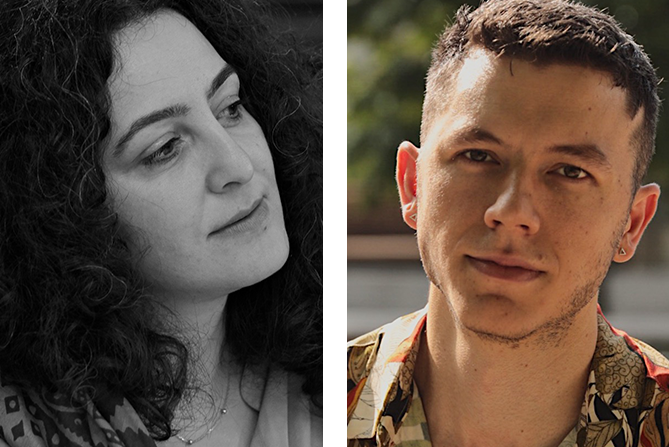
  • Silence, Our Noisy Silence: A Conversation with Sema Kaygusuz and Nicholas Glastonbury

    Silence, Our Noisy Silence: A Conversation with Sema Kaygusuz and Nicholas Glastonbury

    Sema Kaygusuz and Nicholas Glastonbury discuss shame, representation and the Turkish language.

    PEN Transmissions is English PEN’s magazine for international and translated voices. PEN’s members are the backbone of our work, helping us to support international literature, campaign for writers at risk, and advocate for the freedom to write and read. If you are able, please consider becoming an English PEN member and joining our community of over 1,000 readers and writers. Join now.

    Sema, how did Every Fire You Tend come to be?

    SEMA KAYGUSUZ: I have been writing this book since my childhood. I grew up in a secular community, in an incredibly open, loving family. We were close, and we shared things – we had no dramas, violence, or deprivation, but we spoke openly about personal difficulties and emotions. No word was unspeakable. And yet I always felt that something was secret, silent. That all the talking was to cover something up.

    In my childhood, every year, for ten days, I visited my grandparents. There is one particular moment that I always remember. My grandmother said to me, with empty eyes: ‘They butchered us’. This one phrase. I began to ask who they and us were, and this is when I realised that we never spoke about the past.

    This is when I began to conceptualise the silence – our noisy silence. And, then, years later, I discovered our history. At university, I found the history of Dersim. I found witnesses to it. I found out that my grandmother had seen the bodies of all her brothers and sisters floating in the river-waters. She was the only one to survive.

    And then I began to conceptualise shame; to consider the psychology of genocide, and how it related to the silence. There is an important Jewish proverb: the children always want to forget what their parents lived, but the grandchildren always want to remembers what their grandparents lived. I felt I had to remember. This book is my way of doing so.

    You mention two words I wanted to ask about: ‘survival’ and ‘shame’. In a way, this is a narrative of survival – of how one can survive when one’s community, language and culture have been violently removed. But it is also one of shame – of how one remembers, or chooses not to; voices, or chooses not to, because one is ashamed of, is told one must be. I wonder what the relationship between survival and shame are? Is shame a way of surviving?

    SK: Definitely. I know that my grandmother kept asking herself: Why do I get to survive? To be seen – to say something about survival – is not easy. We all live with the taboo that Turkey has not yet confronted. A national secret.

    After the holocaust, Adorno said no one can write poetry, now. But then Paul Celan did. And maybe the silence and shame of my grandmother – what she had to live, as a burden and a legacy in her body – maybe it is a language that I need to decipher. It took me years to understand the shame, the secret, the silence.

    I have chosen a way of trying to decipher it. Zeus has two sons, Chronos and Cosmos. Chronos always talks about time in a linear way. He writes his story by linear arrangement, and always about himself. His story is always written through dominance and power. He uses classification, symbolisation, polarisation, organisation, dehumanisation, extermination, and denial. This is what linear time does. I did not want to write this way.

    I’d say that linear organisation is also tied up with masculine and colonial narrative – and that they do all they can to homogenise and claim totality. In Every Fire You Tend, there’s a plurality of narrative – these are women’s voices, and they’re many. Is this a response to the male, colonial, official narrative?

    SK: Yes – it is. It is Cosmos. I turn my back on Chronos and recognise that time can be elliptical. Cosmos appreciates shame and silence and everything else that comes from history – recognises the small and the large. Cosmos sees things as helical, with pathos and mythos and sensual experiment.

    I agree with Walter Benjamin: tragedy is a pile of debris growing skywards before me. My life is okay; but before me is tragedy. I climb up the debris and I see survival. My life – my survival – is a coincidence. And I ask myself how I convey tragedy not for the past, and not linearly, but for the future, and with plurality.

    Could you speak a bit more about representing plurality?

    SK: I don’t write communities; I write individuals. When you say the Armenians, you make Armenian individuals a material.

    You homogenise.

    SK: Yes, you homogenise and instrumentalise. I didn’t want to do that to the Zaza community. I don’t want to instrumentalise any community as a cultural product. Everyone has their own special moments, and as a writer I need to touch one spirit that can open the others. My grandmother’s individual experience can speak to the global, but it should not speak for the global.

    Nick, when we talk about representation and plurality, we’re talking about something to do with narrative structure. When you came to this book, how did you perceive that?

    NICHOLAS GLASTONBURY: The form is significant when we talk about modes of representation: the novel form, at large, is bound up in the same violences of the nation-state, coloniality and modernity that are at the heart of the novel’s critique. By writing something elliptical, you confront some of the assumptions of how narrative is supposed to function.

    And though this point is about form, it relates deeply to language – something with which Every Fire You Tend is highly concerned. Could you both talk a little about the book’s language – which is, in the English and the Turkish, extraordinary?

    SK: When I go to France, they ask about women in Islam. That’s the role I’m asked to play. But I am not a ‘Muslim writer’ or a ‘Turkish writer’. I call myself a ‘Turkish-language writer’. And this is not a homogenised language: it includes Arabic, Greek, Farsi, Spanish, Armenian, Kurdish. If you speak with a Turkish nationalist, you realise that they don’t speak real Turkish. They don’t know Turkish – just a very narrow version of it. Nationalists get their irons out and flatten everything. The Turkish of Every Fire You Tend refuses this.

    NG: Before I even read the book, I spoke to friends in Istanbul about it. They told me that they stopped ten pages into the Turkish version because they couldn’t ‘understand it’. That emboldened me to translate it.

    As a translator, the difficulty comes in translating the historical development of Turkish that the book explores. Certain words that were used 100 years ago in the Turkish feel as antiquated as words from 400 years ago in the English.

    I suppose that’s another way of capitulating Chronos.

    NG: Yes – and being able to move between language histories was the most difficult, but most rewarding, thing the book asked of me. Each section varies tonally, and striking that polyphonic register took me several years.

    SK: I never choose a word coincidentally; I always choose consciously. Nick got that.

    Did you work together closely on the translation?

    NG: We did, and there’s a long WhatsApp thread – the archive of the process – that testifies to that. I also spent several days staying with Sema, in her home, smoking cigarettes and drinking wine and going to the text. But, even though it was an involved process, something I always felt positive about was the Sema encouraged me to seek out my own authorial capacity – my way of making the constructions of the book sensuous or supple in English.

    You speak in your afterword, Nick, about the novel being ‘written in the coloniser’s language’. Translation into English is often bound up with a history of colonialism; there’s a reason English is prevalent, and that it offers access to wide markets. I wondered if there was something particularly fraught about translating between two languages that, in a conception, are both colonising languages?

    NG: That’s something I spend all my free time thinking about. A lot of the ways in which world literature is framed are about building bridges. But that denies the political, historical and economic violences that subtend cultural contact-zones. It’s totally fraught, and there’s no easy answer. It’s one of the many paradoxes that tear through this book, and make it what it is.

    SK: I’d add to that: whilst every word, on its own, is innocent, the context it is written or means with is not. Nick’s job of transforming Every Fire You Tend into English is paradoxic, yes. But the fact that the book absents masculine and orientalist narratives means the job is, perhaps, a little less fraught.

    Has is taken a combination of you, Sema, as a writer; you, Nick, as a translator; and Tilted Axis as a publisher to make this book work?

    NG: We pitched it a lot. One thing I heard from a lot of editors was that it seemed too experimental. But then wheat is literature if not experimental? If not about new ways of thinking and speaking? Who wants to publish non-experimental literature?

    Capitalists?

    NG: Exactly. Even if the act of translation is about rendering into a colonial language, there are still ways of avoiding the problematics of capitalistic world literature – like Sema refusing the monikers of Turkish writer and Muslim writer. These kind of refusals are important. One of the central points of Every Fire You Tend is that language is always insufficient, but it’s also always all we have. And that’s true of the life of the book itself, too.

    Sema, I want to ask about danger. The environment for Turkish-language writers is fraught, but the Turkish-language literature being translated into English – particularly work by women – is vital and powerful and oppositional. Could you speak a little about your relationship to danger?

    SK: I live some difficulties. But I deny speaking them. I cannot say I’m in danger; if I speak my bravery, I’m really speaking my fear. Living in Turkey, at this moment, is easy for no one. But it is the journalists in prison and academics in exile who are those that can really speak about danger. How can I speak about danger?

    It’s also larger than Turkey. When I’m invited to speak in Germany – an apparent democracy – I think about the fact that they still sell arms to Turkey. When I speak in Germany, I don’t want to allow my existence to become a vehicle. Anywhere in the world, at a moment of crisis, fascism, sexism, essentialism and speciesism emerge. This is why Berlusconi, Erdoğan, Johnson are all the same man. Their differences are just in tone.

    And you’re very sensitive to differences in tone. In being so, you reveal things we aren’t always readily able to see. I was struck by the way you tell violence as silence, and silence as violence. In Every Fire You Tend, atrocious things are described with beauty and lyricism, and lyrical, beautiful things horrifically. I think of the image of the ‘baby struggling to nurse at the breast of the dead mother’. It’s a moment when the beauty of life, with a specific focus on gender and maternalism, is turned into something abject. What do these inversions do?

    SK: To write very raw, brutal moments as raw and brutal requires a certain degree of narcissism. So instead of writing them directly, in this narcissistic register, I took a more wayward path.

    NG: A part of the work of the book is about trying to disrupt our ways of understanding representation. The wayward ways of representing, which Sema talks about, is a way of calling to attention. You likely wouldn’t have been struck by this passage had it not been written in this paradoxical way.

    Yes, sometimes we have to do that. Sometimes, when we are so desensitised to the traumatic, it is only in describing in non-traumatic ways that we’re arrested.

    To finish with a question for both of you, is this novel a celebration or a lament? What do its ‘wail’ and ‘sigh’ signify?

    SK: It celebrates, even as it laments. Everything on earth is divine – even, in a way, our tragedies. But it is not the church of the mosque that has divinity; it is language, which makes everything.

    I think humans want to be gods. But we must ask what kind of god we will be. We do not want to be the sort of prophets who use language that makes us politicians, traders, and slaves to civilisation. If we use the divinity of language, we must look to give the future ethics. We don’t need temples; we need poets. And, really, we are all poets.

    So Nick, with this translation, are you on your way to becoming a god?

    NG: Maybe. To answer your question, I think it’s both. Sema mentioned Walter Benjamin earlier, and I think that part of his philosophy of history is about encouraging us to see ourselves as agents of history – as agents who can stop the ongoing accumulation of destruction and debris. We have this messianic power; this capacity to do so.

    The book, for me, is about how language can provide us with the tools to arrest history. It’s mourning a tragedy, but it’s also a celebration of the human will to make history for ourselves.


    Sema Kaygusuz (born 1972) is one of Turkey’s leading female writers and the author of Every Fire You Tend. She has published five collections of short stories, three novels, a collection of nonfiction essays, and a play, which have won a number of awards in Turkey and Europe and have been translated into English, French, German, Norwegian, and Swedish. Her short story collection The Well of Trapped Words was published in an English translation by Maureen Freely (Comma Press, 2015).

    Nicholas Glastonbury is a translator of Turkish literature. He is also a doctoral candidate in cultural anthropology at the Graduate Center of the City University of New York, and a co-editor of the e-zine Jadaliyya. He is the translator of Every Fire You Tend.

    Interview by Will Forrester, Editor.

  • If This is a Lament

    Bir ağıtsa bu

    Olmayan bir ülkeden söz ediyorlar
    Olmayan dilden, kardeşlikten.
    Konuşma yok
    Yok kelimeler.

    Anlaşılmak içinse yeryüzü
    Kim ölümü anlatacak
    Dağların aldığı nefesi
    Çöken karanlığı
    Kim anlatacak,
    Bir çocuğun rüyasında büyüyenleri
    Kim?

    Kuşların kanatları
    Eski bir masaldan bana doğru çırpınıyor
    Eski kadınların anlattığı
    Tenin taşa yakınlığı.

    Belli ki bir ağıtçıyım ben,
    Karanlık çöktüğünde
    Dağların ötesinde
    Kimi ansam bakıyor bana acıyla.

    Bu bir ağıtsa
    Ağlamak henüz başlamadı.


    If this is a lament

    They speak of a land that never was,
    a non-existent tongue.
    There is no utterance,
    no words.

    If we’re put on earth
    to understand each other –
    who can make sense of death?

    Explain how the mountains stole breath,
    or translate the darkness
    that has fallen?

    Who can say what burgeons
    in a child’s dream?

    Flapping out of an ancient tale,
    birds’ wings bear down
    on me – and skin’s

    akin to stone
    as the old women used to say.
    When darkness falls

    beyond the mountains,
    the people I remember look to me
    in pain. My words are elegy.

    If this is a lament,
    we haven’t even
    begun to cry.

    Jen Hadfield was born in Cheshire and lives in Shetland, whose landscape and natural life persistently informs her work. Her second poetry book Nigh-No-Place (2008, Bloodaxe Books) won the T.S.Eliot Prize in 2008. Her third poetry collection, Byssus, was published by Picador in early 2014. She is currently Writer in Residence at Glasgow University and Glasgow School of Art, supported by Creative Scotland.

    Canan Marasligil is a freelance writer, literary translator, editor and curator based in Amsterdam. She specialises in contemporary Turkish literature as well as in comics. She has worked with cultural organisations across wider Europe and has participated in a range of residencies at the Free Word Centre in London (2013), at WAAW in Senegal (2015), at Copenhagen University (2015) and at La Contre Allée in Lille (2017). She is the creator of ‘City in Translation’, a project exploring languages and translation in urban spaces. www.cityintranslation.com

  • The Greatest Turkish Novel?

    This article is part of the English PEN Between EU and Me project, supported by the European Commission

    I belong to a generation that often measures the success of authors not by their literary achievements but by their political stance. Since my school days, I saw how the artistic sins of a writer could be readily forgiven as long as the author in question had progressive views. After all, we believed, it was their politics, rather than their artistic talents, that mattered most. This category mistake is still made today. When my friends ask me to name the best contemporary author in Turkey, I sense their actual question is: “Which Turkish contemporary author has the views you accept/like the most?

    So imagine the surprise when my generation of young Turks discovered the works of Ahmet Hamdi Tanpınar, an author who had made a mockery of the idea of progress in his comic novels and who had found little to like in the culture of modernity. For Tanpınar, this dissatisfaction was the starting point of a number of books which fed on the discrepancy between the traditional and the modern.

    Tanpınar is not an easy writer. Reading The Time Regulation Institute (translated by Maureen Freely and Alexander Dawe in a handsome edition by Penguin Classics) provides ample evidence of that. This comic novel features the adventures of a group of ‘institution men’, who, heroically and absurdly, try to synchronise all the clocks of Turkey. The result is a challenging and hilarious read and, for me, perhaps the best Turkish novel of the 20th century alongside Orhan Pamuk’s The Black Book.

    Tanpınar’s language is rich with Turkish, French and Ottoman words. The narrators in his books are carefully planned and richly imagined by a novelist, rather than an ideologue. Tanpınar excels at parody, psychological realism and dramatic irony. He is also a poet, but most critics believe that his prose is much superior to his verse.

    Tanpınar’s grammar is nothing like the proper, neat Turkish grammar taught at school. Unlike his contemporary Turkish social-realists, for whom language was merely a tool with which to educate the ‘ignorant masses’, Tanpınar’s prose is impressionistic and musical. It glows and echoes, and one never quite forgets the strange taste of his sentences after reading them.

    He has no patience for the kind of reader who has no patience with the complexities of history and culture. His books are a living challenge to the cultural policies of the modern Turkish state, which has long demanded that writers use language ideologically and for political ends. Tanpınar’s other major novel, A Mind at Peace (also available in English), provided an antidote to the soulless ‘modern’ novels taught to us in academic curricula. In those ideological novels, an eternal and clichéd struggle takes place between preachers and adversaries of modernity. In Tanpınar’s novels things are a bit more complicated. The spiritual characters are cherished rather than demonised. He carefully handles fragile traditions rather than breaking them into pieces.  

    Belittled in his time for his unfashionable intellectual interests, Tanpınar was called Kırtıpil (shoddy) Hamdi by the cultural elite and earned himself a rather tragic image. He came to be seen as a sort of sacred but forgotten figure because of his acute interest in tradition. New studies on Tanpınar and his recently published memoirs (Günlüklerin Işığında Tanpınar’la Başbaşa, 2007) challenge that tragic image. Not only a brilliant author, but also an energetic politician and a member of the establishment, he served in parliament during the single party era and never stood on the sidelines. His critique of modernity owes most of its insights to the fact that he had been a servant of its institutions.

    In my school years, when Tanpınar quickly rose to academic and literary hipness, it was increasingly the norm, rather than the exception, to question the process of modernisation. Modernity’s obsession with progress and efficiency had been largely embraced by the earlier generation of authors who treated them like sacred objects. For Tanpınar, a break with history and tradition was not a cause for celebration. On the contrary, that rupture provided him with a sense of duty about the importance of recollecting the past. I first read his works in black-covered Yapı Kredi editions where he was in good company. The same publishing house published the first complete Turkish translation of Proust’s Remembrance of Things Past.

    Like Proust, and Pamuk, Tanpınar opens doors to other books and ideas. I am curious about what thousands of new readers (some of whom must have first heard his name on Oprah Winfrey’s Book Club where the Institute was recently recommended) will make of him. I think Tanpınar’s crowning success was that, unlike his progressive or conservative contemporaries, no political organisation or school can claim him today. Perhaps the only institute he can be a member of is his own Institute of Time Regulation.

    Kaya Genç is a novelist and essayist from Istanbul. His work has appeared in the Paris Review Daily, the Guardian, the Financial Times, the London Review of Books blog, Salon, Guernica Magazine, Sight & Sound, the Millions, the White Review, the New Inquiry, The Rumpus, Index on Censorship, the Guardian Weekly, HTMLGIANT, Songlines, and PankL’Avventura (Macera), his first novel, was published in 2008. He is the Istanbul correspondent of the Los Angeles Review of Books.

    You can follow Kaya Genç on Twittter.

    For more on Kaya Genç and his writing visit his website.

    Ahmed Hamdi Tanpınar was a beloved Turkish novelist and essayist and a member of Turkish parliament. Born in Istanbul in 1901, Tanpinar came to be educated in several Turkish cities and and travelled widely throughout Europe. The Time Regulation Institute is his most celebrated novel, followed by A Mind at Peace.

    The Time Regulation Institute, by Ahmet Hamdi Tanpınar, translated by Maureen Freely and Alexander Dawe, is available from Penguin Classics.

  • Living by the pen

    What is the cost of going on the payroll for a writer in Turkey? Kaya Genç weighs up the rewards and risks of working for a major paper, the trade-off between authorial freedom and institutional backing, and his simple solution for protecting free speech In April 2007 I was forced to make a decision which seemed important to me at the time.I was trying to make up my mind about whether I should work full time at Newsweek magazine’s Turkish edition. My attempts at convincing the magazine’s editor that I would be more valuable if I worked freelance had failed. His offer was a full time job. ‘I am not interested in hiring a freelancer, I want to pay you a proper wage,’ he said, clarifying his position. This would have been an easy choice had money been my sole concern. It was not. I cared for what I used to think at the time as my ‘authorial freedom’ and this was why I wanted to work as a freelancer.Write for Newsweek, earn money, buy time, and finish your novel, my inner voice said.But the editor reminded me that the category of freelance writers simply didn’t exist in Turkey. Freelance writers couldn’t earn enough money to pay their rent. They were not taken as seriously as their formally employed colleagues. If you wanted respect you needed to become part of your publication’s institutional structure. Simply feeding it from the sidelines wouldn’t do.You were either with them in the office getting paid, or against them in your living room not getting paid. With a handful of notable exceptions, the individual writer devoid of any institutional affiliations didn’t really exist in Turkey.So I reconsidered the situation and my decision became a no-brainer. I accepted the offer, moved into the office and started working.Only a few days had passed behind my new desk before I got a call from the editor of a Turkish literary magazine where I had been publishing essays and short stories for the past few years. The magazine had come to symbolise my pre-Newsweek existence. It paid its contributors little but provided them with a valued literary space.When I received the call that day I wondered whether the editor would ask for a new contribution or inform me about a fan letter.It turned out to be quite a different matter.’The state prosecutor has received a complaint about one of your short stories,’ he informed me in a nervous voice. ‘We went to a preliminary meeting with the prosecutor yesterday. You’ll need to visit him first thing tomorrow. This is serious business, Kaya. The plaintiff wants you to be tried in court.’In 2007 a political court case could very easily become a death warrant. Only a few months had passed since the assassination of Hrant Dink, an independent, Armenian journalist who was murdered by a gang of ultra-secular nationalists in central Istanbul after receiving a prison sentence. His assailants believed that Dink’s views were treacherous and decided to silence him.Dink was part of a group of writers whom the mainstream media had dubbed variously as ‘liberals‘, ‘renegades’ or ‘traitors’. At the time I couldn’t see the curious bond connecting all those authors. They were independent; writers who couldn’t rely on big institutions to protect them. They worked as editors or publishers or academics or columnists but in spirit they were all freelance.They were different from intellectuals who were closely affiliated with powerful institutions. When a writer from the latter group wrote an inflammatory piece about, say, the customs of Turkey’s Kurds, his newspaper would immediately pay the legal costs of the libel case that followed. In Turkish we define their situation with the expression, arkası sağlam, which means you’re well-connected: powerful people have your back. Because they were arkası sağlam people, those nationalist columnists could continue penning their articles without having to worry about their future.But if you were a freelancer with no real connection to a major institution and no wings to protect you, you would be made to pay the legal costs on your own. This was a nice tactic which served to destabilise the financial positions of freelancers, and keep them silent. In this country when a group of institutionalised intellectuals want to dominate the political discourse, the first thing they try to get rid of is the independent writer. This had long been the case: in 1932 after the launch of a magazine called Kadro (‘Cadre’), Turkey’s free thinkers were employed by the state. Their new status as defenders of the state apparatus and its reforms changed not only their intellectual careers but also that of Turkey’s left.By accepting Newsweek’s offer I felt as if I, too, had become an institutionalised intellectual. My independent wings had been severed. The freedom they had provided was no more. Of course, the severing had its advantages, too. My editor reassured me that the magazine would stand by me if a court case was indeed opened.This was good news. If the Turkish state decided to come after me, a news magazine would protect me. I took the dummy issue of the magazine, which had my name printed on one of its pages and headed to the offices of the state prosecutor. There I had the very unpleasant experience of having to defend a fictional story.The narrator of my story spoke ironically and so only the complete opposite of what he said could be attributed to me, I explained. My explanation was as curious as the situation that demanded it. The narrator of my story was an occidentialist who adored western civilisation beyond all measure. I said I was making fun of him by way of using him as my narrator. His voice was designed to outrage the reader. That someone had filed a complaint was proof of the story’s success.And, after all, wasn’t it a work of fiction? What the characters said represented their views, not mine.What the characters said in this particular story was intended to be ironic. My pontifications about the meaning of irony and its rhetorical use seemed to have convinced the prosecutor. He seemed to accept that I was simply a well-meaning young man who had been gravely misunderstood. As I left his office I felt as if I had talked shop with a literature professor rather than defended myself before a state prosecutor.A week passed.No word from the prosecutor.On Monday I learned that the prosecutor decided against opening a case. I felt relieved and yet I couldn’t really tell whether it was my rhetorical skills that had saved me from the wrath of the law. I sensed that something else might have played a role. As I thought more about the matter I became convinced that had I not brought along the copy of Newsweek which bore my name and that of the Washington Post company on its pages, the result might have been different. So the moral to draw from this episode was quite clear. I had been saved thanks to  my decision to stop freelancing.

    * * *

    In countries like Turkey where the literary market offers you only a flimsy hope of living by your pen, being a professional author places you in a very curious position. The road to authorship, when you first enter it, feels like a dead end. Nobody seems to dream, let alone seriously consider, that making a living by one’s pen can become a person’s goal in life.  Consider, for example, how my generation of prospective Turkish writers had the traumatic experience of witnessing the older generation of authors being tried and then killed in broad daylight. Consider how we witnessed their fate as the Turkish state and ultra-secular nationalists came after them and bullied them and threatened them and forced them to flee their country and live in exile in fear of their lives.Consider how we witnessed them being bullied by political columnists who in desperate attempts to control them and force them into changing their views leaked details of their personal lives. I still remember how a newspaper columnist questioned a leading novelist’s sales figures, claiming that it was impossible for such an author to make a living by his pen: the implication was that the novelist’s popularity was a fabrication and that he was in pay of some shadowy institution in a western country.This was the lesson we were forced to learn: being an individual voice in this country would have the automatic result of labeling you as a traitor, a greedy liberal, an enemy of the holy state. Become anonymous and pen nasty articles about free thinking intellectuals, a voice seemed to tell us, destroy the reputations of those who dare start literary careers under their real names. The same voice said that the honourable craft of literature belonged to those who devoted their labours to national leaders or ideals or symbols without asking anything in return. Devotion and duty were the things that really mattered. Literature was a calling, writing was a duty, speaking the national tongue was an obligation. Why did we even ask to be paid for those patriotic acts?Selling your work to editors and publishers also had the sinister implication that words could be exchanged, that they had material value, that they could be used for something other than propaganda.Tragically, the first generation of republican authors accepted these views willingly. But things didn’t change much by the time I made my way into Turkey’s literary market. When people attempted to make a living writing essays and reviews following a path well-trodden by many in London and in New York, they were immediately branded as hacks or suspicious figures who paid too much attention to materialistic, instead of idealistic values.Again, the implication of this bullying was clear. The writing business belonged and should continue to belong to the wealthy —to those who never needed money. The elite had the right to write and speak; others were silenced through this moralistic mirror in which they were portrayed as greedy and decadent figures.There is no better way of showing your gratitude and appreciation for a writer’s work than paying them properly. For more than ninety years of republican history Turkish freelancers had been silenced either by state institutions which employed them or by the lack of a proper literary market. But as I look around and try to see how other authors from my generation are doing nowadays, I see how they no longer share the old state ideas which make freelance authors suspect in the eyes of the intellectual community. On the contrary, they are increasingly joining the ranks of independent writers. I know, from experience, that it won’t be state patronage or employment by special institutions that will save them from the cold realities of pessimism, poverty and prosecution. No, don’t make them part of the state apparatus or turn them into ideologues or employ them as editors: if you want those writers to succeed, just pay them. This is an edited version of Kaya Genç’s speech delivered for the International Authors Forum which met in Istanbul on 1st November 2013. The International Authors Forum is a forum for discussion, debate and collective action between authors’ organisations worldwide. Its focus is on protecting authors and ensuring that legislation, particularly in the area of copyright and related rights, enables authors to be paid fairly for the use of their work.  About the authorKaya Genç is a novelist and essayist from Istanbul. His work has appeared in the Paris Review Daily, the Guardian, the Financial Times, the London Review of Books blog, Salon, Guernica Magazine, Sight & Sound, the Millions, the White Review, the New Inquiry, the English PEN Atlas, the Rumpus, Index on Censorship, the Guardian Weekly, HTMLGIANT, Songlines, and Pank, among others. L’Avventura (Macera), his first novel, was published in 2008. Kaya has a PhD in English literature. He is the Istanbul correspondent of the Los Angeles Review of Books and is currently working on his second novel.

    Additional Information

    You can follow Kaya Genç on Twittter.

    For more on Kaya Genç and his writing visit his website.

  • A literature in search of its language

    Ciwanmerd Kulek charts the ongoing struggle for the Kurdish language, and whether being a language that is now more written than spoken threatens it in new and troubling ways‘I am ready to die for Germany,’ said Ciwan Haco, the world-famous Kurish musician, in a recent interview for a Turkish TV channel, ‘because it gave me my freedom, my language. Not for Turkey, not for Syria, not for Iraq or Iran – but for Germany… Do you see how bitter this is?’ It was hard not to notice the bitterness in the face of the singer who had fled his homeland, the Kurdish region of Syria, because he had not been free and couldn’t sing in his native language there. Many things have changed over the years in the four countries mentioned by Haco – between which almost all the population and territory of Kurdistan is split. In particular, technological changes have broadened perspectives, bringing new challenges and expectations.One of the hottest issues for the Kurdish population in Turkey– where most of Kurdistan is, and where most Kurds live (according to Turkish sources there are 13-14 million of Kurds there, while Kurdish researchers say 20 million) – is education in the mother tongue, an issue which dominates disputes between the Turkish government and Kurdish political movements. The challenge, or as some like to put it ‘the threat’, posed by the 21st century for Kurds is not the struggle to exist as such, but the struggle to exist within their own language, to preserve and promote it without it being destroyed by  repressive regimes. According to some, current discussion of linguistic rights in Turkey suggests that Kurdish is no longer a forbidden language and ‘Kurdishness’ no longer a suppressed identity as it was until recently. They argue that we have reached a good standard of democracy and solved a big part of the problem – whereas the Kurds regard even discussions about the legitimacy of mother tongue education as an outrage.The beginning of this academic year in Turkey has revealed new problems. 160,000 public school students have chosen additional Kurdish lessons in their 5th and 6th grades. But giving the right to choose an optional two-hour weekly course for only 5th and 6th grade students is not enough. Reports say that in some places parents are actively deterred from choosing Kurdish courses for their children. To make matters worse not a single Kurdish language teacher has been appointed in 2013 even though ‘900 students have graduated from the Kurdish Teaching programmes so far,’ according to Prof. Kadri Yıldırım, vice president of Mardin Artuklu University, the most prominent and active official institute carrying out studies in that area. And while Prof. Yıldırım fights to voice the expectations of families and graduates, he cannot conceal his frustration at the negligence of the administration and the ministry of education. Kurdish intellectuals are concerned that Kurdish has the status of an ancient relic or curio, confined to few academic institutions, away from the energy and resources of everyday life.A couple of decades ago, teaching in Kurdish, or even abolishing the language ban itself, would have helped the language greatly. At that time, most Kurdish people lived in the countryside with limited access to schooling. They rarely needed to speak Turkish, except for military service, or in some rare official cases. However, mass destruction of Kurdish villages and migration to cities, especially in the beginning of the 1990s, brought new patterns of behaviour introduced by modern life. The Kurdish people began to feel the urge to preserve their language and culture in the face of this modernisation. The issue of language began to be as significant as that of land. That is why the recent legal amendments, described as a ‘package of democratisation’ by the government, including changes like the freedom to use characters like W, X and Q that are common in the Kurdish Latin alphabet, were far from meeting people’s expectations and were seen as too little too late. It’s hard now to explain to new generations that it used to be forbidden to use those characters in official documents. And that is why, indeed, the 263 books published in Kurdish last year don’t give much consolation to those dissatisfied with the slowness of the process, even though the number is the highest in the history of the Turkish Republic, during most of which a single written Kurdish word could cause great suffering.Kurdish publications in the past were very few and almost all of them appeared abroad. After the launch of Kurdistan (1898) in Cairo, the first newspaper published in Kurdish, some short-lived journals were published from 1908 to 1919 in Istanbul, the capital of Ottoman Empire at the time. The literary magazine Hawar (1932), published in Damascus in Syria, was the first publication in the Kurdish Latin alphabet common among the Kurdish population in Syria, Turkey and the diaspora. The first Kurdish novel, Şivanê Kurmanca (1935), was published in Yerevan in Armenia, a republic of the Soviet Union at that time.The reintroduction of the Kurdish language was helped by the publication of other invaluable works by intellectuals exiled in Europe, together with a law in 1992 which ended the language ban. The millennium brought an atmosphere of semi-freedom and greater tolerance.However,the situation is still far from ideal. We might have more people reading or writing in Kurdish, but we have fewer people speaking in Kurdish. Over the years the language has gradually been given less space in the relentless assimilation policy pursued by the state. Loss of language is as shocking as land sliding away from under your feet. The fact is, people don’t only want to be at home, but they also want to ‘feel at home’ in their own language, especially after their suffering over the years; they want to escape the assimilation process which forces them out of their ‘homes’.Due to this political situation, there isn’t a single Kurdish author with even a year of schooling in his native language living in his homeland. If the government keeps erasing the Kurdish language from people’s minds, memories and daily routines, Kurdish poets and writers will resemble prehistoric figures who just add Kurdish names and phrases randomly in their works, like the characters in Marquez’s town of Macondo, who forgot the names of objects and had to name them again.We must let the Kurdish language travel along its natural path, not be hampered by politics. Maybe this is the only remedy for past suffering: to eradicate and heal trauma, we need to free language, so that it can flow through the dreams of its people and nourish its literature.About the authorCiwanmerd Kulek was born in 1984 in the Kurdish region of Turkey, in a village in the south-eastern part of the country, and has lived in Bismil, a small town by the river Tigris, in the Diyarbakır province, where he works as a teacher of languages. He graduated from the Foreign Language Teaching Department of the Middle East Technical University in Ankara in 2006. He is the author of three novels in Kurdish, published by the Diyarbakir-based press Weşanên Lîs, Nameyekji Xwedêre (A Letter To God, 2007), Otobês (The Bus, 2010), Zarokên Ber Çêm (Children By The River, 2012). He has translated literary works from English, Spanish and Turkish into Kurdish, by writers such as J. M. Coetzee (Disgrace) and William Faulkner (As I Lay Dying), while other translations by Gabriel García Márquez (Cronica de una muerte anunciada), Juan Rulfo (El Llano en llamas), James Joyce (Dubliners) and Orhan Pamuk (White Castle) are being prepared for publication.

  • A wind blows from Gezi Park

    This week PEN Atlas returns to Turkey for an update on Gezi Park. Müge İplikçi reflects on recent events and draws parallels between the treatment of protestors and the ongoing stifling of Turkish writers, who work in a system in which profit is the only validationTranslated from the Turkish by Feyza HowellThe Gezi Park movement goes far beyond ‘external provocation’, as it’s persistently termed by the Turkish government. It affects everyone, young and old, and it will continue to do so.A few weeks ago, a younger demonstrator told me that this was not an environmental movement – or at least not yet. But I suspect we both actually want the same things: to live in a country where nature and humans coexist, where an individual’s rights and freedoms are sacrosanct, enshrined in an ethical framework, and where reason prevails, without interference from any hierarchy.After all, the Gezi Park movement is much more than an excuse for environmental activists to flock to the streets. The real impetus has been a general struggle against a stifling atmosphere –  the increasing interference with our homes, our bodies and our independence. This has included a conservative shift in our education system; the censorship of books; a ‘single voice’ imposed on the Press; and a profits-first policy imposed on the Arts under the guise of ‘privatisation’. In all likelihood, the last straw came with the rapid transformation of the country into a property bubble.But something unexpected happened as the panzer tanks raided Gezi Park on the night of June the 15th
    . We, the older generation, were well acquainted with state violence in a way that the 90s generation have never been, or needed to be. (I call such violence the official language of the state: a language that feeds on censorship and lies.) This was perhaps the first time the younger generation really understood what minorities had to face. One young person regretted his earlier suspicion of gay people, while another exclaimed, ‘Now I understand why the Kurds fled to the mountains!’Fascinating moments and encounters like these have a new address now. A place that inspires innovative protests and – more crucially – teaches us to overcome our fears. Take the ‘standing man’. One day, a solitary young man stood still for hours in Taksim Square, next to Gezi Park. Others joined him. The following day, there were more. In a few days, people were standing still everywhere. They stood still reading books, in silent protest at police violence. They stood to exercise their rights as citizens.Although the state expelled the protestors from the park on June the 15th
    – physically, if not in spirit – the action paradoxically gave rise to hundreds of Gezi Parks. The movement endures, through a variety of initiatives, and as it does it brings about change: both social and political.I won’t deny however that this has all been a terrible ordeal. There’s little need to elaborate on the fug of tear-gas or the police truncheons that we’ve had to face. But for writers, the worst has been on the agenda for years: the relationship between neo-liberal policies and moderate Islam, a relationship with an infinite appetite for expansion.Our work has no real value in such an environment, where profit is the only validation. This has led to yet another type of censorship, one perpetrated by the publishers and the media. All that matters is how your work stands in the marketplace. You are trapped by an undetectable boundary of your visibility, sales and promotion. This is reinforced by a superficial publishing industry and its followers, who place focus on how visible you are. This vicious circle explains why good literature struggles to reach the reader. Over the last decade, good literature has become marginalised before our very eyes, in a process that is now accepted as the norm.For some time, the possibility of breaking free from the vicious circle has been occupying my mind. That is, until very recently. Because now there is a new phenomenon at the heart of the nation: Gezi Park, a resistance that is continuing as I write these words.This movement has the potential for great change, and one whose impact will be felt on the wider literary scene. I don’t necessarily mean writers will gain a wider readership. Rather that there is a chance that readers might think more, and think more deeply – and this in turn might lead to an end to writers’ alienation from their work.I am convinced that this period of deeper thinking will inspire us all, and literature will have its part to play. A nation that can defy its government’s ‘blank cheque’ attitude towards politics might also defy such an attitude coming from other parts of the political and cultural establishment.That is, so long as we writers continue to create, without compromise between integrity and the marketplace. The acclaimed writer Oğuz Atay once said, ‘I am here, Dear Reader! Where are you?’ I am convinced that the reader is there – learning solidarity, learning how to resist the system, developing an awareness of culture. The reader will eventually respond and welcome us.And this might easily mean that everything changes. A paradigm shift in reading would entail a shift in our very perception of life…Could that really be?Recent events have demonstrated that anything is possible.About the AuthorMüge İplikçi was born in Istanbul. A graduate of Istanbul University English Language and Literature Department, İplikci received MA degrees in Women’s Studies from Istanbul University’s Women’s Studies Department and The Ohio State University. İplikci made her mark at a young age, winning the prestigious Yaşar Nabi Nayır Young Author Award in 1996. She has since published four short story collections and three novels, as well as two books of non-fiction. A widely translated short story author, İplikci’s highly creative stories, which are often tinged with, if not doused in, the post-modern, usually revolve around apparently mundane human relationships, and especially the women in them. İplikci has been a member of Writers in Prison Committee (WIPC) of Turkish PEN for 3 years, and has also been the chairperson of the PEN Turkish Women Writers Committee since 2007.About the TranslatorFeyza Howell works as a literary translator as well as serving English PEN as an assessor and a number of public agencies as an interpreter. She has been translating fiction and commercial texts for many years as well as writing copy and non-fiction, including Waste by Hakan Günday and her translation of Madame Atatürk by İpek Çalışlar, which is due for publication by Saqi in the autumn.

  • On the sublimation of authority

    PEN Atlas continues its focus on Turkey this week, in light of ongoing unrest throughout the country. In this  dispatch, Hakan Günday unpacks the notion of authority and censorship, and considers its effects on civilians 

    Translated from the Turkish by Feyza Howell

    All authority has a natural tendency to ultimately vaporise, utilising every tool at its disposal. The fundamental purpose of this tendency is to disperse authority molecules throughout the atmosphere for the governed to inhale in order that submission may be transformed into accepted behaviour. Thus, as authority spreads itself like waves of fog, the governed lose the ability to identify who actually makes their decisions: they themselves, or the authorities? And, in time, they grow to accept their new situation as the norm, turning into the unwitting enforcers of self-censorship. It is at this point that the bodies and minds of those governed display the traces of the aforementioned inhalation, no matter how deftly authority may have evaded criticism -direct or indirect- by simply concealing itself. Art works as a disclosing tool, in certain circumstances, to reveal these fingerprint-like traces.

    Remaining visible is a potential threat for authority, marking it as a target for reaction, and thus hindering its reign. Fully aware of this danger, authority seeks invisibility; the more it does so, the more effective a fingerprint powder art becomes, disclosing to the open eye the stains of oppression on which it’s sprinkled. That’s when the governed notice the traces of authority on their own bodies and minds and try to free themselves of this ‘foreign matter’ they’d been carrying unawares.

    These traces, in addition, indicate a spiritual loss rather than a material one, in contrast to those left behind by a random burglar: not the theft of a laptop, but rather of liberty.

    Authority is the explanation behind the transformation of the compassionate going to sleep and waking up as brutes. Tolerance may have closed its eyes questioning, entered dreamland querying the prosecution, and opens its eyes as bigotry… All manners of authority stain humans from the moment they they’re born, and life is the struggle to purify oneself from these stains.

    It’s only when authority uses a gas bomb -for instance- to permeate the governed that the natural chemistry of the human body and mind rejects this at once. The aforementioned gas, being unable to disperse in open air, congregates at one point, revealing authority that is made concrete anew as hanging in the void, swinging naked. No different from the moment when a burglar is caught red-handed, and therefore no fingerprint powder is required for identification. Authority stands like a leaden cloud, its intransigence and sickness in full view. 

    Now all that the governed needs to do to see it is raise their heads, but staring at it is a problem. A medical problem. Because the true face of authority is too dangerous to look upon with the naked eye, too perilous to touch with the bare hand. Which is why the following personal safety equipment is essential before attempting the above-mentioned actions: a helmet, swimming goggles, protective facemask, a pair of work gloves and sufficient quantities of antacid solution.

    As İstiklal Road would shed its leaves onto Taksim Square, so did the resistance flock to it, a five-minute walk from the verdant Gezi Park. Accessories were essential from the first night onwards, the 31st of May. Accessories that serve to protect, contrary to popular misconception, not from the effects of tear gas, but from the germs of authority. The resistance was fully aware that such an infection would manifest itself with equal violence in response to police brutality; this first symptom would poison their peaceful movement. The superhuman determination to stay sterile and thus fend off authority’s attempts to sideline the resistance is extraordinary.

    Consequently, the Gezi Park Resistance -whose ecological demands went up in the smoke of their torched tents on what was only the second day of their action- and has today become a ‘Protest to Earn the Right to Protest’ is a poem, not a story, in the history of protest on the freedom of expression. A poem written by the object of its own tribute: the activists still resisting, sustaining injuries and losing their lives…

    About the Author

    Hakan Günday was born in Rhodes in 1976. He finished his primary education in Brussels. After attending Ankara Tevfik Fikret High School, he studied at the Department of French Translation in the Faculty of Literature of Hacettepe University. He then transferred to Universite Libre de Bruxelles.

    About the Translator

    Feyza Howell works as a literary translator as well as serving English PEN as assessor and a number of public agencies as interpreter. She has been translating fiction and commercial texts for many years as well as writing copy and non-fiction, including Waste by Hakan Günday and her translation of Madame Atatürk by İpek Çalışlar is due for publication by Saqi in the autumn.

  • The Walnut Tree of Gezi Park

    Following recent events, PEN Atlas is running an additional dispatch this week from Turkey. Kaya Genç writes for us about Nâzım Hikmet Ran, whose poem ‘The Walnut Tree’ has taken on a prophetic turn and an inspirational one in light of Gezi Park

    Nâzım Hikmet Ran, who died fifty years ago this week on June 3 1963, was one of the most sophisticated poets of Turkish language. His reputation as a romantic communist seems uncomplicated on the face of it. His works, however, attest to an author whose ideas were far from simple: a communist who was fascinated by the minutiae of industrialization; a poet who preached art for the masses while devoting his verses to elaborate philosophical discussions with figures as demanding as George Berkeley and Karl Marx.  

    Born in the then Ottoman-ruled Thessaloniki in 1902, Hikmet studied at a Naval Academy before traveling to Anatolia to join the anti-imperialist resistance movement. From there he moved to Moscow where he witnessed the foundation of the Soviet Union. Inspired by Futurists and Vladimir Mayakovsky’s modernist experiments he returned to Turkey where a nasty surprise awaited him in the form of an increasingly authoritarian regime. The new ruling elite, which trampled all dissent after 1925, picked on Hikmet; as a result he spent more than twelve years in Turkish prisons. After he finally decided to flee to Moscow in 1950, a newspaper printed his picture on its cover, urging its readers to spit on it. He was denationalized a few days later.

    The sheer range of Hikmet’s interests was fascinating. Although he spent almost a fourth of his life under confinement he had a ravenous appetite for current affairs, artistic movements and women from all nationalities. With their multiple perspectives his epic city poems bring to mind Dziga Vertov’s filmic experiments. In “The Epic of Kuvayi Milliye” he narrated the war of independence from the perspectives of ordinary people of Anatolia, challenging the official historiography of the state. As an extremely well-read poet he challenged a number other things, too. Hikmet was too clever, too bright, too passionate. Whatever happened on earth interested him; like a journalist he was quick to react to events. When the Atomic Bomb was dropped on Hiroshima he described this atrocity from the posthumous point of view of a seven year old child (“I’m only seven though I died / In Hiroshima long ago / I’m seven now as I was then / When children die they do not grow”) and from that of a fisherman (“A young Japanese fisherman was killed / by a cloud at sea. / I heard this song from his friends, / one lurid yellow evening on the Pacific.”) 

    Hikmet’s love poems make good reading; as a young man I effectively made use of them while courting girls. Indeed, I have never met a Turkish girl who didn’t react to Hikmet’s love poems in a positive way. Being a reader of Hikmet provided me with the double advantage of appearing politically and sexually mature.

    Last week I remembered Hikmet, like thousands of others who opposed the cutting of trees in Istanbul’s Gezi Park. One of his most popular poems, “The Walnut Tree”, had a contemporary resonance here: “I am a walnut tree in Gulhane Park / My leaves are nimble, nimble like fish in water / My leaves are sheer, sheer like a silk handkerchief / pick, wipe, my rose, the tear from your eyes / My leaves are my hands, I have one hundred thousand / I touch you with one hundred thousand hands, I touch Istanbul / My leaves are my eyes, I look in amazement / I watch you with one hundred thousand eyes, I watch Istanbul / Like one hundred thousand hearts, beat, beat my leaves / I am a walnut tree in Gulhane Park / neither you are aware of this, nor the police.” Hundreds of people chanting those verses to defend the cutting of trees in an Istanbul park—perhaps this was a fitting way to pay tribute to his memory.


    About the Author

    Kaya Genç is a Turkish novelist and essayist. He specializes in late-Victorian authors and wrote a doctoral dissertation on Conrad, Wilde and Stevenson. Newsweek Turkey named him as one of Turkish literature’s 20 under 40. His essays appeared, both in print and online, in the Guardian, London Review of Books, Songlines, Sight & Sound, Index on Censorship, the Rumpus, Los Angeles Review of Books, the Millions and many others. He translated ten books into Turkish (Tom McCarthy’s C, among others), writes both in his native tongue and in English and lives in Istanbul.

    Additional Information

    You can follow Kaya Genç on Twittter.

    For more on Kaya Genç and his writing visit his website.


  • Literature rises in the East

    Ayfer Tunç writes for PEN Atlas about the importance of looking beyond the clichés so that Turkish literature is seen in the context of World Literature. This is the first in a series of reports from Turkey, a focus both for London Book Fair, and for English PEN

    From the West, Turkey marks the start of the East, while from the East it’s the beginning of the West. The country possesses a vivid, vibrant literature which captures all the key dynamics of our age, and its ranks of talented young writers make me hopeful. However, even if they carry fewer prejudices than their forebears, even though they are more curious and more enthusiastic, still this is a literature that the western gaze either cannot see, or does not wish to.

    It pains me to point out that a neo-orientalist mind-set holds sway over Western publishers, and therefore over Western readers. They don’t expect works of great distinction from us or from those to our East; they don’t expect us to have shaken off the bonds of adolescence. Western writers expect us to write novels that show them more clearly as Westerners, and us more clearly as Easterners; they want us to make them feel happy and secure in this regard. Putting the many concrete examples to one side for a moment, I know that we bear some of the responsibility. For we are just the same. We burden our own eastern neighbours with the same expectations, because every contemporary society approaches its own East through a more or less orientalist prism.

    Western publishers sit up and pay attention if you write novels which deal in the Ottoman histories and histrionics that appeal so much to the Western reader. They want stories of abject penury: about lives ruined under the weight of customs and traditions, about the unbreachable chasm between Muslim and Western lifestyles, and tales of ethnic strife. The doors open all too swiftly if you’re telling a tale of damsels in the distress of being Muslim – or alternatively about their pains on adopting a Western lifestyle. Of course, these themes can be treated in ways that are literary. But the problem is this: most publishers are more often interested in examples of these themes that are tawdry, clichéd, and that barely trouble the intellect of the average reader.

    Yet alongside these works which fulfil Western expectations, in Turkey there is a real literature, which looks seriously at the past and present of both Turkey and the wider world, and deserves to be judged by more universal criteria. Works are being written that fully deserve to be understood as part of the shared riches that, after Goethe, we term Welt Literatur. Instead of trading in ‘Muslim’, ‘Westerner’, ‘villager’, ‘urbanite’, ‘minority’, ‘woman’, ‘man’ or similar categories of identity, these books are interested in people’s  existences, ontologies, philosophies, intellectual faculties, their unconscious and every shade of their selfhood. The Turkish writers of such literary texts display a nuanced engagement with the world around them and they use very sophisticated narrative techniques.

    For years I was referred to as a ‘young writer’. On the eve of turning fifty, it pleases me to see that the younger generation coming up after us are braver, more strident, more innovative and more at peace with the world than we are. My own generation was crushed under the fist of the 12th September 1981 military coup, which ripped Turkish democracy to shreds. We sustained heavy injuries, and it took us a long time to pull ourselves back together. In a country whose democracy is still battered and where attempts to trim back freedom of expression are still very much underway, we have a new generation who have learnt from our experiences. A great many of them are vaulting the constraints of barren ideologies, and now take the stage as world writers. This is why I have a request to put to the Western literary world, both in my name and in the name of my generation and in that of the next. It’s a request for equality. We’re also a valid piece of the story in our collective Welt Literatur.

    Of course I’m not going to make the case that every work that gets written in Turkey is of inestimable value, but I can be sure in saying this: both in my generation and the younger one, Turkish writers are working in a way that will stir up the stagnant waters with new and exciting literary currents, and their number should not be underestimated. Certainly they deserve to be taken seriously in this endeavour. Those at the vanguard of this new generation are aware of the development of high literature across the world, they follow it closely and they expend considerable effort understanding and analysing it. Furthermore, most of them are women. Young, smart women. Some are religious, some are not. Some of them feel an affinity with Eastern philosophies, some prefer the exegesis of Western literature. Furthermore, despite the vicissitudes of the publishing industry and the cruelty of marketing techniques, some of the very best of them do realise some successes, and they manage to make themselves heard in the places they wish to be heard. Amongst them are poets and writers of short stories. They may not boast the sales of the novelists, but they still manage to capture the attention of readers interested in serious literature. They are broadening the ambit of our rich poetic traditions and reviving the short story, previously declared dead by so many publishers.

    I’m aware that my words seem too shiny, too portentous. You’re going to say, ‘If Turkish literature is really this special, why isn’t it obvious?’. Well, it’s actually not that great at all. Dulling this sheen and obscuring it from view are two simple issues. One is the barren state of our cultural climate. Here, literature of a high quality directs itself at a pitifully small minority of readers. Although book sales in Turkey have increased over the last ten years by a staggering measure, the sales of literary works have not kept pace. That’s because in Turkey, there isn’t such an appetite for literature and culture as there is in the West – in fact for a large segment of the population there isn’t even an appetite at all.

    The other issue is that we’ve come to find it hard to believe in our own quality. This is because the history of our republic is the history of our complex about the West. We imported from the West, but we couldn’t believe we could send anything back in the other direction. This is the issue at the heart of our literature. But I’m keen to believe that young writers from this country can overcome this complex.

    As a middle-aged writer from this country, I’d like to put forward many names from both my generation and the next. But I don’t want to do an injustice to those who deserve to be remembered by forgetting to count them in that number. Suffice it to say that in the internet age, all ways are open to those who want to learn the names of the writers who are driving Turkish literature forwards.

    About the Author

    Ayfer Tunç was born in the city of Adapazari in northwest Turkey in 1964. While still a student of political science at Istanbul University, she wrote articles for various literary and cultural magazines. Her first collection of short stories, titled Sakli, was published in 1989. It was followed by her debut novel, Kapak Kizi, in 1992. In addition to novels and short stories, Tunç also writes reports, radio plays and scripts for TV series. Her works have been translated into several languages and honored with the Yunus Nadi Short Story Prize (1989) and the Balkanika Award for Literature (2003). 

    Her new novel, The Aziz Bey Incident will be published this March in the UK by Istros Books. It is translated by Stephanie Ateş.   

    Additional Information

    Ayfer Tunç will be in the UK in April as part of the British Council’s Cultural Programme as part of the Turkey Market Focus at The London Book Fair. She will launch her new book, The Aziz Bey Incident at Belgravia Books in London on Monday 15th April 2013.

    www.ayfertunc.com

    http://rcm-uk.amazon.co.uk/e/cm?lt1=_blank&bc1=000000&IS2=1&bg1=FFFFFF&fc1=000000&lc1=0000FF&t=enpe-21&o=2&p=8&l=as4&m=amazon&f=ifr&ref=ss_til&asins=1908236116

    izzy finkelAbout the Translator

    Izzy Finkel is a writer and translator based between London and Istanbul. She co-edits BÜLENT, a quarterly journal which aims to foster new ways of thinking and writing about Turkey.